
Table of Contents
Why exercise is risky so soon after a hair transplant
Before diving into timelines, it helps to understand why working out poses a genuine risk during recovery, not just as a precaution, but as a biological reality.
In the first two weeks after your procedure, newly implanted grafts are not yet anchored to their blood supply. They are essentially sitting in your scalp in a fragile, provisional state. Any significant increase in blood pressure, which happens with almost all forms of exercise, can dislodge them or cause minor bleeding around the follicles. That bleeding, even if invisible on the surface, can disrupt the grafts’ ability to take root.
Sweating after a hair transplant is the other major concern. Sweat is not sterile. It introduces bacteria to a scalp that has dozens or hundreds of tiny open wound sites. This creates a real risk of folliculitis (infection of the hair follicles) or crust formation that smothers new grafts before they can establish. Your surgeon may not always emphasise this point strongly enough, but it is arguably just as important as avoiding physical strain.
Your week-by-week exercise guide after a hair transplant
Days 1–7: Complete rest, no exceptions
This is non-negotiable. During the first week, your scalp is at its most vulnerable. The grafts are beginning to receive their initial blood supply, and any disruption, even something as mild as a brisk walk that raises your heart rate, carries real risk.
What this means practically: no gym, no sport after a hair transplant of any kind, no yoga, no swimming, and no housework that involves bending or lifting. Even light activity that causes you to sweat should be avoided. Rest is not passive during this phase; it is the most important thing you can do to protect your investment.
Sleep with your head elevated at roughly 45 degrees to minimise swelling, and avoid leaning over at the waist. This raises cranial blood pressure in a way that can affect graft stability.
Days 7–14: Gentle movement only
From around day seven, most patients can begin very light, low-impact movement. Think short, leisurely walks, not brisk ones. The goal is to get circulation going without raising your heart rate meaningfully.
Stationary cycling at a very easy pace is generally considered safe during this window, provided you are not hunching over handlebars and are not sweating heavily. Keep sessions short 10 to 15 minutes maximum. The moment you feel yourself working hard, stop.
Avoid anything involving the upper body, including light resistance work. Raising your arms above your head or any movement that increases tension through the neck and scalp should be postponed. This rules out most resistance machines, all free weights, and any overhead movement.
Weeks 2-4: Gradual reintroduction of moderate activity
By the end of week two, if healing has been straightforward (no signs of infection, no excessive scabbing, no unusual swelling), most patients can begin to reintroduce moderate cardio. Light jogging, longer walks, and easy cycling are typically fine.
Bodyweight exercises that do not involve straining, such as gentle squats or walking lunges, are generally acceptable, but listen to your body carefully. If you feel any throbbing or pressure in your scalp during or after exercise, scale back immediately.
Sweating is now less of a critical threat, but you should still shower promptly after any session and avoid leaving sweat to dry on your scalp. Heavy lifting after a hair transplant remains off the table at this stage. Any exercise that involves bearing down, holding your breath, or significantly elevated blood pressure should be postponed until after the four-week mark.
Swimming after a hair transplant also remains off limits until at least week four, and potentially longer. Chlorinated pool water and open-water bacteria both pose infection risks, and submerging your scalp can disturb grafts that are still consolidating.
Week 4 and beyond: Returning to your full routine
From four weeks onwards, the vast majority of patients are cleared to return to their regular exercise routine. This includes gym after hair transplant sessions involving heavy compound lifts, high-intensity interval training, contact sports after a hair transplant, and swimming.
That said, everyone heals differently. FUT (strip) procedures typically involve a longer recovery than an FUE hair transplant, due to the linear incision at the donor site. If you had an FUT, your surgeon may advise waiting closer to six weeks before returning to heavy resistance work, not because of the grafts, but because of the donor wound under tension.
Always get the green light from your own clinic before returning to intense training. A quick email or follow-up call is worth it.
FUE vs FUT: Does the procedure change your exercise timeline?
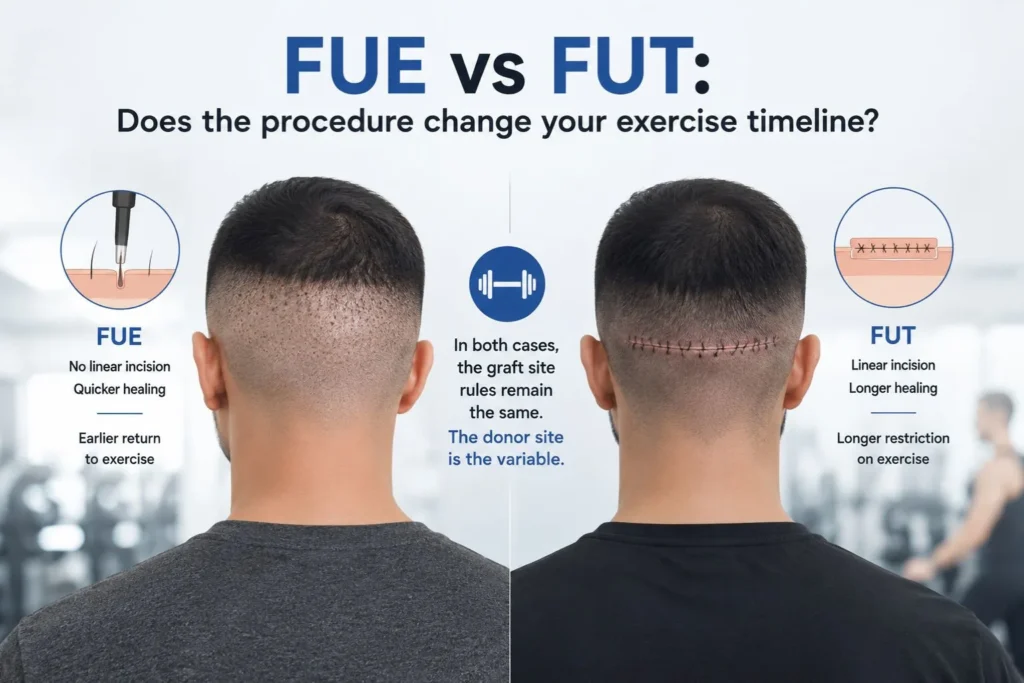
The short answer is yes, but perhaps not as dramatically as you might think. FUE (Follicular Unit Extraction) involves no linear incision; individual follicles are extracted one at a time from the donor area, leaving tiny circular wounds that heal relatively quickly. This means the donor site is generally less of a limiting factor in determining when you can resume exercise.
FUT, by contrast, involves removing a strip of scalp from the back of the head and stitching the wound closed. That suture line is under tension during any movement that stretches or strains the neck and upper back, which includes virtually all resistance training. Most FUT patients are advised to avoid any significant upper body work for at least six weeks and to be cautious with heavy deadlifts and squats for up to eight weeks.
In both cases, the graft site rules remain the same. The donor site is the variable.
Common mistakes patients make during exercise recovery
Myth: Light yoga is fine in the first week.
Reality: Many yoga poses involve significant head-down positions, forward folds, downward dog, and inversions that dramatically increase blood pressure at the scalp. These should be avoided for at least three to four weeks, not just seven days. Even a gentle flow that gets your heart rate going is riskier than most patients assume.
Myth: Swimming is gentle, so it must be safer than the gym.
Reality: Swimming after a hair transplant is actually one of the higher-risk activities in the recovery period, specifically because of prolonged scalp submersion. Both pool water (chlorine, other swimmers’ bacteria) and open water pose infection risks until your scalp is fully healed. Four weeks is the minimum; some surgeons advise six.
Myth: Only turning up the intensity when you can no longer feel pain.
Reality: Graft dislodgement and early infection often present with no obvious pain. The absence of discomfort is not a clearance to exercise harder. Follow the timeline, not how you feel in the moment.
The bottom line
Getting back to exercise after a hair transplant is a gradual process, not because surgeons are being overly cautious, but because graft survival genuinely depends on those early weeks of reduced physical stress. The investment you have made in your hair is significant, and four weeks of modified training is a small price to protect it.
When you are not sure whether a certain activity is appropriate for your level of healing, the best way is to get in touch with your clinic directly. For instance, The Skin and Hair Clinic will be happy to provide you with a tailored recovery plan that takes into account your particular operation, number of grafts, and the state of your healing.
Frequently Asked Questions
Q: When can I exercise after a hair transplant if I only had a small procedure?
A: Even with a smaller graft count, the same recovery timeline applies. The vulnerability of individual grafts is the same regardless of how many were implanted. You should still avoid strenuous exercise for at least four weeks and refrain from any activity that causes significant sweating in the first two weeks.
Q: Can I go to the gym after a hair transplant if I just do legs?
A: Not in the first four weeks, no. Lower body exercises, particularly squats, leg press, and deadlifts, involve the Valsalva manoeuvre (holding your breath under load), which spikes intracranial and scalp blood pressure significantly. These exercises carry graft risk even though they feel unrelated to your head.
Q: How long after a hair transplant can I go swimming?
A: Most surgeons advise waiting a minimum of four weeks before swimming after a hair transplant in a chlorinated pool, and potentially six weeks for open water or sea swimming. The risk is infection at the scalp from prolonged water exposure, not the physical movement itself.
Q: Is sweating after a hair transplant dangerous, and for how long?
A: Immediately after a hair transplant, sweat is the biggest reason for the infection risk as the wound sites of the scalp are still open and vulnerable. Sweating after the first two weeks is not a big problem, but you must wash and clean your scalp immediately after exercising for the first month.
Q: When can I play contact sports after a hair transplant?
A: Contact sports after a hair transplant should be avoided for a minimum of four to six weeks. The risk is not just elevated heart rate and sweating; it is also a direct physical impact on the scalp, which can dislodge grafts or cause trauma to the donor area. Football, rugby, martial arts, and boxing should all be postponed until your surgeon confirms full healing.
Q: Will exercise permanently damage my hair transplant if I return too soon?
A: If you return to intense exercise very early in the first seven days, particularly yes, you risk permanently losing grafts that have not yet established their blood supply. Grafts that are dislodged or fail to take cannot be replaced in the same session. This is why the first week of strict rest matters so much.
Q: Can I do heavy lifting after a hair transplant in three weeks?
A: Heavy lifting after a hair transplant at three weeks is still not recommended by most surgeons. At this point, grafts are typically still consolidating, and the increased blood pressure from heavy compound lifts remains a risk. Most clinics advise waiting until the four-week minimum, and for FUT patients, closer to six weeks before returning to maximum-effort lifts.