
Women can absolutely get a hair transplant, and for many, it changes everything. But before you take that step, here is everything you need to know.
According to the Institute of Trichologists, female-pattern hair loss affects around 50% of women over 65 in the UK.
Yet hair transplant surgery for women barely gets a mention compared to the male equivalent. That silence leaves thousands of women quietly struggling, not knowing that a lasting surgical solution even exists for them.
The Skin and Hair Clinic in Liverpool sees this regularly. Women come in after years of trying every product on the shelf. For a great many of them, a hair transplant for women turns out to be the answer they had been searching for all along.
So let us break it all down: how it works, whether you qualify, and what the recovery actually looks like.
Table of Contents
Key takeaways
- Women are good candidates for hair transplants, but the cause and pattern of hair loss must be assessed first, as not every type of loss qualifies.
- FUE is the most commonly used technique for women, offering minimal scarring, faster healing, and no requirement for a full head shave.
- Shock shedding after surgery is completely normal. Transplanted hairs fall out before new, permanent growth begins around month three.
- Hormonal conditions must be identified and managed before proceeding. Unresolved PCOS or thyroid issues can undermine results.
- Results are permanent once follicles are established. Adding PRP or topical treatments alongside surgery can further improve density over time.
How a Women’s Hair Transplant Actually Works
The idea behind women’s hair transplant is fairly simple. Healthy follicles are taken from a donor area, typically the back or sides of the scalp, and moved into zones where hair has thinned or stopped growing. It is your own hair, just repositioned. The two techniques most commonly used are:
- FUE (Follicular Unit Extraction): Follicles are removed one by one using a small precision tool. No linear scar, minimal downtime, and the results look completely natural. This is the gold standard right now.
- FUT (Follicular Unit Transplantation): A narrow strip of scalp is removed, the follicles are separated under a microscope, and then implanted. Less common for women, but still appropriate in certain situations.
For most women, FUE hair transplant for women is the better fit. It is less disruptive to daily life, heals faster, and leaves no tell-tale scarring, which matters when you consider the range of hairstyles women wear.
Can Women Get Hair Transplants for Thinning Hair?
Many people ask: Can women have a hair transplant? The answer is yes. But the right candidate is not simply anyone experiencing hair loss. The type of loss matters enormously.
Unlike most men, many women develop diffuse unpatterned alopecia, where thinning affects even the back of the scalp. If the donor area is also weak, there is not enough healthy hair to work with, and surgery would not produce the results you are hoping for.
Women who tend to see the best outcomes from hair transplant surgery for women are those dealing with:
| Condition | Suitable for Transplant? |
| Female-pattern hair loss (FPHL) | Usually yes |
| Traction alopecia from tight hairstyles | Yes |
| Scarring alopecia | Sometimes, with specialist review |
| Diffuse unpatterned alopecia | Often not |
| Hairline recession | Yes |
| Post-trauma or post-surgical scarring | Often yes |
A thorough scalp assessment is non-negotiable before any decisions are made. That starts with understanding what causes hair loss in women, because picking the right treatment depends entirely on what is driving the problem.
What Happens on the Day of Surgery
Hair transplant surgery for women is done under local anaesthesia. You are awake the whole time, but the scalp is fully numbed, so there is no pain during the procedure itself. Here is how the day typically unfolds:
- The donor area is trimmed, and the local anaesthetic is applied.
- Follicles are extracted individually using a fine micro-punch tool (for FUE).
- Tiny incisions are made across the recipient area.
- Each graft is placed at a precise angle to match your natural hair direction.
- The scalp is gently cleaned and dressed before you go home.
Depending on how many grafts are needed, the session for hair transplant for women can run anywhere from four to eight hours. Most women find it far more manageable than they expected.
The Recovery Timeline: Week by Week
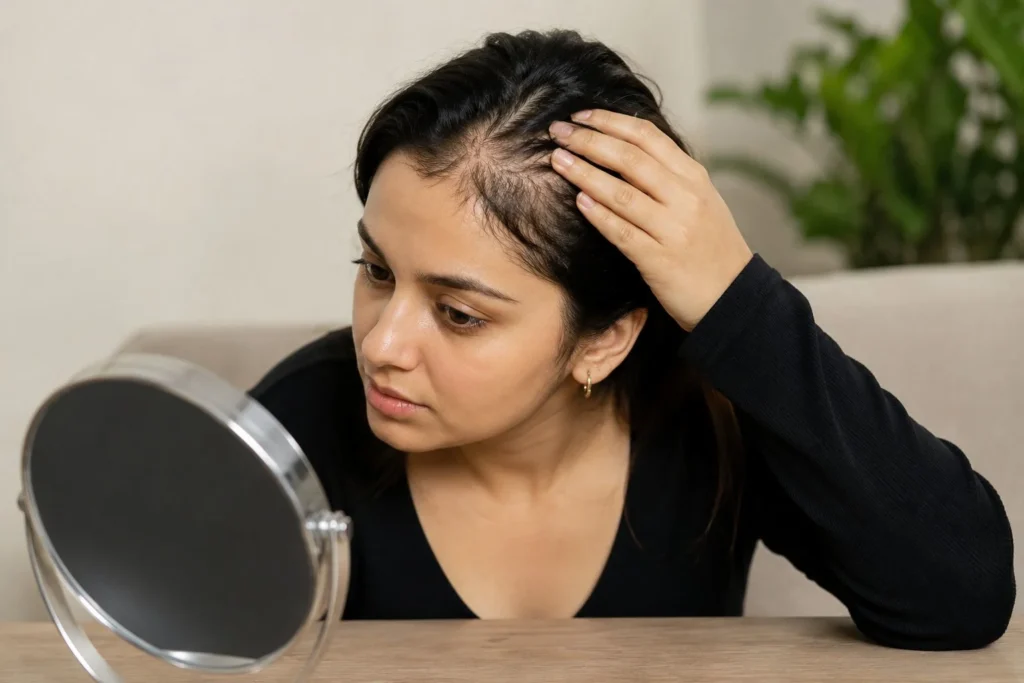
Recovery after a woman’s hair transplant is a slow and steady process. Nothing happens overnight, but every week brings you closer to the result.
- Days 1 to 5: Some mild swelling and small scabs form around the grafts. Keep the area dry and avoid rubbing it.
- Weeks 2 to 3: Shock shedding kicks in. The transplanted hairs fall out. It looks alarming, but this is completely expected and part of the process.
- Months 3 to 4: Fine new hairs start pushing through. Growth is subtle at this stage, but it is happening.
- Months 6 to 12: The hair thickens noticeably. Most women feel a genuine difference in density around month nine.
- Months 12 to 18: This is when the final result comes into its own. Fuller, more even coverage across the treated areas.
The waiting is genuinely the hardest part. But the results, once they arrive, are permanent.
What Kind of Results Should Women Expect?
When the procedure is carried out properly, the results for women hair transplant look completely natural. The transplanted follicles grow, shed with the seasons, and respond normally to heat styling and colouring.
Many women pair their surgery with non-surgical treatments such as PRP therapy or medical-grade topicals to push density even further. This approach works particularly well for those managing hair transplant for thinning hair in the early stages, where coverage rather than total restoration is the goal.
How Female Hair Transplants Differ From Male Procedures
The surgical technique is broadly the same, but the experience of hair transplant surgery women go through differs in some meaningful ways:
- Most women do not need to shave their full head. Many clinics now offer unshaven FUE, so your hair stays intact during the process and throughout recovery.
- Female hair loss is often more diffuse and spread across the scalp, which makes the donor assessment more detailed and critical.
- Hormonal factors; things like thyroid dysfunction or polycystic ovary syndrome (PCOS), need to be identified and addressed before surgery is even considered.
- Women typically focus on hairline definition and overall density rather than filling in large bald patches.
These distinctions are exactly why choosing a clinic with specific experience in female cases makes such a difference.
Take the Next Step Towards Fuller, Thicker Hair!
If you have spent months or years watching your hair thin and wondering whether women hair transplant surgery could genuinely help, a specialist consultation is the most sensible thing. You get real information customized to your scalp, your hair type, and your goals. The Skin and Hair Clinic offers free consultations with GMC-registered surgeons who specialise in female hair restoration. Book yours today and find out, with confidence, what is actually possible for your hair.
Frequently Asked Questions
1. Can women get hair transplants for thinning hair rather than complete baldness?
Yes. Many women opt for surgery specifically to restore density across thinning areas rather than to treat full bald patches. Whether it is suitable depends on the strength of the donor zone, which a specialist will assess before anything is recommended.
2. Is the procedure painful for women?
During surgery, the scalp is fully numbed with local anaesthetic, so pain is not a concern at the time. Afterwards, some tenderness and a tight sensation in the scalp are normal for a few days. Most women manage this comfortably with standard pain relief.
3. How many grafts does a typical female hair transplant need?
It varies from person to person. Women often need between 800 and 2,500 grafts per session, depending on the size and location of the area being treated. Your surgeon will give you a precise estimate after examining your scalp in person.
4. Will anyone notice I have had the procedure done?
Not if it is done well. A skilled surgical team places each graft at the natural angle and direction of your existing hair, so the result blends seamlessly. Most women are back to their normal social routine within a week or two.
5. Are the results from a female hair transplant truly permanent?
Yes. The follicles used in transplantation are taken from areas of the scalp that are genetically resistant to thinning. Once they establish themselves in the new location, they c