

Both men and women can get a hair transplant for thinning hair, and the results genuinely do change lives. But before you book anything, there is a lot worth knowing first.
According to the World Population Review, of the 46 countries studied for 2024, 28 countries have male pattern baldness rates in the 30–39.99% range, 12 in the 40-44.5% range, and only 5 in the 20-29.99% range, starting at 26.96%
Yet so many of those people never look into surgical options. Why? Because they assume transplants are only for people who have already gone fully bald. That is simply not true. A hair transplant for thinning hair can work brilliantly at early to mid-stage loss; sometimes even better than waiting. If you are noticing hairline thinning creeping in or patches that were not there six months ago, the window to act is right now.
The Skin and Hair Clinic, based in Liverpool, is a CQC-registered clinic that treats both men and women dealing with hair loss at every stage.
Table of Contents
Key takeaways
- Both men and women can qualify for a hair transplant for thinning hair, though the eligibility criteria differ considerably between the two.
- A FUE hair transplant is the most precise and scar-free surgical route available for restoring density to thinning areas.
- Women typically experience diffuse rather than patterned thinning, which means the donor area assessment is a critical first step before any surgery is considered.
- Non-surgical treatments like PRP and Minoxidil are genuinely effective and often precede or complement hair thinning surgery for stronger long-term outcomes.
- Starting the process earlier in the thinning journey almost always leads to more natural and satisfying results from hair implants for thin hair.
How Thinning Hair Responds to a Hair Transplant in Men and Women
Hair thinning does not look the same across both genders. Knowing what to look for in your own case is the starting point for everything else.
How Male Hair Thinning Usually Develops
For men, it typically starts quietly. A slightly higher hairline here. A thinner crown there. Before long, a pattern begins to emerge that follows the Norwood Scale quite predictably. Look out for these signs:
- A slow but steady hairline thinning that pulls back from the temples
- Thinning at the crown that spreads further each year
- Hair thinning on the side of the head, just above the ear line
- A bald spot that is growing wider and harder to hide
Men showing these signs are often good candidates for a hair transplant for balding or early-stage thinning. The donor hair at the back and sides of the scalp stays genetically stable. That makes it ideal for transplanting into areas that have thinned.
How Female Hair Thinning Typically Looks
Women rarely lose hair the same way men do. Instead of a receding line, they usually experience what is called diffuse thinning, a general reduction in volume across the top of the scalp, with the front hairline staying mostly intact.
The causes of female hair loss span a wide range, from hormonal shifts and iron deficiency to stress and genetic predisposition. Common signs to watch for include:
- A parting that keeps getting wider
- Hair that sits flat, looks thin, and lacks volume
- A visible reduction in density across the crown area
- Occasional hair thinning on side of head in more advanced cases
Women’s hair transplant is absolutely possible. But the assessment process is more involved, simply because the pattern of female hair loss is less predictable than male pattern baldness.
What Are the Best Treatments for Thinning Hair?
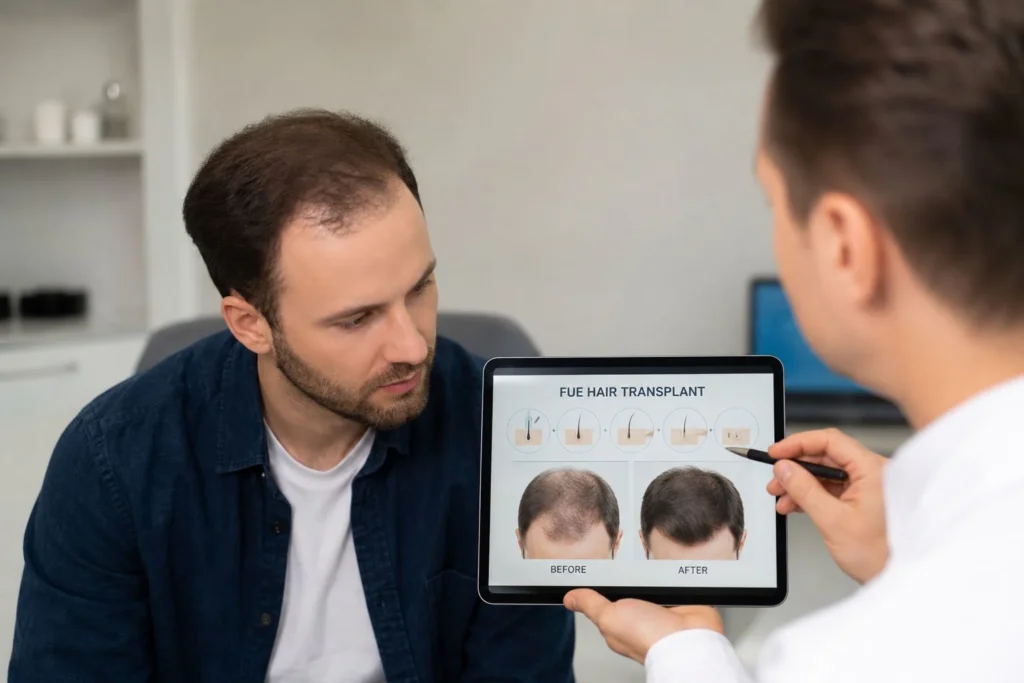
The best treatment for thinning hair depends on what is causing the loss, how far along it is, and whether the donor area is healthy and dense enough to work with.
FUE Hair Transplant: The Most Trusted Surgical Option
A FUE hair transplant is now widely considered the gold standard in surgical hair restoration. Individual follicles are removed one by one from a donor zone, then carefully placed into areas where thinning has occurred. Here is what makes it particularly good for thinning hair:
- No linear scar is left behind
- Minimally invasive, with a recovery window of roughly 7 to 10 days
- Results look completely natural once the hair grows through
- Works well for both men and women in the right circumstances
A thin hair transplant carried out using the FUE method tends to produce strong results precisely because it targets sparse areas with precision. You are not trying to cover a completely bare scalp. You are restoring density where it has started to fade, which is a more forgiving task technically.
Hair Implants for Thin Hair: The Process Explained
Hair implants for thin hair follow the same core logic. A surgeon takes healthy follicles from a stable donor area and implants them directly into thinning zones. The follicles settle, enter a resting phase, and then begin growing permanent hair over the following months.
Most patients see early signs of new growth between three and four months after the procedure. By the twelve-month mark, the full result becomes visible, and for most people, it is genuinely transformative.
| Feature | FUE for Thinning | Traditional Transplant for Baldness |
| Suitable for early thinning | Yes | Sometimes |
| Scar-free | Yes | No (linear scar) |
| Recovery time | 7–10 days | 10–14 days |
| Natural finish | Excellent | Good |
| Suitable for women | Often yes | Rarely |
Who Actually Qualifies for a Hair Transplant for Hair Loss?
This is the question that matters most. Not everyone is a suitable candidate, and an honest assessment from a qualified hair thinning specialist will make that very clear from the start.
For Men: What the Consultation Covers
A proper assessment for men will look at:
- Whether the hair loss has stabilised or is still actively progressing
- The quality, density, and health of the donor zone
- Younger men in their early twenties may be advised to wait
- The Norwood stage and overall suitability for a hair transplant for balding
The best outcomes tend to come when hair loss has slowed and the donor area is still strong.
For Women: Why the Assessment Is Different
A hair-thinning surgery consultation for women digs deeper. Surgeons will want to understand:
- Whether there is a clearly defined, stable donor zone available
- What is actually driving the thinning in the first place
- Whether non-surgical treatments have already been explored
- The exact pattern and location of the loss across the scalp
Women with androgenetic alopecia who have a well-defined thinning zone often respond extremely well to surgery. On the other hand, diffuse unpatterned alopecia, where hair is thinning randomly across the entire scalp, is generally not suitable for a surgical approach.
Non-Surgical Routes Worth Considering First
Surgery is rarely the very first step. Many patients get meaningful results from non-surgical options of hair transplant for thinning hair.
Options that have real clinical backing include:
- PRP therapy: Platelet-rich plasma injections that stimulate dormant follicles back into action
- Minoxidil: One of the few topical treatments with solid clinical evidence behind it for both sexes
- Finasteride: Commonly prescribed to men to reduce the DHT that causes follicle miniaturisation
- Nutritional correction: Addressing deficiencies in iron, vitamin D, or biotin that quietly contribute to thinning
These are not just filler suggestions. For many patients, one or more of these options genuinely slows the progression of thinning over time. And when combined with hair thinning surgery down the line, the overall results tend to hold much better long-term.
Regain Your Confidence with the Right Hair Restoration!
Thinning hair is not something you have to accept and work around forever. Whether you are dealing with hair thinning on the side of head, a slowly retreating hairline, or a crown patch that is getting harder to ignore, a clear plan from the right specialist changes everything. The Skin and Hair Clinic connects every patient with GMC-registered surgeons who understand both the medical and emotional sides of hair loss. Book your free consultation and get a straight answer about what will actually work for your hair.
Frequently Asked Questions
1. Can a hair transplant fix thinning hair without full baldness?
Absolutely. A hair transplant for thinning hair is actually very well suited to early and mid-stage loss. Surgeons can implant follicles into sparse areas while existing hair is still present, which makes the final result look far more natural.
2. Is a woman’s hair transplant as effective as one for men?
It can be just as effective, but it requires a more thorough assessment. Women who have a stable donor zone and a well-defined area of thinning often see outstanding results from a women’s hair transplant. The key is making sure the loss pattern and cause are properly understood beforehand.
3. How long does it take to see results after a thin hair transplant?
The first signs of new growth usually appear around the three- to four-month mark. Full results from a thin hair transplant become clearly visible at the twelve-month point, once the transplanted follicles have fully settled and grown through.
4. What is the best treatment for thinning hair before considering surgery?
Minoxidil, PRP therapy, and correcting any nutritional deficiencies are worth exploring first. The best treatment for thinning hair always depends on the underlying cause, which is why a proper diagnosis matters before starting anything.
5. Does a hair transplant for a bald spot look natural?
Yes, when carried out by an experienced surgeon. A hair transplant for a bald spot using the FUE technique places each follicle individually at the correct angle and direction. The result blends seamlessly with the surrounding hair.