
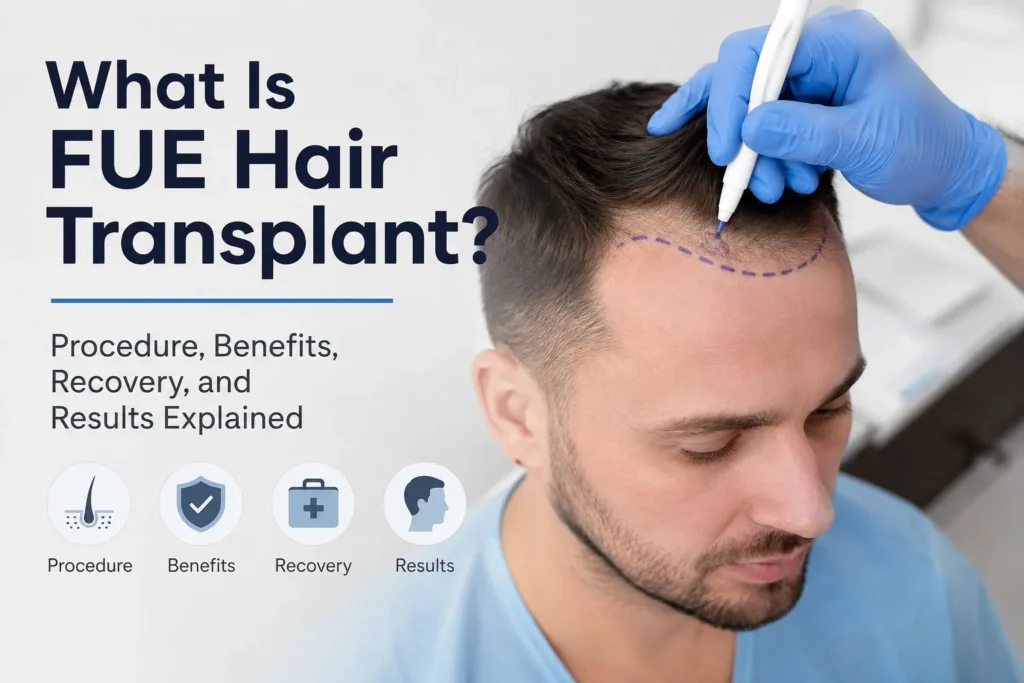
FUE hair transplant is a minimally invasive procedure that permanently restores lost hair, and the results can genuinely change how you feel about yourself. Losing your hair is never just a physical thing. It impacts your confidence slowly, sometimes before you even notice it happening.
Did you know? According to the NHS, Male-pattern baldness is the most common type of hair loss, affecting 6.5 million men in the UK.
Yet most of them never realise a lasting solution already exists. If you have been quietly Googling remedies at midnight, understanding what is FUE hair transplant can really help you.
Key takeaways
- FUE extracts and implants individual follicles without leaving any linear scar behind.
- Full FUE hair transplant results take between 12 and 18 months to develop completely.
- The procedure works well for both men and women, including those with diffuse hair loss patterns.
- Recovery is quick; most people resume normal daily life within 7 to 10 days.
- Results are permanent because transplanted follicles are naturally resistant to the hormones that cause baldness.
Understanding the Basics of FUE Hair Transplant Surgery
FUE stands for Follicular Unit Extraction. It sounds technical, but the idea behind it is simple.
A trained surgeon removes individual hair follicles from a healthy part of your scalp. Those follicles are then carefully placed into areas where hair has thinned or stopped growing altogether. Nothing is cut in strips. No long scar is left behind.
That single detail is what makes FUE hair transplant surgery stand apart. You can keep your hair short after the procedure, and nobody will know you had anything done.
How Does Follicular Unit Extraction Transplant Work?
A lot of people feel nervous simply because they do not know what to expect. Once you see the process laid out clearly, it becomes far less daunting.
Step 1: Consultation and Planning
Everything starts with a thorough scalp assessment. The surgeon looks at your hair density, how your loss is patterned, and the quality of your donor hair sources. From there, a plan is built around your specific situation rather than a generic template.
Step 2: Anaesthesia
Local anaesthesia goes into both the donor and recipient areas. You stay fully awake, but you will not feel a thing during the procedure itself.
Step 3: Follicle Extraction
A micro-punch tool is used to extract individual follicular units one by one. The back and sides of the scalp are the most common donor sites because the hair there is naturally resistant to shedding.
Step 4: Graft Preparation
Each extracted follicle is sorted and stored carefully under magnification. This stage matters more than most people realise; healthy grafts mean better results.
Step 5: Implantation
Tiny openings are made in the thinning areas. Each follicle is placed at the right angle and depth so that the new hair grows in the same direction as the rest. This is what creates that natural, undetectable finish.
Step 6: Post-Procedure Care
Before you leave, you get clear aftercare instructions. Follow-up appointments for FUE Hair Replacement keep the healing process on track.
FUE Hair Replacement vs FUT: A Quick Comparison
| Feature | FUE Hair Replacement | FUT (Strip Method) |
| Scarring | Tiny dot scars, barely visible | Linear scar at the donor site |
| Recovery Time | 7 to 10 days | 2 to 3 weeks |
| Suitable For | Short hairstyles | Those needing maximum grafts |
| Pain Level | Minimal | Moderate |
| Minimal scarring with hair transplant | Yes | No |
Top Benefits of FUE Hair Transplant You Should Know
People often focus on the cosmetic side of things. But the benefits of FUE hair transplant run much deeper than that.
- No linear scar: Short haircuts remain an option without any visible marks
- Faster recovery: Most people are back at their desks within a week
- Natural-looking results: Follicles are placed to follow your existing growth direction
- Permanent solution: Once transplanted, these follicles do not behave like the ones that thinned out
- Versatile: The technique works on the scalp, beard, and eyebrows
- Works for women too: FUE hair transplant for women patients, particularly those with diffuse thinning, reports excellent outcomes
- Comfortable throughout: Local anaesthesia keeps the entire session pain-free
FUE Hair Transplant Before and After: What to Realistically Expect
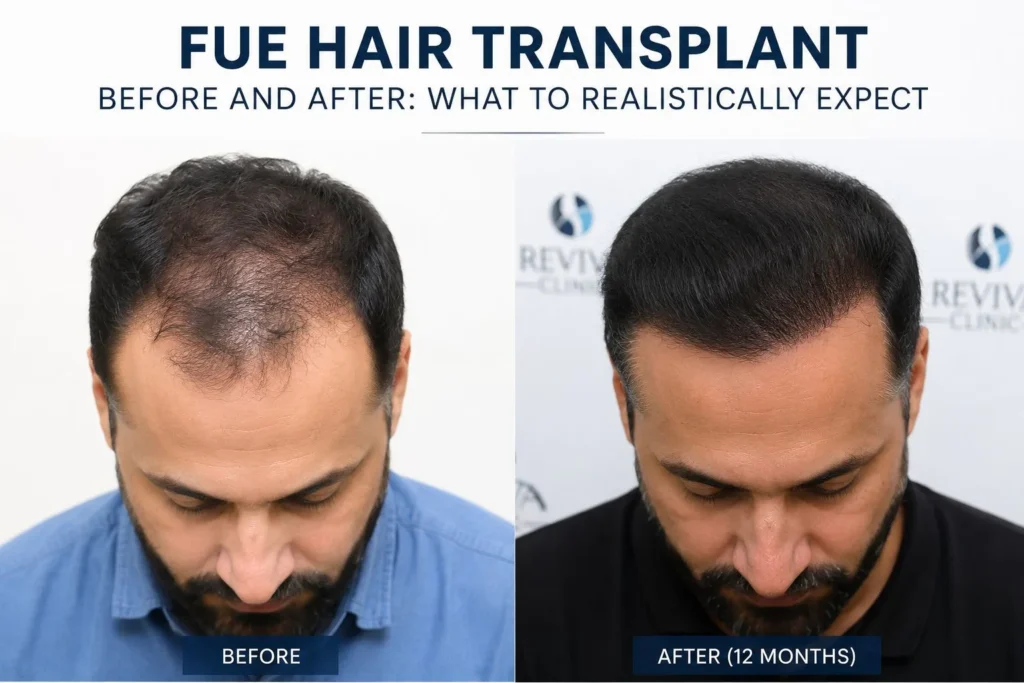
Browsing FUE hair transplant before and after photos gives you a realistic picture of what is achievable. What those photos do not always show is the timeline in between. Here is what the before and after FUE hair transplant journey actually looks like, month by month:
- Month 1 to 3: The transplanted hair sheds. This is called shock loss, and it is completely normal; do not let it worry you
- Month 4 to 6: Fine new hair starts pushing through
- Month 9 to 12: Density builds noticeably, and the difference becomes clear
- Month 12 to 18: Final FUE hair transplant results are fully visible
Patience is a big part of this process. But almost every patient says the wait was absolutely worth it.
FUE Transplant for Women: Is It Any Different?
Women typically experience diffuse thinning rather than a defined receding hairline. This means the fue transplant approach needs to be adapted. Instead of rebuilding a hairline, surgeons focus on restoring density across a broader area.
FUE hair transplant for women candidates with conditions like traction alopecia, frontal fibrosing alopecia, or post-pregnancy hair loss often see remarkable results. The key is working with a surgeon who understands female hair loss patterns specifically, not just male pattern baldness.
Recovery After FUE Hair Transplant Surgery: What to Expect Week by Week
Recovery is honestly far smoother than people imagine before going through it.
Week 1: Some redness and tiny scabs appear around the grafts. Leave them alone and let the healing happen.
Week 2: Scabs fall off on their own. Most people feel comfortable enough to get back to social activities.
Week 3 to 4: Shock shedding kicks in. The scalp may look similar to how it did before the procedure. This stage tests your patience, but it passes.
Month 2 to 3: The scalp looks completely normal. Follicles are quietly entering their active growth phase beneath the surface.
Month 6 onwards: New hair grows progressively thicker with each passing week.
As a general rule, avoid intense exercise, swimming pools, and direct sun exposure for at least four weeks after your hair transplant fue surgery.
FUE Hair Transplant Results: How Long Do They Actually Last?
FUE hair transplant results are permanent. The follicles used in the procedure come from areas of the scalp that are genetically programmed to resist hair loss. Once they settle into their new location, they carry that same resistance with them.
Your native hair around the transplanted area may continue to thin over time. Some patients choose a second session a few years down the line to top up overall density. But the transplanted hair itself? That stays.
Stop Watching Your Hair Disappear, Here Is What to Do Next!
You have spent long enough looking in the mirror and feeling like there is nothing you can do. There is. You deserve to feel confident in your own skin again. The Skin and Hair Clinic brings together GMC-registered surgeons, a 98% success rate, and a genuinely personal approach to every patient’s journey. From your very first free consultation through to full recovery, you are supported at every single stage. Book your consultation today and take back control.
Frequently Asked Questions
Q1. Is FUE hair transplant painful?
Not during the procedure itself. Local anaesthesia is applied before anything begins. You might feel mild pressure at certain points, but genuine pain is not part of the experience for most patients.
Q2. How many grafts will I need for a full result?
That depends entirely on the extent of your hair loss. After examining your scalp, a surgeon will typically recommend anywhere between 1,000 and 4,000 grafts based on what your situation actually requires.
Q3. Can women have a FUE hair transplant?
Absolutely. FUE hair transplant women patients are strong candidates for this procedure, especially those dealing with traction alopecia, hormonal thinning, or frontal hair loss.
Q4. When will I start seeing new hair growth?
Visible growth usually begins around the four-month mark. The full picture of your fue hair transplant results becomes clear somewhere between 12 and 18 months after the procedure.
Q5. Will the scarring be noticeable after FUE?
No. The only marks left are tiny dot-shaped scars in the donor area. Even with a very short haircut, these are virtually impossible to spot.