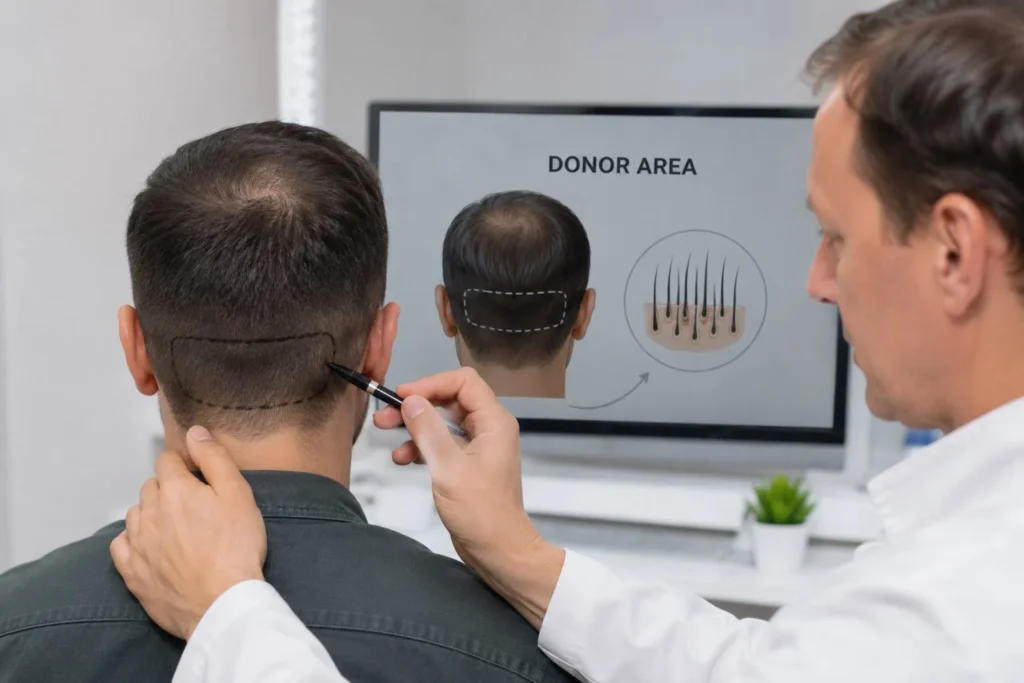
Hair transplants use your own hair, taken from parts of your scalp (or occasionally your body) that are naturally resistant to hair loss. These donor follicles are carefully extracted and relocated to thinning or bald areas, where they continue to grow just as they did before. Understanding the hair transplant donor area is one of the most important things to grasp before considering surgery.
Did You Know?A single hair graft (called a follicular unit) can contain between one and four individual hairs. Skilled surgeons select and place single-hair grafts along the hairline for a natural finish, and multi-hair grafts further back to build density.
Table of Contents
Why your own hair is always the source
Unlike organ transplants, hair transplants don’t use donor tissue from another person. Using someone else’s follicles would trigger an immune rejection response, meaning the transplanted hair would simply fall out. Your surgeon works exclusively with your own hair: specifically follicles that carry a genetic resistance to the hormone DHT (dihydrotestosterone), which is the primary driver of male and female pattern hair loss.
This is the fundamental principle behind every hair transplant: relocate follicles that are programmed to survive, into areas where the original follicles have already been lost.
The main donor area: back and sides of the scalp
The most common source of transplanted hairs is the posterior and lateral scalp, the band of hair running around the back and sides of the head. Surgeons refer to this as the “safe zone” because follicles here are genetically coded to remain unaffected by DHT, regardless of where they are placed on the scalp.
This permanence is what makes the results of a well-performed transplant long-lasting. The relocated follicle retains the biological identity of its original location. So hair taken from the back of your head and placed at your hairline will behave exactly as it did at the donor site, growing, cycling, and persisting for decades.
The density of this donor zone varies considerably from person to person, which is one reason surgeons carry out a thorough assessment before committing to a treatment plan. Patients with higher donor density have more flexibility in the number of grafts available.
Alternative donor sources: beard and body hair
In cases where the scalp donor area is insufficient, most often in patients with advanced hair loss (Norwood scale stages 6 or 7) or those having a repair procedure after a previous poor-quality transplant, surgeons may harvest hair from elsewhere on the body.
Beard hair is the most commonly used alternative. It tends to be coarser and grows in a similar cycle to scalp hair, making it reasonably compatible for transplantation to the crown or mid-scalp. Some surgeons combine beard and scalp grafts in the same session to maximise overall coverage.
Chest, back, and arm hair can also be used in exceptional circumstances, though these follicles behave differently: they have shorter growth cycles and produce finer, shorter strands. Body hair transplantation (BHT) is a specialist procedure and not suitable for every patient or every area.
The decision to use body hair is never a first resort. Surgeons exhaust scalp donor options first, and body hair is typically reserved for cases where no other option exists.
How the donor hair is extracted: FUE vs FUT
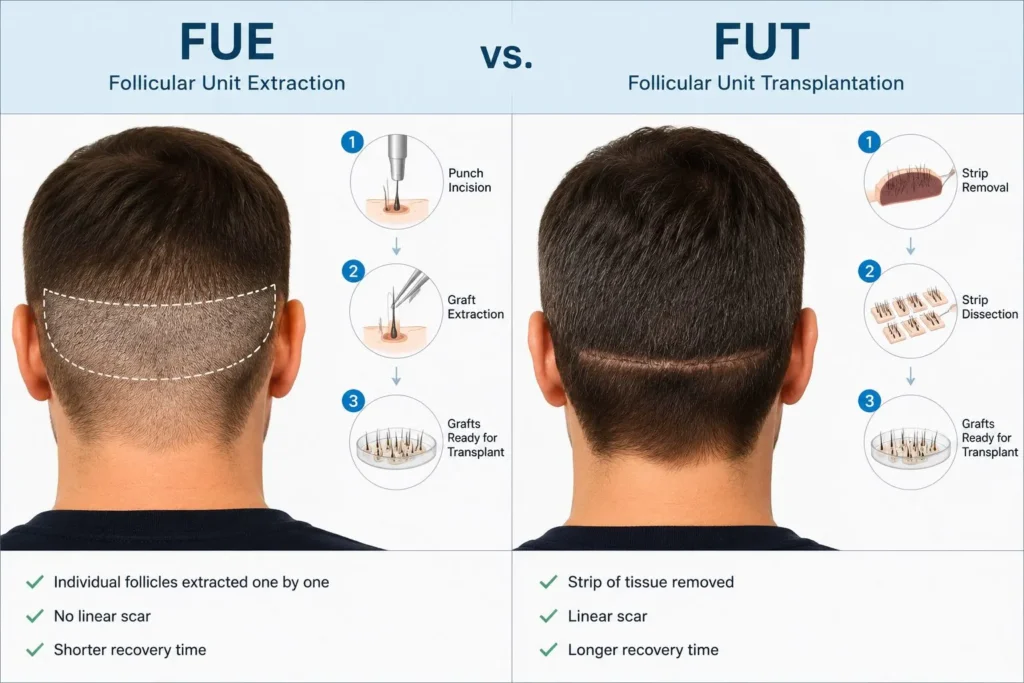
Two surgical methods are used to harvest follicles from the donor area. Both have distinct trade-offs, and the right choice depends on the patient’s goals, donor characteristics, and the volume of grafts needed.
FUE (Follicular Unit Extraction)
An FUE hair transplant uses a small circular punch tool (typically 0.7mm to 1.0mm in diameter) to extract individual follicular units one at a time directly from the donor area. The tiny wounds heal as near-invisible dot scars scattered across the back and sides of the scalp.
FUE is the preferred method for patients who want to wear their hair very short, as the dot scars are far less noticeable than a linear scar. Recovery time is generally quicker, and there is no need for stitches.
The trade-off is time: extracting grafts individually is significantly more labour-intensive than removing a strip, which can limit the number of grafts achievable in a single session.
FUT (Follicular Unit Transplantation)
In FUT, a thin strip of hair-bearing skin is surgically removed from the donor area, usually from the mid-occiput. The wound is closed with sutures or staples, leaving a single linear scar that runs across the back of the head. Under a microscope, a team then dissects the strip into individual follicular units.
FUT typically yields a higher number of grafts per session, making it a strong option for patients requiring extensive coverage. The linear scar is the main aesthetic drawback, as it becomes visible if the hair is kept very short.
In practice, many surgeons now offer a combination approach, using FUT for the bulk of grafts and FUE to harvest from areas around the linear scar in subsequent sessions.
What happens to the donor area after surgery?
A question many patients ask about hair transplant recovery, and one that top-ranking sources often gloss over, is what the donor area looks like during recovery.
Immediately after surgery, the donor area will appear red and slightly swollen, with small scabs forming around each extraction point in FUE, or around the sutured incision in FUT. Most of this resolves within 7–14 days. The hair in the donor area is typically trimmed short before the procedure, so there is a temporary period where this area may look visibly thinner while the surrounding hair grows back.
Crucially, the donor area does not regenerate removed follicles. Each follicular unit extracted is gone permanently from that site. This is why donor supply is finite, and why experienced surgeons are conservative in their harvesting strategy; preserving the donor area for potential future procedures matters.
At The Skin and Hair Clinic, patient consultations include a detailed donor area analysis using trichoscopy, which provides an accurate count of available follicular units and allows surgeons to plan across potential future sessions, not just the immediate one.
Common misconceptions about hair transplant donor hair
Myth: “The more grafts extracted, the better the result.”
Reality: Over-harvesting the donor area leaves it permanently thinned and limits your options for future sessions. Quality of graft extraction matters as much as quantity. An overly aggressive harvest can also damage follicles neighbouring the extracted ones, reducing the survival rate of transplanted hair.
Myth: “Anyone can donate hair to someone else for a transplant.”
Reality: Hair transplants are always autologous: your own tissue only. External donor hair is never used in standard hair restoration surgery.
Myth: “Body hair works just as well as scalp hair.”
Reality: Body hair has a shorter anagen (active growth) phase than scalp hair, which means transplanted body hair may not grow as long or as consistently. It is a supplementary option, not an equivalent substitute.
Understanding your donor hair changes everything
Knowing where do hair transplants come from, and why those specific follicles are chosen, helps you ask the right questions before committing to surgery. The permanence of the result depends entirely on using DHT-resistant follicles from the right source, harvested with a strategy that protects your long-term options.
If you are considering a hair transplant, the most important first step is a comprehensive scalp and donor hair assessment. At The Skin & Hair Clinic, our specialists carefully evaluate donor density, hair loss patterns, and long-term suitability to provide honest, realistic guidance. Through detailed trichoscopic analysis and personalized consultations, we help you understand what results may be achievable before any treatment plan is recommended.
Frequently Asked Questions
Q: Where does the hair come from for a hair transplant?
A: Hair transplant donor hair always comes from your own body, most commonly the back and sides of the scalp, where follicles are genetically resistant to DHT-driven hair loss. In some cases, beard or body hair may be used as a supplementary source when scalp supply is limited.
Q: Does the donor area grow back after a hair transplant?
A: No. Individual follicles that are extracted do not regenerate at the donor site. However, the surrounding hair grows back to cover the area, and the visible thinning typically resolves within a few weeks. This is why careful, conservative harvesting is so important.
Q: How do hair plugs work compared to modern hair transplants?
A: The old hair plugs process extracted large, obvious clusters of follicles, resulting in an unnatural, doll-like appearance. Modern FUE and FUT techniques work with individual follicular units of 1–4 hairs, producing results that are virtually indistinguishable from natural hair growth.
Q: How many grafts can be taken from the donor area?
A: This varies significantly between individuals, but most patients have between 4,000 and 8,000 available follicular units in the scalp safe zone. Donor density, scalp laxity, and hair calibre all influence what is realistically harvestable. A surgeon should map this precisely before any procedure is planned.
Q: Can women have hair transplants, and is the donor area the same?
A: Yes, women can undergo hair transplant surgery. The donor area is typically the same (back and sides of the scalp), though female pattern hair loss can sometimes affect the entire scalp more diffusely, making donor assessment more complex. Not every woman with hair loss is a suitable candidate.
Q: Is FUE or FUT better for preserving the donor area?
A: FUE preserves the option to wear hair short since scars are minimal and scattered. FUT yields more grafts per session but leaves a linear scar. Neither is universally superior; the right choice depends on your hair loss pattern, donor characteristics, and long-term goals.
Q: What makes donor area hair resistant to hair loss after transplantation?
A: Follicles from the safe zone carry a genetic programming that makes them insensitive to DHT, the hormone responsible for follicle miniaturisation. This resistance is intrinsic to the follicle itself, not its location, which is why transplanted hair continues to grow and persist even in a previously bald area.