
You could be losing your hair due to one or several factors, such as stress, hormonal imbalance, or genetics. Read on to discover exactly what is stealing your strands.
“Did you know? According to a report by the NHS, an individual can lose between 50 and 100 hairs a day, often without noticing. “
If you notice that extra hairs appear on your pillowcase, in the drain of your shower, or on your hairbrush, then rest assured, you are not the only one. Millions of men and women from the UK ask the same question day after day:why is my hair falling out?
Understanding the root cause is the first step toward doing something about it. Let us break down the most well-known triggers.
Table of Contents
Key Takeaways
- Genetics is one of the most important factors. Androgenetic alopecia is a hereditary disorder that affects both men and women and is the most common type of hair loss.
- Stress is a proven trigger. Telogen effluvium is the term used for the diffuse shedding that occurs 2-3 months after the body is subjected to some kind of physical or emotional stress.
- Hormonal changes are especially significant in women. Pregnancy, menopause, and polycystic ovary syndrome (PCOS) are the major causes.
- Most people overlook nutritional deficiencies. Hair thinning is often a result of low levels of iron, vitamin D, and zinc.
- Traction alopecia is preventable. Avoiding tight hairstyles early can protect your hairline from permanent damage.
When hair loss runs in the family: Androgenetic Alopecia
Male-pattern baldness is a common condition. It affects both men and women, though it shows up differently.
- In men, it most often starts at the temples or crown of the head.
- In women, it is usually a wider parting or overall thinning of the hair.
Hair loss occurs when certain genes cause the hair follicles to become sensitive to a hormone called dihydrotestosterone (DHT), which is converted from testosterone. Hair loss is slow and continuous. The earlier it begins, the more it will show over the years. This is one of the primary causes of hair loss in men and is equally significant among women.
Stress and hair loss: A connection too real to dismiss
The connection between stress and hair loss is closely connected, yet most people don’t realize how impactful this relationship is. With severe emotional or physical stress, the body can force a great number of hair follicles to enter the resting phase at the same time. This thing is known as telogen effluvium.
Hair shedding typically develops 2-3 months after the stressor. Some triggers include:
- Bereavement or emotional trauma
- Illness or surgery
- Extreme weight loss or crash dieting
- New job pressure or burnout
What is the good news? Stress-related hair loss is often temporary. After the cause is resolved, hair growth generally starts within six months, and treatments like PRP hair treatment can help accelerate this recovery.
Sudden hair loss causes: What could happen overnight?
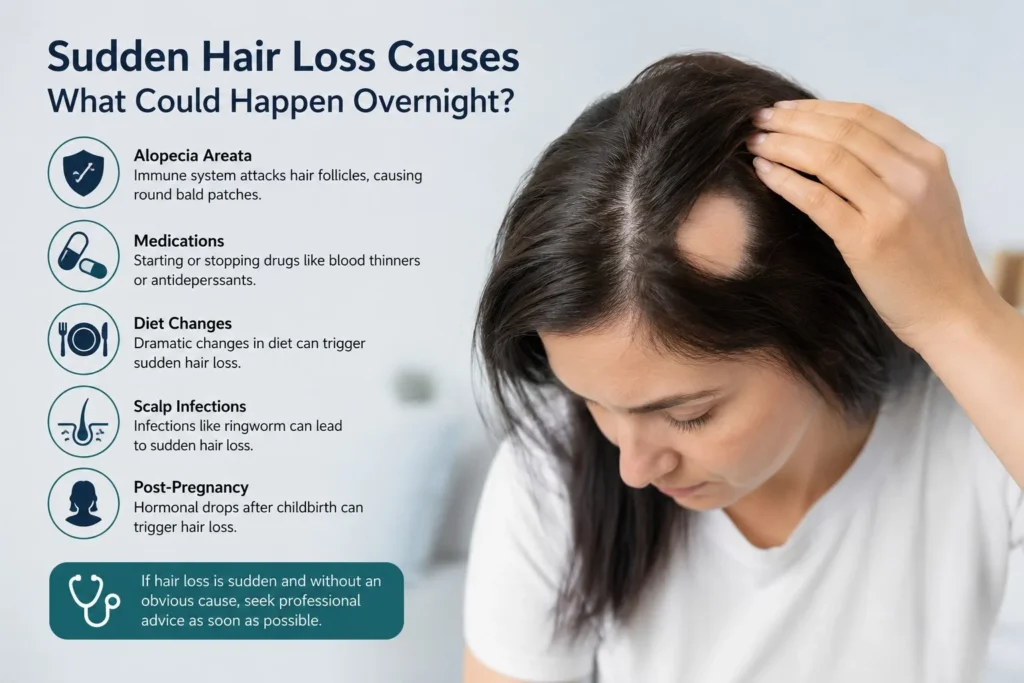
Sudden hair loss causes a great deal of anxiety, and rightly so. If you see areas of hair loss coming up rapidly, it might be alopecia areata, a situation in which the immune system mistakenly attacks hair follicles. The outcome is usually bald patches that have a round shape and smooth skin, and they can be located anywhere on the scalp.
Other sudden triggers include:
- Starting or discontinuing some drugs (like blood thinners or antidepressants)
- A dramatic change in diet
- Scalp infection, such as ringworm
- Post-pregnancy hormonal drop
If hair loss is sudden and without an obvious cause, seek professional advice as soon as possible.
Hormonal shifts and hair loss in women
Hormones play a massive role in hair health, especially for women. Major life events that shift hormone levels can trigger noticeable shedding.
| Hormonal Event | Effect on Hair |
| Pregnancy | Temporary fullness during, shedding after |
| Postpartum period | Significant shedding 3-6 months after birth |
| Menopause | Reduced estrogen leads to thinning |
| Polycystic Ovary Syndrome (PCOS) | Elevated androgens trigger thinning |
These are among the most overlooked causes of hair loss in women. Addressing the underlying hormonal imbalance often helps slow or reverse the loss.
Thyroid disorders: A silent culprit
Hair thinning can be a result of both an underactive thyroid (hypothyroidism) and an overactive thyroid (hypothyroidism). The thyroid gland is responsible for regulating metabolism as well as numerous bodily functions, among which is the hair growth cycle.
Hair thinking reasons linked to thyroid problems include:
- Diffuse thinning across the entire scalp
- Hair is becoming dry, brittle, and breaking easily
- Hair loss on the outer sides of the eyebrows
A straightforward blood test can reveal thyroid problems. In most cases, with suitable treatment, hair loss due to thyroid disorders is reversible.
Nutritional deficiency and hair health
One of the most frequent yet overlooked hair thinning reasons is poor nutrition. Hair follicles require a constant supply of essential nutrients to stay healthy. Deficiency in these nutrients is very often linked to hair loss:
- Iron: Low ferritin levels are the number one reason for hair loss in women.
- Vitamin D: Related to the hair follicle cycle and regrowth.
- Zinc: Helps repair the tissue and function of hair follicles.
- Biotin (Vitamin B7): Involved in keratin production.
- Protein: As hair is mainly composed of keratin, insufficient protein intake will lead to follicle damage.
Don’t simply rely on supplements without first conducting blood tests. Excess of certain nutrients can also cause harm.
Traction Alopecia: The style that slowly steals your hair
Traction alopecia is caused by the continuous pulling or stretching of hair follicles. Most people who suffer from it are those who usually wear:
- Tight ponytails or buns
- Braids, extensions, or weaves
- Hair wraps are worn overnight
The very first sign of damage is usually seen at the hairline and edges. Over time, if the tension continues, the follicles can become permanently scarred. This is one sudden hair loss cause that is completely preventable by simply changing the hairstyle if made early enough.
Regain your confidence with expert hair loss care!
Now you have gained the answer to your question: why is my hair falling out? Losing your hair is distressing, but it doesn’t matter whether your hair loss is due to hormonal changes, a lack of some nutrients in your body, or is genetically programmed. What matters is that you get the right support at the right time.The Skin and Hair Clinic offers personalised, scientific assessments to figure out what exactly is causing the hair loss and lead you toward the right treatments. Don’t wait for the problem to get worse. Book a consultation today and make your first, confident step towards healthier, fuller hair.
Frequently Asked Questions
1. Why is my hair falling out so much all of a sudden?
Many times, sudden shedding is a result of stress, illness, hormonal changes, or a new drug. Also, it is highly recommended that you see a specialist if you experience a great deal of shedding or if the shedding is accompanied by the appearance of bald patches.
2. Can stress really cause hair loss?
Definitely. A lot of stress – either physical or mental – causes hair follicles to enter the resting phase, which makes hair loss visible about two to three months later. But, in most cases, it is only a temporary condition.
3. How do I know whether my hair loss is normal or something that needs medical attention?
It is perfectly normal to shed 50-100 hair strands daily. But if you experience notable hair thinning, bald spots, or alterations to the hairline, it might be a good idea to get a professional evaluation.
4. Does diet affect my hair loss?
Definitely. Not getting enough iron, vitamin D, zinc, biotin, and protein is among the main causes of hair thinning and loss.
5. Is hair loss in women distinctly different from hair loss in men?
Really. Male hair loss is mostly characterised by receding hairlines or thinning at the crown, whereas in females, the main signs tend to be a wider parting or overall diffuse thinning of the scalp.