Reviewed by Dr. Jyotsna Kumari
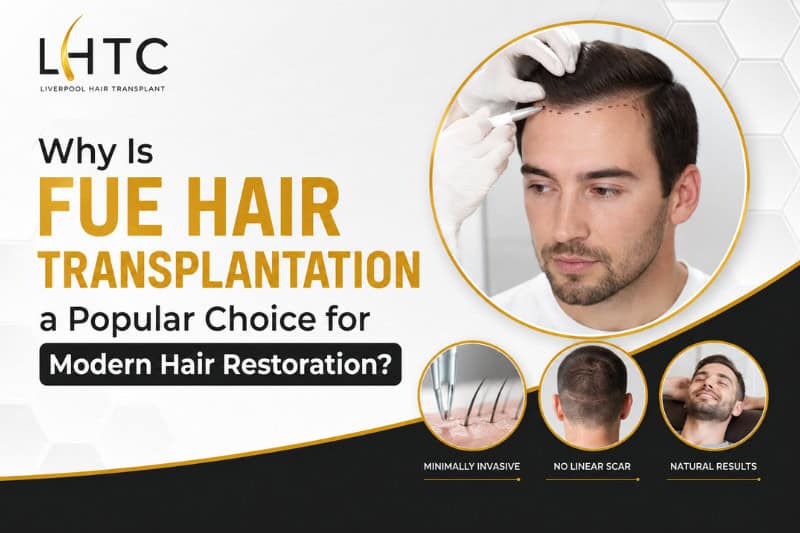
Hair loss can affect your appearance, confidence and the way you feel about your hair. For people considering a surgical solution, understanding how different transplant techniques work can make the decision easier. FUE has become a widely discussed option because it moves individual follicles rather than removing a strip of scalp.
Did You Know? The NHS explains that FUE removes individual hair grafts from the scalp and places them into areas affected by hair loss. Unlike FUT, it leaves multiple tiny scars rather than a single linear scar, which may be less noticeable.
The Skin & Hair Clinic provides FUE hair transplantation in Liverpool alongside FUT and DHI procedures. Learning how the treatment works, who may be suitable and what results can realistically be expected can help you decide whether it is right for you.
Key Takeaways
- FUE involves removing individual hair follicles from a suitable donor area and placing them into areas affected by hair thinning or loss.
- Unlike FUT, FUE does not involve removing a strip of scalp, which means it does not leave a linear scar.
- The technique can be used to restore areas such as the hairline, temples and crown, depending on the patient’s hair loss and available donor hair.
- Hair growth after treatment takes time, with new growth developing gradually over the following months.
- Suitability depends on factors such as the pattern of hair loss, donor hair availability, scalp health and overall treatment goals.
What Is FUE Hair Transplantation?
A FUE hair transplant involves taking individual hair follicles from a donor area, usually where the hair is more resistant to pattern hair loss. These follicles are then placed into areas where greater density is needed.
The procedure is performed under local anaesthetic. Since follicles are removed separately, there is no linear donor-area scar associated with the strip technique used in FUT.
During a consultation, the surgeon can assess your existing hair, donor supply and areas affected by hair loss. This helps determine whether FUE is suitable and how many grafts may be needed.
Why Has FUE Become So Popular?
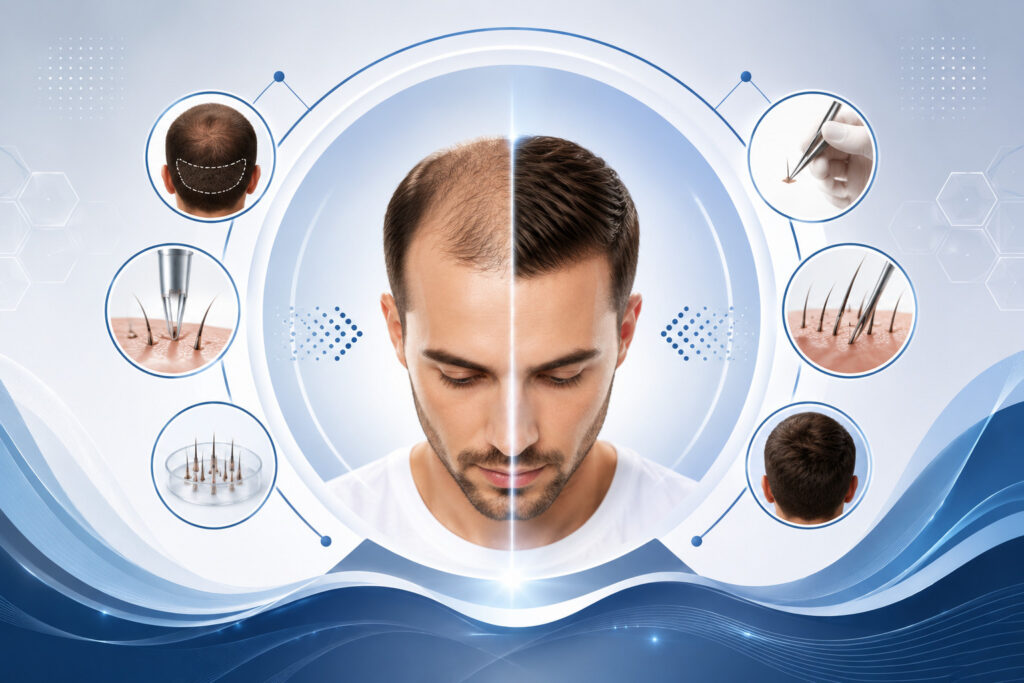
The growing interest in FUE is linked to the way the procedure is performed and the results it can produce for suitable patients. It also gives surgeons the ability to place individual grafts according to the direction and pattern of existing hair.
Some reasons people consider FUE include:
- Individual follicle extraction can avoid a linear scar.
- Grafts can be placed carefully around the hairline and thinning areas.
- The donor area can often heal with small extraction marks.
- The procedure can be suitable for different levels of hair loss, depending on donor supply.
- Hair growth develops from the transplanted follicles rather than from artificial hair.
The FUE hair transplant benefits can therefore be relevant to people looking for a surgical option that uses their own existing follicles.
What Happens During a FUE Procedure?
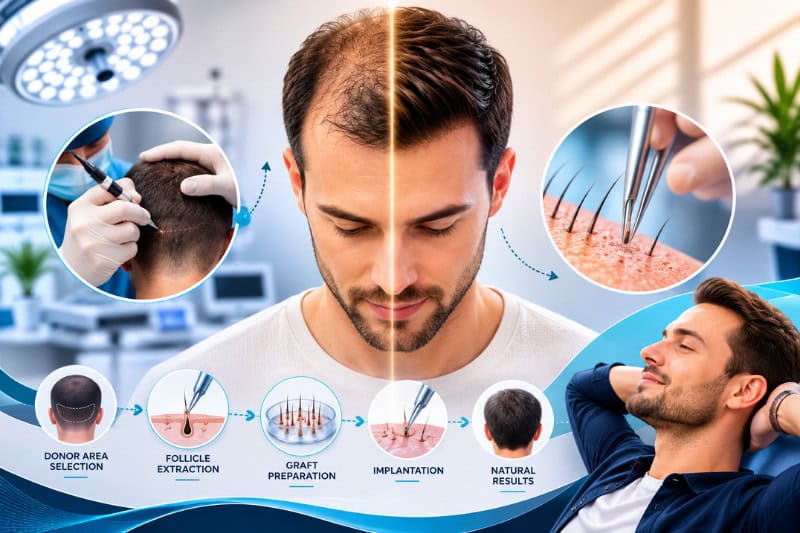
The FUE treatment process starts with an assessment and treatment plan. The surgeon identifies suitable donor follicles and discusses the areas that require additional coverage.
On the treatment day, the preparation stage occurs, and the local anaesthesia is applied. Each follicle is removed and processed for transplanting. The grafts will be implanted in the small recipients’ sites by considering the direction and angle of hair around them.
The length of the treatment might differ depending on the number of grafts that have to be transplanted. Your surgeon will inform you about your planned treatment and recovery period prior to the treatment.
What Can You Expect During Recovery?
Recovery differs from person to person. Some redness, swelling, tenderness or small scabs can appear around the treated areas during the early healing period.
Following the clinic’s aftercare instructions is important for protecting the newly placed grafts. You may be advised to avoid strenuous activity for a period and to follow specific instructions for washing your scalp.
Hair growth does not happen immediately. Transplanted hairs can shed during the early stages before new growth develops. This is why judging the outcome too soon can give a misleading impression of the final result.
How Long Does It Take to See Results?
Hair growth after transplantation takes time. New growth usually develops gradually over several months, with the final outcome becoming clearer as the transplanted follicles mature.
Several factors can affect the result, including:
- The number and quality of available donor follicles
- The extent and pattern of existing hair loss
- The placement and survival of transplanted grafts
- Individual hair growth characteristics
- Following post-treatment care instructions
Your surgeon should explain the expected timeline during your consultation rather than promising a particular result.
Is FUE Suitable for Everyone?
FUE is not automatically suitable for every person experiencing hair loss. A proper assessment is needed before deciding on treatment.
A hair transplant clinic should assess your donor area, hair loss pattern, scalp condition and future hair loss. In some cases, another treatment may be more appropriate, or surgery may need to be delayed.
A consultation also gives you the chance to ask about the procedure, recovery, possible risks and expected outcome before making a decision.
FUE vs Other Hair Transplant Techniques
FUE is one of several surgical hair restoration procedures. The FUT procedure involves the removal of a strip of scalp with follicular units whereas the DHI procedure employs another implantation technique.
The best technique would depend on your hair loss, donor resources, treatment objectives, and also a recommendation by a qualified doctor. Judging the techniques on popularity and costs alone may not give a complete picture.
Modern hair restoration should be evaluated based on suitability and expected results and not solely on the latest or most advertised technique.
Ready to Explore Whether FUE Is Right for You?
Choosing a transplant technique should begin with understanding your hair loss and the options available. The Skin & Hair Clinic offers FUE alongside FUT and DHI hair restoration in Liverpool, allowing patients to discuss their suitability and treatment choices with the clinical team.
If you are considering FUE hair restoration, speak with a qualified clinician about your hair loss, expected results and recovery before deciding whether treatment is right for you.
Frequently Asked Questions
Q: Is FUE a permanent hair transplant?
Transplanted follicles are generally taken from areas that are more resistant to pattern hair loss. Once established, these follicles can produce hair for the long term. However, existing non-transplanted hair can still thin over time.
Q: Does FUE leave scars?
FUE does not create the linear scar associated with FUT. Small extraction marks can occur where individual follicles have been removed, and their visibility can vary between patients.
Q: Is FUE painful?
Local anaesthetic is used during treatment to reduce discomfort. Some tenderness or sensitivity can occur after the procedure while the scalp heals.
Q: How soon can I return to normal activities?
This depends on the procedure and your recovery. Your clinical team should provide specific guidance on washing, exercise, work and other activities after treatment.
Q: How do I know if FUE is right for me?
A clinical assessment is the best way to determine suitability. Your surgeon can review your hair loss, donor area and overall scalp health before discussing whether FUE is an appropriate option.