
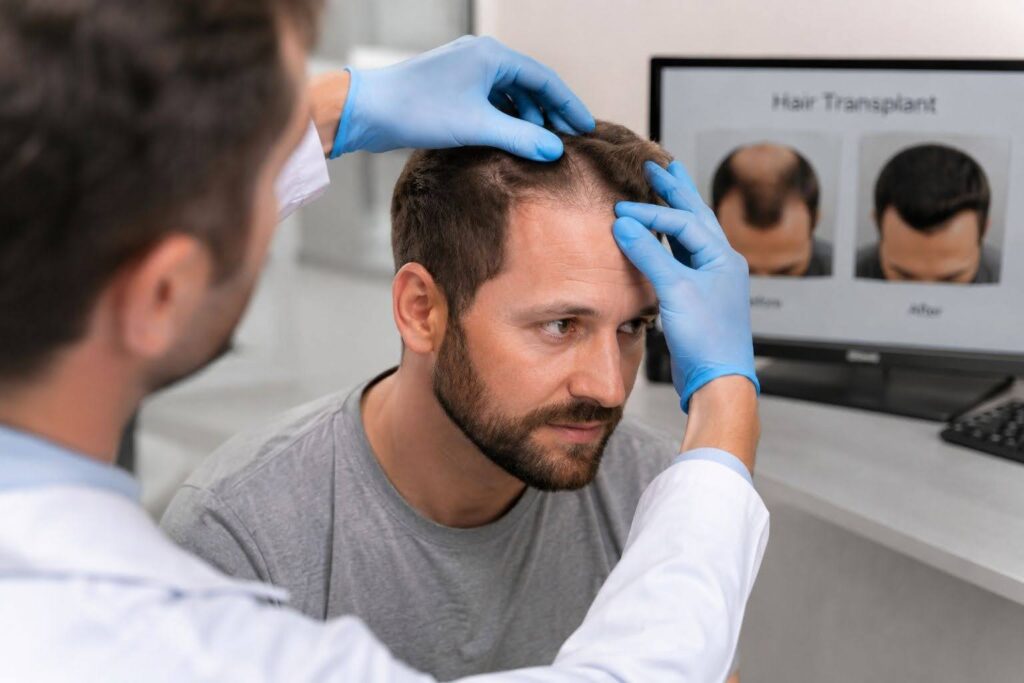
The success rate for hair transplant surgery in 2026 ranges from 85% to 98%. The exact number depends on your surgeon’s skill, the technique used, and your own hair type.
Did you know? According to the International Society of Hair Restoration Surgery, FUE harvesting accounted for 85.4% of male and 68.2% of female transplant procedures, making it the most widely used surgical technique today.
And your success rate for hair transplant results isn’t fixed the moment you leave the clinic. Aftercare choices still shape the outcome for months afterward. This matters because a hair transplant is a serious investment, both financially and emotionally.
At The Skin and Hair Clinic, one question comes up more than any other: will my grafts actually survive? It’s a fair question, and honestly, not enough clinics answer it honestly. Let’s get into the actual data behind it.
Key Takeaways
- Hair transplant success rates range between 85% and 98% overall.
- Robotic DHI currently offers the highest graft survival rates available.
- Female hair transplant success depends heavily on stable donor density.
- Aftercare choices measurably affect your final graft survival numbers.
- Always review before-and-after pictures before choosing a clinic.
What Drives Hair Transplant Surgery Success Rate
Surgeons quietly track two separate scores, even though patients rarely hear about the split. The first is graft survival. This simply counts how many transplanted follicles take root and grow. The second is patient satisfaction, which measures how natural the end result actually looks in the mirror. Here’s the catch: a clinic can score 95% on graft survival and still leave a patient unhappy. Placement, density, and hairline design all sit outside the raw survival number.
Reputable UK clinics typically report hair transplant success rates somewhere between 90% and 95%. Elite surgeons with tightly refined protocols push past that, sometimes reaching 98%. Weaker or rushed practitioners, on the other hand, can fall as low as 75%. That means roughly one in four grafts simply fails to grow. Not exactly the odds you’d want for a procedure you’re paying thousands for.
Technique Comparison: Graft Survival by Method
| Technique | Typical Graft Survival | Best Suited For |
| FUT (Strip Method) | 90–95% | Larger sessions, thicker donor supply |
| FUE | 90–95% | Natural, scar-free harvesting |
| DHI | 90–97% | Precise, dense hairline work |
| Robotic DHI | 96–98% | Consistency, reduced human fatigue |
Crown restorations tend to underperform slightly, often landing between 75% and 90%. Blood supply is naturally weaker in that area of the scalp, so grafts have to work harder just to survive the first few days.
Female Hair Transplant Success Rate: A Different Picture
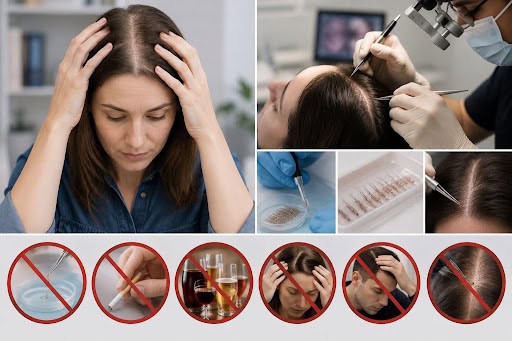
Women’s hair loss rarely follows the same script as male pattern baldness. It’s usually diffuse thinning spread across the scalp, rather than one clear receding hairline. That changes the maths quite a bit. The female hair transplant success rate still sits close to the general 90% to 95% range surgeons quote for men. But candidacy matters far more here.
A good surgeon needs to confirm stable donor density before recommending surgery at all. Skip that step, and results tend to disappoint no matter how skilled the technique is. This is one area where a rushed consultation can quietly set a patient up to fail before the procedure has even begun.
Why Some Procedures Under perform
Understanding the hair transplant failure rate helps you avoid becoming a statistic yourself. Grafts fail for a handful of fairly predictable reasons, and most of them are avoidable:
- Poor handling: grafts left out of solution for over four hours lose viability fast
- Smoking or alcohol close viability, which restricts blood flow to the scalp
- Touching the scalp within 72 hours, which can dislodge fresh, unsettled grafts
- Unstable donor hair especially common in patients under 25
- Inexperienced technicians placing grafts at the wrong angle or depth
Pro tip: Avoid nicotine for two weeks before surgery, and for four weeks after. It sounds like a small sacrifice, but it makes a measurable difference to your final graft count.
How Patients Can Improve Their Own Odds
Many patients also ask, is hair transplant worth it before committing to the procedure. The answer largely depends on choosing the right candidate, an experienced surgeon, and following proper aftercare. When performed well, with high graft survival and natural-looking results, most patients consider the procedure a worthwhile long-term investment in their confidence and appearance.
Your surgeon isn’t the only variable in this equation. Your own behaviour, before and after surgery, genuinely moves the needle more than most people expect. Saline spray every thirty minutes for the first three days keeps grafts hydrated and reduces crusting. Staying off alcohol for roughly a week beforehand supports healthy circulation right when it matters most. Long-term use of finasteride, where appropriate, protects your surrounding native hair, which keeps the overall result looking fuller for years rather than months.
Sleep position matters too, though it rarely gets mentioned. Sleeping propped up for the first few nights reduces swelling around the hairline. It’s a small habit, but it adds up alongside everything else.
How Long Until You See Real Results?
Patience plays a bigger role than most patients expect going in. Transplanted hair typically sheds within the first month, which understandably alarms a lot of people. That’s normal, though the follicle itself stays put underneath the skin. New growth usually starts around month three or four. Most patients see meaningful density by month six, with the full, final result visible somewhere between twelve and fifteen months later. Checking a clinic’s hair transplant before and after the results gallery is one of the fastest ways to gauge what’s realistic. Photos don’t lie the way marketing copy sometimes does.This information has been medically reviewed by Dr Jyotsana Kumari to ensure it is clear and clinically informed
Book Your Consultation With The Skin and Hair Clinic!
Numbers only ever tell half the story. Your hair transplant success ultimately depends on a surgeon who treats every single graft like it matters, because it really does. The Skin and Hair Clinic offers honest, evidence-led consultations, so you know exactly what to expect before you commit to anything. Get in touch today, and start your journey with facts instead of guesswork.
FAQs
Q: What is the average success rate for hair transplant surgery?
Most reputable clinics report success rates between 90% and 95%, with top surgeons reaching 98% through refined technique and disciplined aftercare protocols.
Q: Can a hair transplant fail completely?
Total failure is rare in practice. Partial failure happens more often, usually caused by poor graft handling, smoking, or touching the scalp too soon after surgery.
Q: Is the success rate different for women?
Yes, slightly. Female results depend more heavily on donor hair stability, since women’s hair loss is typically diffuse rather than localised like male pattern baldness.
Q: How long until I see final results?
Most patients notice meaningful growth by month six, with full, final density becoming visible somewhere between twelve and fifteen months after the procedure.
Q: Does technique affect the success rate?
Yes, to an extent. Robotic DHI and standard DHI tend to edge out FUE and FUT slightly, though skilled hands narrow that gap considerably either way.
“`html
“`