
Reviewed by Dr. Jyotsna Kumari

A patchy, thin, or uneven beard is one of the most common reasons men now book a consultation for facial hair restoration. But before committing to surgery, most people want a straight answer to one question: how does a beard hair transplant work, and how long before it actually looks like a beard?
Did you know?According to the ISHRS 2025 Practice Census, beard and moustache transplants are now the top non-scalp procedure for men, making up 5% of all male hair restoration surgeries performed in 2024.
This guide walks through the procedure step by step, what recovery involves, and the realistic timeline for results using data from clinical research and industry census reports rather than marketing claims.
Key Takeaways
- A beard transplant moves individual hair follicles usually from the back of the scalp into thin or bald areas of the beard using the FUE technique.
- The procedure typically takes 4 to 8 hours under local anaesthetic and is done as a single day case.
- Transplanted hairs shed within 2 to 6 weeks (a normal phase called shock loss) before new growth begins.
- Early regrowth appears around month 3 to 4, with full, mature density visible between month 9 and 12.
- Choosing a clinic registered with the Care Quality Commission (CQC) and a GMC-registered surgeon is the single biggest factor in avoiding a repair procedure later.
What Is a Beard Hair Transplant?
A beard hair transplant is a minor surgical procedure that relocates healthy, permanent hair follicles into areas of the beard, jawline, moustache, or cheeks where growth is patchy, thin, or absent. It uses the same underlying science as a scalp transplant: donor hair is genetically resistant to the hormone that causes some hair loss, so once it’s moved and it takes root, it keeps growing for life.
Most clinics harvest donor follicles from the safe donor area at the back and sides of the scalp, though some surgeons combine scalp and chest hair for patients who need extra grafts.
How Does a Beard Hair Transplant Work? Step-by-Step
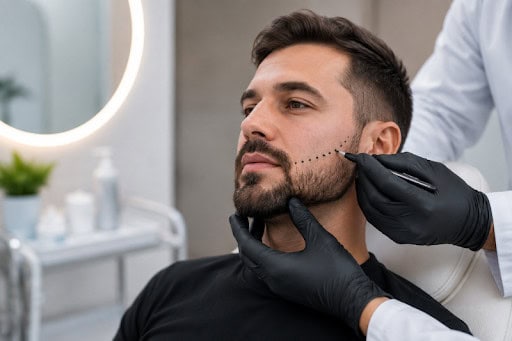
The mechanics are close to a scalp procedure, covered in more depth in our step-by-step hair transplant guide, but the design work in the beard region is more precise because hair grows in several directions across the jaw, chin, and cheeks.
Step 1: Consultation and Design
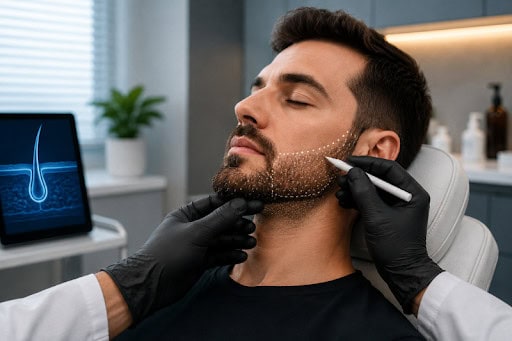
The surgeon maps the desired beard shape, marking density zones and growth-direction angles across the goatee, cheek line, and moustache. This design stage determines how natural the final result looks. Poor angle-matching is the most common cause of an unnatural appearance.
Step 2: Donor Extraction (FUE)
Individual follicular units are removed one at a time from the donor area of the scalp using a fine punch tool, under local anaesthetic. Each graft usually contains one to three hairs.
Step 3: Graft Preparation
Extracted grafts are sorted by hair count and kept hydrated in a holding solution while the recipient sites are prepared, minimising the time follicles spend outside the body.
Step 4: Implantation
Using fine needles or an implanter pen, the surgeon places each graft into the beard area at the correct angle and direction typically 30 to 40 degrees for the beard, shallower for the moustache so hair grows flat and natural rather than jutting outward.
Beard Transplant Procedure: FUE vs Other Techniques
Follicular Unit Extraction (FUE) is the standard beard transplant procedure because it leaves no linear scar and allows precise, single-follicle placement. Strip harvesting (FUT) is rarely used for facial hair. If you’re comparing techniques for a combined scalp-and-beard plan, our FUE vs FUT comparison breaks down scarring, downtime, and graft yield for each approach.
Who’s a Good Candidate for a Beard Hair Transplant?
- Men with patchy, uneven, or genetically sparse beard growth
- Those with beard scarring from acne, burns, or previous surgery
- Patients wanting a fuller moustache, goatee, or defined cheek line
- Anyone with a sufficient donor supply of healthy scalp hair
Active alopecia areata affecting the beard (alopecia barbae) is generally a contraindication, since transplanted hair can be affected by the same autoimmune process. A consultation with a qualified surgeon should confirm suitability before booking.
Beard Transplant Recovery: Day-by-Day Timeline
Recovery follows a fairly predictable pattern, similar to the scalp hair transplant healing timeline, though facial skin tends to heal a little faster.
- Days 1–3: Mild swelling and redness around the jaw and donor area; tiny scabs form at each graft site.
- Days 4–10: Scabs flake off naturally; most people can return to non-strenuous work within a week.
- Weeks 2–6: Transplanted hairs shed (shock loss) this is expected and does not mean the graft has failed.
- Months 3–4: New, finer hairs begin to emerge from the transplanted follicles.
- Months 6–9: Density and thickness continue to build steadily.
When Can You Expect to See Beard Transplant Results?
Most patients see meaningful coverage by month 6, but the full hair transplant results timeline shows that final density, texture, and curl pattern aren’t fully settled until 9 to 12 months post-procedure. Beard hair can also be trimmed and styled from around month 4 onward, once growth is established enough to shape.
Is a Beard Transplant Safe? Risks and Realistic Expectations
Beard transplant surgery is generally low-risk when performed by an experienced, appropriately regulated surgeon. Possible side effects include temporary swelling, minor bruising, small scabbing, and rarely, infection or ingrown hairs. Because transplanted hair retains the characteristics of its donor site, colour and curl won’t change to match surrounding beard hair; a good surgeon accounts for this at the design stage.
Ready to See What a Beard Transplant Could Look Like on You?
Book a one-to-one consultation with our team to get a personalized graft estimate, honest advice on whether you’re a good candidate, and a clear price before you commit to anything.
FAQs
Q: How does a beard hair transplant work?
It works by removing individual hair follicles from a donor area, usually the back of the scalp, and implanting them one by one into thin or bald sections of the beard, matching the natural growth angle of facial hair.
Q: How long does the beard transplant procedure take?
Most sessions take between 4 and 8 hours, depending on how many grafts are needed, and are performed under local anaesthetic in a single day.
Q: Is beard transplant recovery painful?
Discomfort is usually mild and manageable with over-the-counter pain relief. Most people return to normal daily activities within a few days, though strenuous exercise is typically paused for around two weeks.
Q: When does transplanted beard hair start growing?
Transplanted hairs shed within the first few weeks, then new growth typically begins around month 3 to 4, with full density visible by month 9 to 12.
Q: How many grafts does a beard transplant need?
This varies by coverage goal, but most beard transplants use anywhere from a few hundred to around 2,000+ grafts, depending on the size of the treatment area and desired density.
Q: Is a beard transplant permanent?
Yes. Because donor follicles are genetically resistant to the hormone that causes pattern hair loss, transplanted beard hair continues growing for life once it establishes.
{
“@context”: “https://schema.org”,
“@type”: “FAQPage”,
“mainEntity”: [
{
“@type”: “Question”,
“name”: “How does a beard hair transplant work?”,
“acceptedAnswer”: {
“@type”: “Answer”,
“text”: “It works by removing individual hair follicles from a donor area, usually the back of the scalp, and implanting them one by one into thin or bald sections of the beard, matching the natural growth angle of facial hair.”
}
},
{
“@type”: “Question”,
“name”: “How long does the beard transplant procedure take?”,
“acceptedAnswer”: {
“@type”: “Answer”,
“text”: “Most sessions take between 4 and 8 hours, depending on how many grafts are needed, and are performed under local anaesthetic in a single day.”
}
},
{
“@type”: “Question”,
“name”: “Is beard transplant recovery painful?”,
“acceptedAnswer”: {
“@type”: “Answer”,
“text”: “Discomfort is usually mild and manageable with over-the-counter pain relief. Most people return to normal daily activities within a few days, though strenuous exercise is typically paused for around two weeks.”
}
},
{
“@type”: “Question”,
“name”: “When does transplanted beard hair start growing?”,
“acceptedAnswer”: {
“@type”: “Answer”,
“text”: “Transplanted hairs shed within the first few weeks, then new growth typically begins around month 3 to 4, with full density visible by month 9 to 12.”
}
},
{
“@type”: “Question”,
“name”: “How many grafts does a beard transplant need?”,
“acceptedAnswer”: {
“@type”: “Answer”,
“text”: “This varies by coverage goal, but most beard transplants use anywhere from a few hundred to around 2,000+ grafts, depending on the size of the treatment area and desired density.”
}
},
{
“@type”: “Question”,
“name”: “Is a beard transplant permanent?”,
“acceptedAnswer”: {
“@type”: “Answer”,
“text”: “Yes. Because donor follicles are genetically resistant to the hormone that causes pattern hair loss, transplanted beard hair continues growing for life once it establishes.”
}
}
]
}