
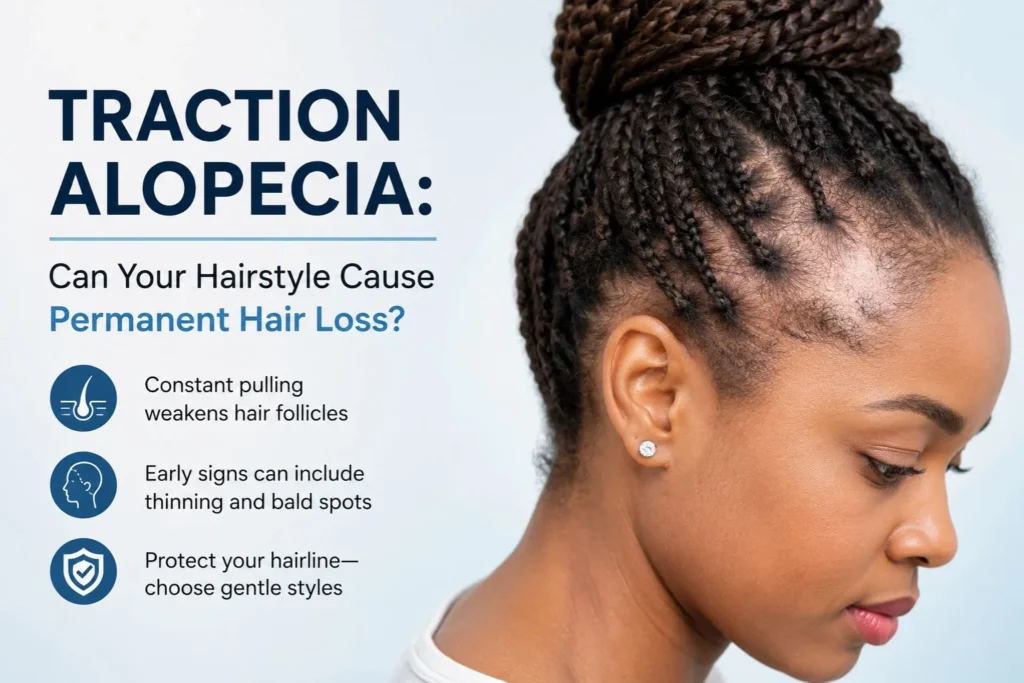
Tight hairstyles can cause permanent hair loss and it happens more gradually, and more commonly, than most people realise. The condition is called traction alopecia, and it develops when sustained pulling force on the hair follicles causes repeated inflammation that, over time, can lead to irreversible scarring. The good news is that if you catch it early, the damage is largely reversible. The critical question is knowing what to look for before that window closes.
Table of Contents
How traction alopecia actually damages your follicles
Hair follicles are remarkably resilient structures, but they have a threshold. When hair is pulled tightly whether from braids, cornrows, a high ponytail, or extensions it places mechanical tension directly on the root. A single occasion of tight styling is unlikely to cause lasting damage. The problem is repetition.
Each episode of tension triggers a mild inflammatory response around the follicle. Do this consistently over months or years, and that low-grade inflammation begins to cause structural damage. The follicle narrows, its blood supply becomes compromised, and eventually fibrous tissue replaces the follicle entirely in a process called follicular fibrosis. At that stage, the follicle can no longer produce a hair shaft, and the loss becomes permanent.
The British Association of Dermatologists describes traction alopecia as a form of scarring alopecia in its advanced stage, distinguishing it from the reversible early phase where follicles are damaged but not yet destroyed. This distinction reversible versus irreversible is the most important clinical concept for anyone concerned about hair loss from tight hairstyles.
Which hairstyles carry the highest risk?
Not all updos are equal. The risk depends on three factors: how much tension is applied, how frequently the style is worn, and how long each session lasts. Styles that score high on all three are the ones most consistently linked to traction alopecia hairstyles research.
Braids and cornrows
Braids causing hair loss is one of the most frequently reported presentations of traction alopecia, particularly in Black women, who are disproportionately affected due to cultural hairstyling practices that begin in childhood. A 2016 review in the Journal of the American Academy of Dermatology reported that about one in three Black women in America have some degree of traction alopecia. That number shows not only how common this condition is but also how seldom it is talked about openly.
The danger is much greater if braids are done very tightly at the roots, kept for long durations, or used together with chemical treatments like relaxers, which make the hair shaft weaker and hair follicles more vulnerable to mechanical stress.
Ponytails and buns
Hair loss from ponytail styles is a growing concern, particularly among women who wear their hair pulled back tightly every day for work, exercise, or convenience. The hairline and temples are the most vulnerable zones, as the hairs in these areas are finer and have less follicular anchoring than those at the crown. Repeated elastic band use at the same point on the hair shaft also causes breakage, which is sometimes confused with true follicle loss but is a separate (and more reversible) problem.
Hair extensions and weaves
Extensions introduce a compounding risk: the weight of the added hair creates downward traction, while the attachment method whether bonded, sewn, or clipped adds lateral tension at the root. The longer the extensions are worn without a break, the greater the cumulative damage.
Tight headwear
This is an often-overlooked contributor. Helmets, tight headbands, and religious headwear worn continuously against the same area of the hairline can generate low-level but sustained tension. This tends to produce a distinctive band of thinning along the forehead rather than at the temples.
Recognising the warning signs early
Traction alopecia follows a recognisable progression, and the earlier it is identified, the better the outcome. The challenge is that the earliest signs are easy to dismiss or attribute to something else.
The fringe sign
One of the earliest and most clinically significant indicators is what dermatologists call the fringe sign, a row of short, fragile, broken hairs remaining along the frontal hairline while the bulk of the hair is pulled away. These hairs are not regrowing from a healthy follicle; they are the last survivors of repeated tension. Seeing this pattern is a strong prompt to stop tight styling immediately.
Scalp symptoms before visible hair loss
Many people experience scalp pain, itching, or a feeling of tightness after removing a tight style. These sensations are the follicles signalling distress. Persistent or recurring tenderness in the same area, small red bumps or pustules near the hairline, or flaking around the brow and temples should all be taken seriously they often precede visible thinning by several months.
Hairline recession and edges hair loss
The term edges refers to the fine hairs along the frontal hairline and temples. Edge hair loss is often the first cosmetically noticeable sign of traction alopecia, and it tends to present as hairline recession women hairstyles find it difficult to explain if they have been styling their hair the same way for years. The recession is typically symmetrical, gradual, and confined to the areas of greatest tension.
Can tight hairstyles cause permanent hair loss and how do you know?
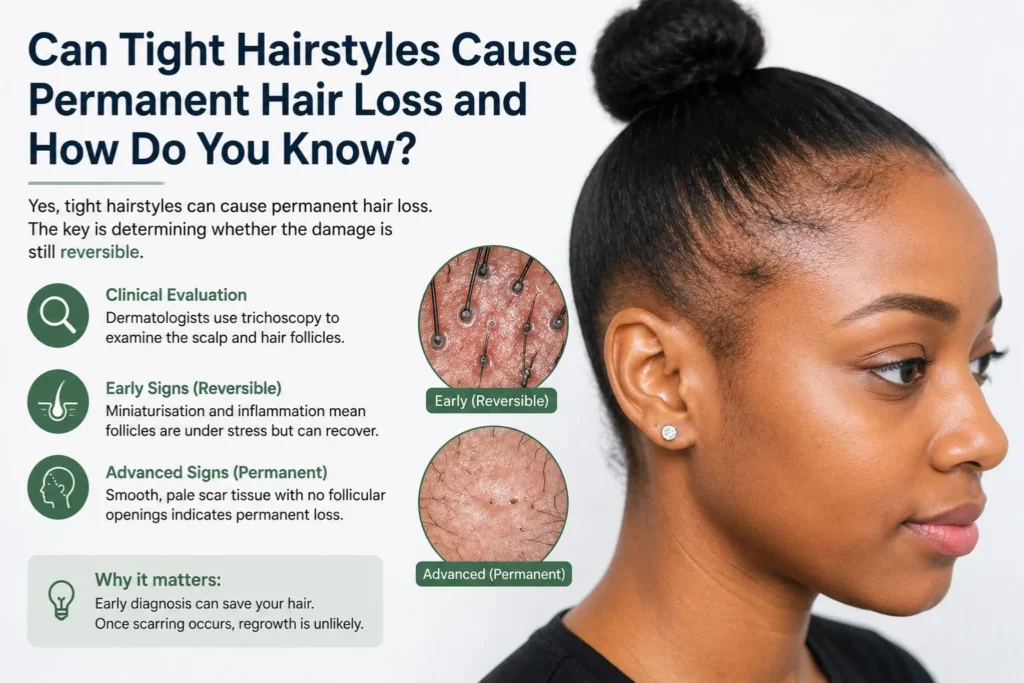
Yes, can tight hairstyles cause permanent hair loss is a question with a clear clinical answer: they can, but permanence is not inevitable. The determining factor is how much follicular fibrosis has already occurred.
A dermatologist or trichologist can assess this through trichoscopy, a non-invasive technique that uses a dermatoscope to examine the scalp under magnification. In early traction alopecia, trichoscopy reveals hair follicle miniaturisation and perifollicular inflammation, both of which are signs of a follicle under stress but still capable of recovery. In advanced cases, the absence of follicular openings replaced by smooth, pale scar tissue indicates permanent loss.
This assessment matters enormously for treatment planning. Pursuing regrowth treatments on permanently scarred follicles is unlikely to produce results, whereas early intervention in reversible cases can be highly effective.
Traction alopecia recovery: what treatment actually looks like
Step one remove the source of tension
This sounds obvious, but it is the single most important intervention. Traction alopecia recovery cannot begin while the causative stress is ongoing. Switching immediately to looser styles, avoiding tight elastics, and giving the hairline a period of complete rest from tension is the non-negotiable foundation of any treatment plan.
In practice, what we find at The Skin and Hair Clinic is that patients often see early regrowth within three to six months of stopping the offending style provided follicular scarring has not progressed too far. The follicle is more resilient than people expect when the source of stress is removed promptly.
Topical minoxidil
Minoxidil is the most popular topical treatment for traction alopecia and the British Association of Dermatologists has it as one of the main options. It works through extending the growth phase of the hairs and increasing the blood supply to the follicle. After three to four months of regular use, you can usually notice the difference. Yet, since minoxidil only makes easier healing of follicles that still have some function, it is not capable of reactivating a follicle that has been permanently scarred.
Anti-inflammatory treatments
Because inflammation is both the cause and the ongoing driver of follicular damage, managing it is a key part of traction alopecia recovery. Topical or intralesional corticosteroids are commonly used in clinical settings to reduce active inflammation around the follicle, particularly in cases that show signs of progression toward scarring. These are prescribed treatments not available over the counter and are best administered under dermatological supervision.
Platelet-Rich Plasma (PRP) therapy
PRP therapy is a procedure that entails taking a few milliliters of blood, spinning it down to obtain concentrated platelets, and then injecting it back into the scalp regions where hair is thinning or lost. In 2022, a systematic review published in the Journal of Cosmetic Dermatology identified PRP as a very well-tolerated and effective supplementary treatment for different types of alopecia, with clear improvements in hair density. When it comes to traction alopecia, PRP gives the best results when used in the early, non-scarred stage.
Hair transplant as a last resort
Where permanent follicular loss has occurred and other treatments have been exhausted, FUE hair transplant can restore the hairline. This is only appropriate once the underlying traction has fully ceased transplanting into a scalp that is still subject to ongoing pulling tension will not produce lasting results.
Protecting your hairline without giving up your style
The goal is not to avoid all updates permanently. It is to wear them in a way that does not accumulate damage over time. These adjustments make a meaningful difference.
Alternate your styles regularly so that tension is not concentrated on the same follicles repeatedly. When wearing tight styles, build in rest days a loose braid, a silk scrunchie low ponytail, or simply wearing hair down. Avoid combining chemical treatments (relaxers, perms, bleach) with tight mechanical styling, as chemically weakened hair is significantly more vulnerable. For hairline recession women are already managing, a lighter hold styling gel and a soft-bristle brush rather than a hard-pulling comb can significantly reduce daily trauma to fragile edges.
The American Academy of Dermatology also recommends sleeping on a silk or satin pillowcase to reduce friction-related hair breakage overnight, a small change that adds up over months and years.
Common misconceptions about traction alopecia hairstyles
Myth: My hair has always bounced back before, so it will again.
Reality: Traction alopecia recovery is not linear. Each episode of tension inflames the follicle, and that cumulative damage is not always visible until it crosses a threshold. What feels like resilience can actually be the follicle approaching its limit.
Myth: Traction alopecia only happens to people with very tight curl patterns.
Reality: Traction alopecia is most common in Black women but can happen to anyone no matter their hair type. Why is regular wearing of hairstyles that place high tension on the hair, no matter the texture. Reports of hair loss from ponytail styles and extensions are increasing in all ethnic groups.
Myth: If my scalp does not hurt, my hair is fine.
Reality: Pain indicates a problem, but if there’s no pain, it doesn’t necessarily mean everything is okay. Quite a few people get traction alopecia without ever having scalp pain, In particular if the hair was slowly kept under tension over a long period of time. Often, hair thinning is the first sign people notice.
Your hairline is still talking the question is whether you are listening
Traction alopecia is one of the few forms of permanent hair loss that is almost entirely within your control to prevent and often to reverse, if caught in time. The damage does not happen overnight, and that same gradual pace means there is usually a window to act.
If you have noticed hairline thinning, edges pulling back, or persistent scalp tenderness after taking your hair down, that is your signal to seek an assessment rather than wait. At The Skin and Hair Clinic, a trichoscopy consultation can confirm whether what you are seeing is reversible follicular stress or something that requires more targeted treatment and from there, a plan that works around your lifestyle, not against it.
Frequently asked questions
1: Can tight hairstyles cause permanent hair loss if I have been wearing them for years?
Yes, long-term, repeated tension from tight hairstyles can cause permanent hair loss by progressively scarring the follicles. Whether your specific loss is reversible depends on how far follicular fibrosis has progressed, which a dermatologist or trichologist can assess through trichoscopy. Early identification significantly improves your options.
2: How can I tell if my edge hair loss is due to traction alopecia or something else?
Hair loss at the edges that happens because of traction alopecia usually shows up as a pattern of your hairstyles, a symmetrical recession of the temples and frontal hairline and is often accompanied by the fringe sign. Other diseases like alopecia areata, frontal fibrosing alopecia, or nutritional deficiencies may also cause hairline thinning that looks similar which makes a skin doctor’s evaluation the correct step rather than self-diagnosis.
3: Does hair grow back after stopping braids causing hair loss?
Usually, if the hair follicles haven’t been damaged beyond repair, removing the source of tension can cause hair regrowth. A noticeable regrowth phase usually occurs within 3-6 months. Still, if braids were combined with harsh chemical treatments or the same hairstyle was kept for years, chances of complete hair regrowth without clinical help are slim.
4: Is hair loss from ponytail styles reversible?
Hair loss due to ponytail styles is reversible if detected at the early stage, given that pulling the hair is stopped and substantial follicle damage (fibrosis) has not occurred. Besides moving on to less constricting hairstyles and not tying hair at the same spot, one can use topical products such as minoxidil with the support of a doctor to aid regrowth.
5: What is the best treatment for traction alopecia recovery?
The best treatment method for traction alopecia recovery is a complete omission of the source of tension. There is no point in any treatment if pulling continues. After that, it’s common for a dermatologist to suggest minoxidil (a topical medication), anti-inflammatory medication if there is an active inflammation, and even PRP therapy to help the follicles. If scarring is permanent, a procedure like an FUE hair transplant might be the best solution.
6: How long does traction alopecia take to become permanent?
There is no fixed duration; it depends on how much tension is applied, how often a person changes their style, how resilient the follicles are individually, and whether other harmful factors like chemical treatments are involved. Some people experience irreversible loss after several years of tight daily styling; while others witness early signs after just a few months. This is why it’s imperative to respond to early warning signs.