Table of Contents
If you’re researching hair restoration, is hair transplant painful is probably the question on your mind right now. That’s a fair worry. According to the NHS, a hair transplant is usually carried out under local anaesthetic, so you stay awake but shouldn’t feel pain during the procedure itself. At The Skin and Hair Clinic in Liverpool, this comes up in nearly every consultation, so here’s an honest answer covering what you’ll feel before, during, and after treatment.
Objective
This guide explains what hair transplant pain actually feels like at each stage, from numbing injections to the final days of healing, so you can approach surgery informed rather than anxious.
Key Takeaways
- Local anaesthetic numbs the scalp, so the surgery itself is largely pain-free.
- Injections cause the most noticeable discomfort, usually a brief sting.
- Soreness afterwards is typically mild and settles within a couple of weeks.
- The donor area tends to feel more tender than the recipient site.
- FUE and DHI generally involve less post-operative discomfort than FUT.
- A consultation with a qualified surgeon can settle most pain-related worries beforehand.
Is Hair Transplant Painful? The Honest Answer
So, is hair transplant painful? Not in the way most people fear. Local anaesthetic numbs the scalp completely before any work begins, so you won’t feel cutting, extraction, or implantation. You might notice pressure or light tugging, sensation rather than pain. Discomfort sits in two short windows: the numbing injections, and the first night or two of recovery once the anaesthetic wears off. Outside those windows, most patients describe the experience as closer to a long dental visit than major surgery.
Does Hair Transplant Surgery Hurt During the Procedure?
Does hair transplant surgery hurt once you’re on the table? For most patients, no. Your scalp is cleaned and marked, then a fine needle delivers local anaesthetic, this is the hair transplant injection pain stage everyone asks about. It causes a brief sting, similar to a flu jab. Once numbness sets in, extraction or implantation begins, and pain during hair transplant itself largely disappears, since nerve signals are blocked. Want to talk it through first? Book a free consultation with our surgeons.
How Painful Is a Hair Transplant Compared to Other Procedures?
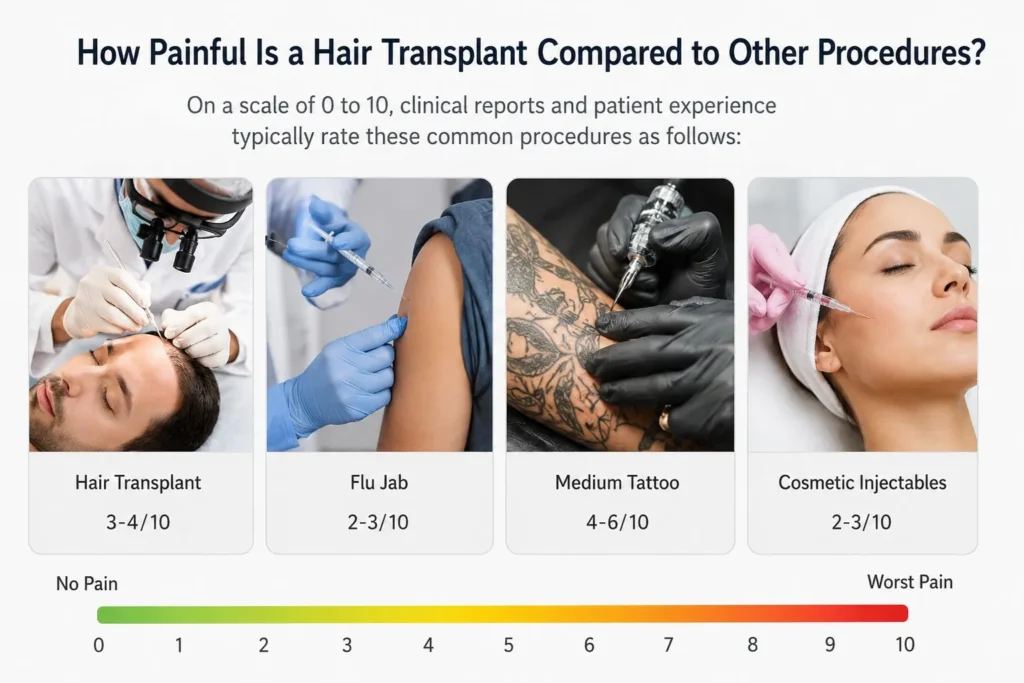
People often ask how painful is a hair transplant next to something familiar. Clinical reports typically place the hair transplant pain level at around 3 to 4 out of 10 during injections, comparable to:
- A flu jab or dental numbing shot
- A medium-sized tattoo, arguably less, since anaesthetic is used throughout
- Minor cosmetic injectables
Anxiety usually drives the perceived pain more than the procedure does. Most people relax within the first half hour.
FUE vs FUT: Which Hurts More?
Technique affects recovery comfort more than the surgery itself, and patients often want to know whether a hair transplant hurt more under one method than the other.
FUE: Smaller Punctures, Less Tenderness
An fue hair transplant extracts individual follicles with tiny punch tools, leaving small puncture marks and generally less tenderness.
FUT: A Single Wound, More Tightness
A fut hair transplant removes a thin strip of scalp, closed with sutures, so the donor site can feel tighter while healing.
Both use the same anaesthetic during surgery; the difference shows up afterwards as donor area hair transplant pain, which tends to settle faster after FUE than FUT. Compare our FUE and FUT pages for more detail.
Pain After Hair Transplant: What’s Normal
Pain after hair transplant follows a predictable pattern, and donor area pain is usually the most noticeable part of it.
A Day-by-Day Recovery Timeline
Days 1 to 3
Soreness peaks, particularly in the donor area. Paracetamol usually manages this well, alongside mild swelling around the forehead.
Days 4 to 7
Discomfort fades, and itching may appear, which is a good healing sign.
Week 2 Onwards
Most soreness has resolved and scabbing clears.
A small number of patients notice neck pain after hair transplant sessions, usually from holding one position for hours rather than the grafts themselves. Gentle movement breaks during longer appointments help with this.
Is Hair Transplant Surgery Safe Despite the Injections?
Is hair transplant surgery safe with so many injections involved? Yes, when carried out by GMC-registered surgeons in a properly regulated clinic. The injections use fine needles in small, controlled amounts targeting specific scalp areas. Choosing a CQC-registered clinic adds further accountability around hygiene and safety protocols, which matters as much as pain management when picking where to go.
Does Hair Implants Hurt as Much as People Expect?
Does hair implants hurt the way people imagine beforehand? Usually not, expectation tends to outweigh reality. In DHI, follicles go in directly using a pen-like tool, often described as light taps rather than anything painful. With effective numbing, hair implants painful experiences are rare when carried out correctly.
Can You Get a Hair Transplant Without Pain Entirely?
Some patients search for a hair transplant without pain, hoping for zero sensation at any stage. Total numbness during surgery is realistic; claiming no sensation during the injection itself wouldn’t be honest. What clinics can genuinely offer:
- Fine-gauge needles and slow, controlled delivery
- Vibration or cooling devices to distract nerve receptors during injections
- Optional mild sedation for anxious patients
These measures get you close to a pain-free experience overall, even with a brief sting at the start. Get in touch with our team to discuss comfort options for your case.
Managing Hair Transplant Discomfort at Home
A few habits make recovery noticeably smoother:
- Take recommended painkillers on schedule rather than waiting for discomfort to build
- Sleep with your head elevated for the first few nights
- Avoid touching or scratching the treated areas
- Skip strenuous exercise for at least a week
- Follow your clinic’s washing instructions precisely
- Avoid alcohol and smoking during early recovery
Final Word on Hair Transplant Pain
Hair transplant surgery isn’t entirely sensation-free, injections sting briefly and some tenderness follows, but it’s far milder than most people picture beforehand. With proper anaesthetic, an experienced team, and sensible aftercare, discomfort stays short-lived for the overwhelming majority of patients. Book a free consultation with The Skin and Hair Clinic to discuss your concerns with a GMC-registered specialist.
Frequently Asked Questions
1. Is hair transplant painful during recovery?
Not really, not by the second day. The first 48 to 72 hours are when you’ll feel it most, mainly as tightness or soreness around the donor area. Paracetamol or ibuprofen sorts most of it out, and plenty of patients say it’s milder than they’d braced themselves for.
2. How long do injections sting for?
A few seconds each, honestly. It’s the kind of sting that’s gone before you’ve finished registering it. The bit that takes longer is the surgeon working through the whole donor and recipient area, which adds up to roughly 15 to 20 minutes start to finish.
3. Does post-surgery soreness affect the results?
No, the two aren’t connected. Whether your scalp feels tender or barely anything at all, it has no bearing on how the grafts settle in or how dense the final result looks. Soreness is just your nerves and skin healing, nothing to do with the follicles themselves.
4. Is hair transplant painful enough to need time off work?
For most people, the bigger issue is how things look rather than how they feel. Scabbing and some swelling are the main reasons patients take 2 to 4 days off, not pain. Desk-based jobs tend to allow a faster return than anything physical or outdoors.
5. Which technique causes less discomfort, FUE or FUT?
FUE tends to win out here. Because it leaves small individual puncture marks instead of one long incision, the donor area usually feels less sore. FUT can leave more of a tight, pulling sensation in that first week while the strip wound closes up.