
There is a common question that many people ask when considering a hair restoration procedure: Is hair replacement permanent, and will the results last for years to come? The answer is yes, but there is more to it than a simple yes or no.
Did you know? The International Society of Hair Restoration Surgery (ISHRS) reports that first-time hair restoration surgery patients in 2024 skewed younger than the general adult population, with 95% initiating hair restoration surgery between the ages of 20-35.
This shows that more young people are opting for hair restoration surgery. So, if you are thinking about a transplant, you need the real answers before committing to anything. Permanent hair transplant procedures relocate follicles from a donor area that naturally resists the hormone DHT. Once those follicles take root in the scalp, they tend to grow for life. That said, long-term success depends on your technique, your suitability, and how well you follow aftercare instructions.
Table of Contents
Key Takeaways
- Transplanted hair is permanent because donor follicles carry a built-in resistance to DHT.
- Surrounding native hair can still thin over time, which is why hair loss stability before surgery matters so much.
- FUE and FUT both deliver strong results, and the better option depends on your graft volume needs and lifestyle.
- PRP hair treatment is a proven non-surgical route for early-stage loss or post-transplant maintenance.
- Not everyone is a suitable candidate. Your age, donor density, health, and hair loss stability all play a role in determining this.
How hair transplants deliver lasting results
The permanent hair implants work by taking follicles from the back or sides of the scalp. These zones are genetically coded to resist hair loss. Once moved to a thinning area, they carry that resistance with them. That is the core reason hair transplant surgery is permanent in the way it functions. Two techniques lead the field today:
- FUE (Follicular Unit Extraction): Single follicles are removed and placed one at a time. Scarring is minimal, and recovery is relatively quick.
- FUT (Follicular Unit Transplantation): A narrow strip of scalp is removed and divided into individual grafts. A FUT hair transplant specialist typically recommends this when a patient needs a higher volume of grafts.
Both approaches produce hair that grows naturally from the scalp. Learn more about how long a hair transplant lasts to understand the growth stages in detail.
Does the transplanted hair last forever?
Many patients ask, does hair transplant last forever? The grafts themselves are built to survive long-term. What people often overlook, though, is that your existing hair around the transplant can still thin over time. Ongoing male or female pattern baldness does not stop just because you had surgery.
This distinction matters. The hair transplant is permanent for the grafts that were placed. But your overall hair picture may shift as surrounding follicles respond to DHT. That is precisely why hair loss needs to be stable before you go ahead with any procedure.
| Factor | Impact on Longevity |
| Donor hair density | Higher density means more grafts available |
| Age at procedure | Younger patients risk further native hair loss |
| Hair loss stability | Stable loss leads to more predictable outcomes |
| Health conditions | Conditions like alopecia areata can affect results |
| Aftercare compliance | Poor aftercare puts grafts at risk |
Realistic expectations: Success rate for hair transplant
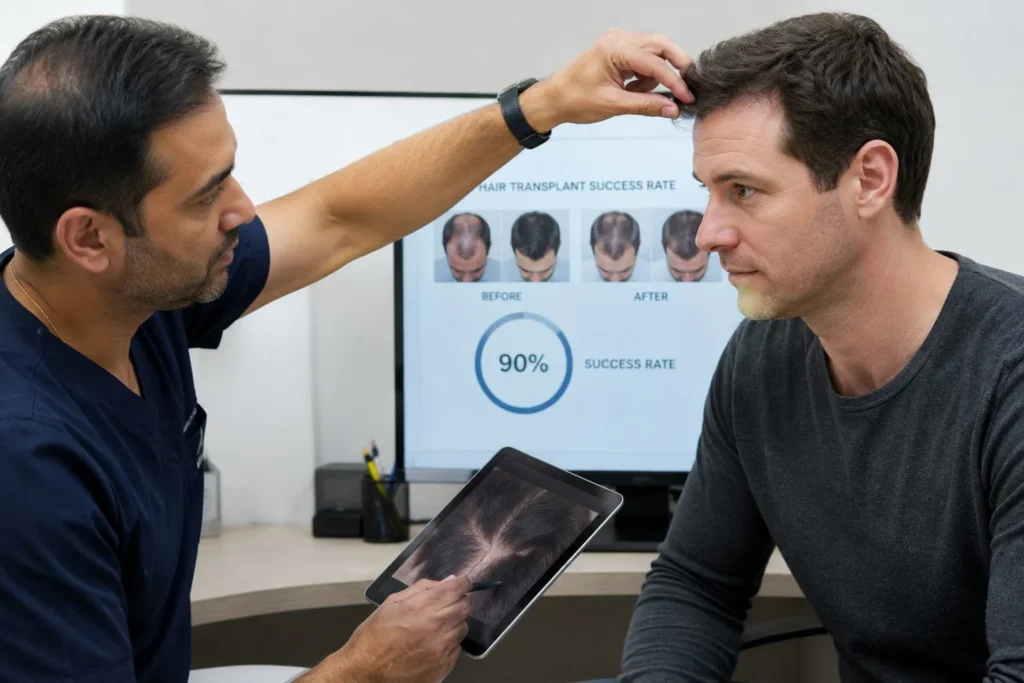
The success rate for hair transplant procedures is genuinely encouraging. Most reputable clinics report graft survival rates between 85 and 95 percent, provided a qualified surgeon performs the work. Results do not appear overnight. Here is what the typical timeline looks like:
- Weeks 1 to 4: Grafts settle in; some shedding is completely normal
- Months 3 to 4: Early new growth starts becoming visible
- Months 9 to 12: Full density gradually emerges
Do hair implants work? Consistently, yes, when the right patient chooses the right clinic. For the grafted follicles, without question. For your scalp as a whole, that depends on your natural hair loss progression.
Supplementary treatments: PRP hair treatment and beyond
Surgery is not the only path. PRP hair treatment, or Platelet-Rich Plasma therapy, is a non-surgical approach that uses growth factors from your own blood to stimulate existing follicles. It suits patients in the early stages of hair loss or those looking to support their results after a transplant.
Long hair implants are also possible. With FUE, longer grafts can be placed directly, allowing some patients to skip the shaved-head regrowth phase entirely.
Who is not a good candidate?
This is the part many clinics avoid. You should know it. You may not be suitable if you:
- Have unstable or rapidly advancing hair loss
- Have very limited donor density at the back and sides
- Are under 25 with no established loss pattern yet
- Have autoimmune alopecia or an active scalp condition
- Expect unrealistically high density or full coverage from one session
Please do not try to assess this yourself. Only a proper scalp evaluation by a qualified surgeon will give you a reliable answer.
Is a hair transplant worth it?
Is a hair transplant worth it? For most suitable candidates with stable hair loss, yes, it is a one-time procedure that produces natural, permanent results. Unlike hairpieces, fibers, or concealers, transplanted hair grows, gets cut, and washes exactly like your own.
How long does hair plugs last? The old plug technique is no longer used. Modern FUE and FUT grafts are far more refined and are designed to last a lifetime. Is hair replacement surgery permanent? When carried out correctly by the right hands, the answer is yes.
Book your free consultation today!
The Skin and Hair Clinic offers expert assessments with GMC-registered surgeons who give you an honest, no-pressure evaluation. Stop guessing about what your hair future looks like. Book a consultation, and take the first step with complete confidence.
FAQs
Q1. Is hair replacement permanent for everyone?
Not in every case. The transplanted grafts are permanent, but ongoing thinning in surrounding areas can affect how the overall result looks over time. Hair loss stability before surgery is a key factor.
Q2. How long does hair plugs last compared to modern transplants?
The old plug technique aged poorly and looked unnatural over time. Modern FUE and FUT grafts are built to last a lifetime, with far superior density and a completely natural appearance.
Q3. Is a hair transplant permanent if I have alopecia?
It depends on the type. Androgenetic alopecia responds well to transplantation. Autoimmune forms like alopecia areata are more complex and may affect graft survival, so candidacy needs careful assessment.
Q4. Does a hair transplant last forever if I keep losing hair?
The transplanted hair remains permanent. However, loss continuing in non-transplanted zones may mean a second session or ongoing medical management, such as PRP hair treatment, is needed.
Q5. What is the success rate for hair transplant procedures?
Qualified clinics typically report graft survival rates of 85 to 95 percent. Results vary based on surgeon experience, patient suitability, and how well post-operative care instructions are followed.