
Reviewed by Dr. Jyotsna Kumari
If you’ve been researching eyebrow hair restoration, chances are you’ve already asked yourself: how long does an eyebrow hair transplant procedure take? It’s usually the very first practical question people have, right after “will it actually work?” The reassuring answer is that the surgery itself is completed in a single, same-day visit. What takes longer is the growth cycle that follows the months it takes for transplanted follicles to settle in and produce visible, permanent brows.
A systematic review of 354 eyebrow and eyelash transplant patients across 18 countries found the average patient was a woman around 29 years old, with burns being the most common underlying cause of hair loss requiring the procedure.
This guide walks through the full timeline: what happens on the day of your procedure, how long each stage takes, what can shorten or extend your session, and when you’ll see your final results.
Key Takeaways
- Most eyebrow hair transplant procedures take 2 to 6 hours, depending on the number of grafts required.
- The procedure is performed under local anaesthetic, so you’re awake and comfortable throughout.
- Surgeons typically place 150 to 400 grafts per eyebrow, taken from the back of the scalp.
- Visible regrowth starts around 6 to 12 weeks after surgery, with full results developing over 9 to 12 months.
- Unlike microblading or brow tattoos, transplanted eyebrow hair is permanent and continues to grow for life.
- This guide has been prepared with reference to peer-reviewed clinical research and reviewed by our hair restoration team for accuracy.
How Long Does an Eyebrow Hair Transplant Procedure Take?
On the day itself, an eyebrow hair transplant procedure typically takes between two and six hours. The exact time depends on how many grafts are being placed, the complexity of the brow design, and whether one or both eyebrows are being treated. Because eyebrow grafts are placed one at a time, by hand, to match a precise angle and direction, the process is naturally more time-intensive than it might sound but it’s still completed as a single outpatient visit, such as through our eyebrow transplant service in Liverpool, with no overnight stay required.
Most patients are back home the same day and can return to light activities within a day or two.
Step-by-Step: What Happens During the Procedure
Consultation and Brow Design
Before the transplant day, you’ll have a consultation to map out your desired brow shape, density, and symmetry. Your surgeon will assess your donor hair, usually at the back of the scalp, discuss your goals, and explain what to expect.
Extraction of Donor Grafts
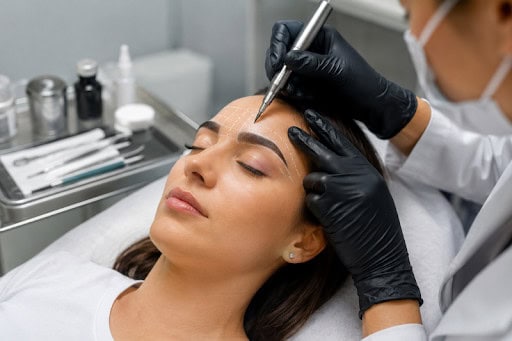
On the day of surgery, local anaesthetic numbs both the donor area and the eyebrow site. Individual hair follicles are then removed one at a time using the FUE hair transplant technique, which leaves minimal scarring and allows for precise, natural-looking placement.
Graft Preparation
Extracted grafts are sorted under magnification into single-hair follicular units, since eyebrow hair typically grows in single strands rather than clusters. Multi-hair grafts are separated before implantation to keep the result looking natural.
Implantation
Each graft is placed into a tiny incision at a shallow angle, usually 10 to 15 degrees, to mimic the natural lay and direction of eyebrow hair. This stage takes the most time, since precision here largely determines how natural the final result looks.
Eyebrow Hair Replacement Options and How Timing Differs
Not everyone arrives at eyebrow hair replacement the same way. Some patients are dealing with age-related thinning or over-plucking, while others are addressing eyebrow hair loss caused by conditions such as alopecia areata or trichotillomania, or reconstructing brows after burns, scarring, or chemotherapy. The surgical technique, usually FUE, stays broadly similar across cases, but sparser or scarred brows may need more grafts, more careful mapping, or a staged approach across two sessions which can extend total treatment time even though each individual session still takes only a few hours.
What Affects How Long Your Eyebrow Hair Implants Take
Several factors influence how long an individual session takes:
- The number of grafts needed for more extensive hair loss requires more grafts, and more time in the chair.
- Extent of existing brow hair partial restoration is quicker than full reconstruction.
- Surgeon technique and experience efficient, precise placement can shorten the session without compromising results.
- Single vs. two-session approach some patients return 8 to 12 months later for a second round to add density.
- Consultation and preparation time numbing and graft sorting both add to the total time spent at the clinic.
Recovery Timeline After Eyebrow Hair Restoration
Understanding the recovery timeline helps set realistic expectations for when you’ll actually see results:
- Days 1–5: Mild redness, swelling, and small scabs around each graft. Most people return to light activity within a couple of days.
- Weeks 2–4: Transplanted hairs often shed. This is a normal, expected part of the hair transplant healing timeline and doesn’t mean the graft has failed.
- Weeks 6–12: New hair growth begins.
- Months 6–12: Hair continues to thicken and mature, reaching its full, permanent, long-term result by around the one-year mark.
Ready for Fuller, Natural-Looking Eyebrows?
If you’re exploring your options for eyebrow hair restoration, our team can talk you through exactly what to expect from procedure time to final results based on your own hair and goals. Book a consultation to find out how many grafts you might need and how quickly you could see results.
Frequently Asked Questions
Q1: How long does an eyebrow hair transplant procedure take?
Most eyebrow hair transplant procedures take between two and six hours in a single visit, depending on the number of grafts needed and whether one or both brows are treated.
Q2: Is an eyebrow hair transplant painful?
The procedure is performed under local anaesthetic, so you shouldn’t feel pain during surgery. Mild tenderness, swelling, or scabbing afterward is normal and typically settles within a week.
Q3: How many grafts are needed for eyebrow hair restoration?
Most patients need between 150 and 400 grafts per eyebrow, depending on current density and the desired shape.
Q4: When will I see results after eyebrow hair implants?
New growth usually starts 6 to 12 weeks after the procedure, with full, mature results visible after 9 to 12 months.
Q5: Are eyebrow hair transplant results permanent?
Yes. Because the transplanted follicles come from your scalp, they behave like normal scalp hair and continue growing for life, unlike microblading or brow tattoos, which fade after a few years.
Q6: How is eyebrow hair replacement different from microblading?
Eyebrow hair replacement transplants real, living hair follicles for a permanent result, while microblading deposits pigment into the skin, which fades and needs repeating every one to three years.