Table of Contents
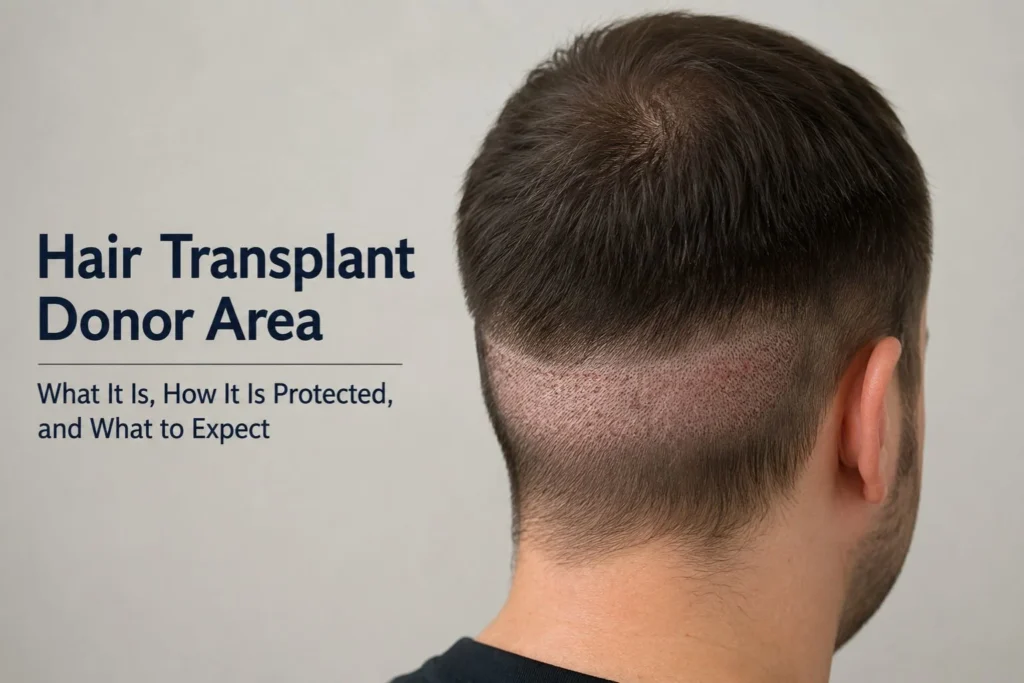
The hair transplant donor area is the region at the back and sides of the scalp, usually the occipital and parietal zones, where healthy follicles are harvested for transplant. These follicles are genetically resistant to DHT, the hormone responsible for most pattern hair loss, which is why they keep growing even after they’re moved somewhere else. Understanding this area matters just as much as understanding the bald patches you’re trying to fix, because it’s the one part of the procedure with a hard limit. Get it wrong, and no amount of surgical skill on the front of the scalp will fix the damage left behind.
What makes this patch of scalp so important
Every graft used in a transplant has to come from somewhere, and that somewhere is finite. The donor area isn’t just “the back of your head” in a loose sense; surgeons work within what’s known as the safe donor zone, a band of scalp mapped out because it’s statistically unlikely to thin further as a patient ages. Hair taken from outside that zone, even if it looks dense today, carries a higher risk of shedding later in life through natural pattern loss, which would leave visible gaps where transplanted hair used to sit.
Most people have somewhere between 6,000 and 7,000 viable grafts across a lifetime, though this varies with hair density, scalp laxity, and how much of the safe zone is actually usable.
How donor hair is actually harvested
There are two established ways to remove grafts, and the choice usually comes down to the size of the session, scarring tolerance, and how short a patient wants to wear their hair afterwards.
| Method | How it works | Scarring | Best suited for |
| FUE (Follicular Unit Extraction) | Individual follicles removed one at a time with a small punch tool | Tiny dot scars, largely invisible | Patients who want to keep hair short |
| FUT (Follicular Unit Transplantation) | A strip of tissue is removed and dissected into grafts under a microscope | Single linear scar, hidden by surrounding hair | Larger sessions needing maximum grafts in one sitting |
| Body/beard hair transplant | Follicles harvested from beard or chest as a secondary source | Minimal, scattered | Cases where scalp donor supply is limited |
FUE suits most patients wanting a low-maintenance result, FUT can yield more grafts per session but leaves a visible if concealable scar, and body hair is a backup option rather than a first choice, since beard and chest follicles behave differently to scalp hair once transplanted.
At The Skin and Hair Clinic, we find the method matters less than the planning behind it. A surgeon who maps the donor area properly before touching a single follicle will get a better long-term result than one relying purely on technique.
Donor area after hair transplant: what recovery looks like
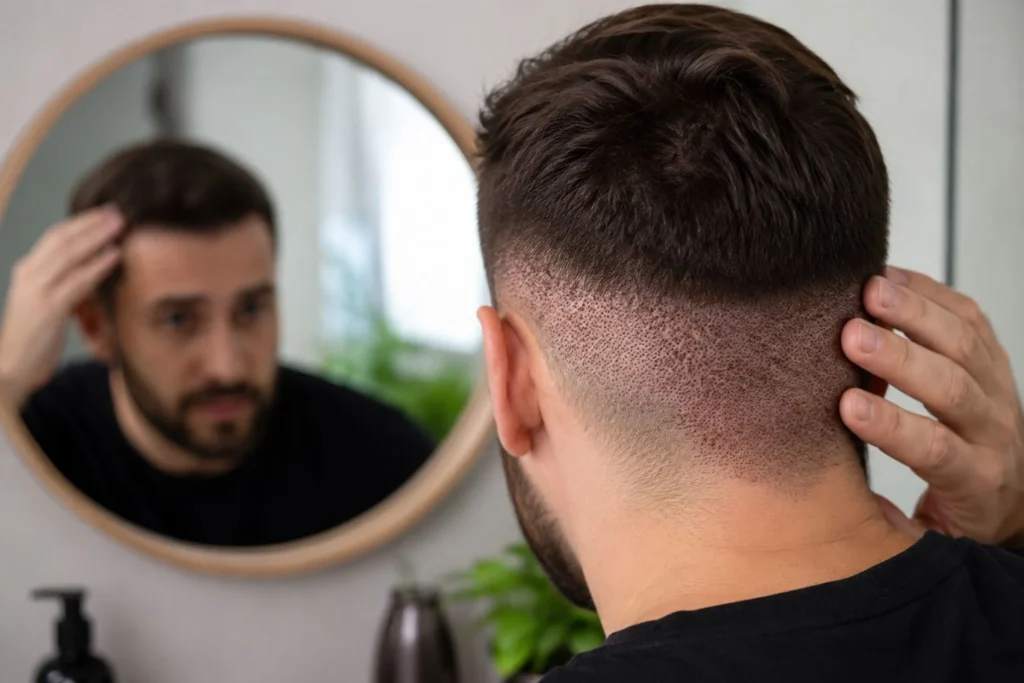
In the first few days, the donor area will feel tight, sore, or slightly numb as the nerves settle after extraction. Tiny scabs form over each extraction point within 24 to 48 hours, and these typically fall away within one to two weeks, revealing pink skin that fades to match the surrounding scalp.
Washing needs a gentle touch during this window. A mild, surgeon-recommended shampoo keeps the site clean without disturbing the healing follicles, and most clinics advise avoiding direct water pressure on the area for the first several days. Sleeping propped up on your back for the first week or so also reduces swelling and friction against the pillow.
Overharvesting and donor area thinning: what can go wrong
Overharvesting is the single biggest risk in donor area management. Taking too many grafts, or taking them too close together, can leave the area permanently patchy, with visible scalp showing through even once everything has healed. Unlike a bad haircut, this doesn’t grow back, because the follicles removed are gone for good.
Donor area thinning can also creep in gradually if a patient undergoes multiple sessions over several years without proper spacing between extractions. A surgeon working within the safe donor zone, and leaving adequate density behind at each sitting, is the main safeguard against this. It’s a genuine trade-off: covering more of the recipient area sometimes means accepting a slightly less full donor area, and any honest clinic should walk you through that balance before booking a large session.
Common misconceptions about the donor area
Myth: “The donor area has unlimited hair to give.”
Reality: it’s a finite resource. Once a follicle is extracted, nothing grows back in that exact spot, which is why lifetime planning across multiple possible sessions matters more than maximising one procedure.
Myth: “Body hair works just as well as scalp hair.”
Reality: beard and chest follicles differ in growth cycle and texture from scalp hair. They’re a useful secondary option when scalp donor supply runs low, not an equivalent substitute.
Myth: “A bigger session always gives a better result.”
Reality: pushing graft numbers beyond what the donor area can comfortably supply raises the risk of visible thinning at the back, even if the front looks fuller.
Conclusion
The donor area is the foundation of every hair transplant, and protecting it matters just as much as the result on top of the scalp. Treat it as a finite resource, ask any clinic you’re considering how they assess and preserve it, and you’ll be in a far stronger position to get a result that still looks natural years from now. If you’re planning a consultation, bring questions about graft numbers and donor zone mapping specifically; a clinic that answers them clearly is one worth trusting with the rest of the procedure.
Frequently Asked Questions
Q: How long does the donor area take to heal after a hair transplant?
A: Most of the visible healing, scabbing and redness, resolves within one to two weeks. Full settling of the skin and surrounding hair can take a little longer, but by the two to three week mark the area usually blends in well.
Q: Does hair grow back in the donor area after extraction?
A: No, extracted follicles don’t regenerate. The area still looks full afterwards because surrounding hair covers the individual extraction points, not because new follicles have appeared.
Q: What is the safe donor zone in a hair transplant?
A: It’s the band of scalp at the back and sides that’s least likely to be affected by future pattern hair loss. Surgeons harvest primarily from within this zone to protect against thinning that could appear years down the line.
Q: Can the donor area be used more than once?
A: Yes, provided it wasn’t overharvested the first time and enough density remains. Many patients undergo a second, smaller session years later, though the total lifetime supply of grafts is still limited.
Q: Is FUE or FUT better for the donor area?
A: Neither is universally better; it depends on your priorities. FUE leaves smaller, less visible scars and suits shorter hairstyles, while FUT can extract more grafts in a single session at the cost of one linear scar.
Q: What causes donor area thinning?
A: It’s usually the result of overharvesting, either in one large session or across multiple procedures without enough recovery and planning in between. Working with an experienced surgeon who respects the safe donor zone is the best protection.
Q: Can beard or body hair be used if the scalp donor area is depleted?
A: Yes, in many cases. It’s typically used as a secondary source rather than a first choice, since it behaves slightly differently once transplanted onto the scalp.