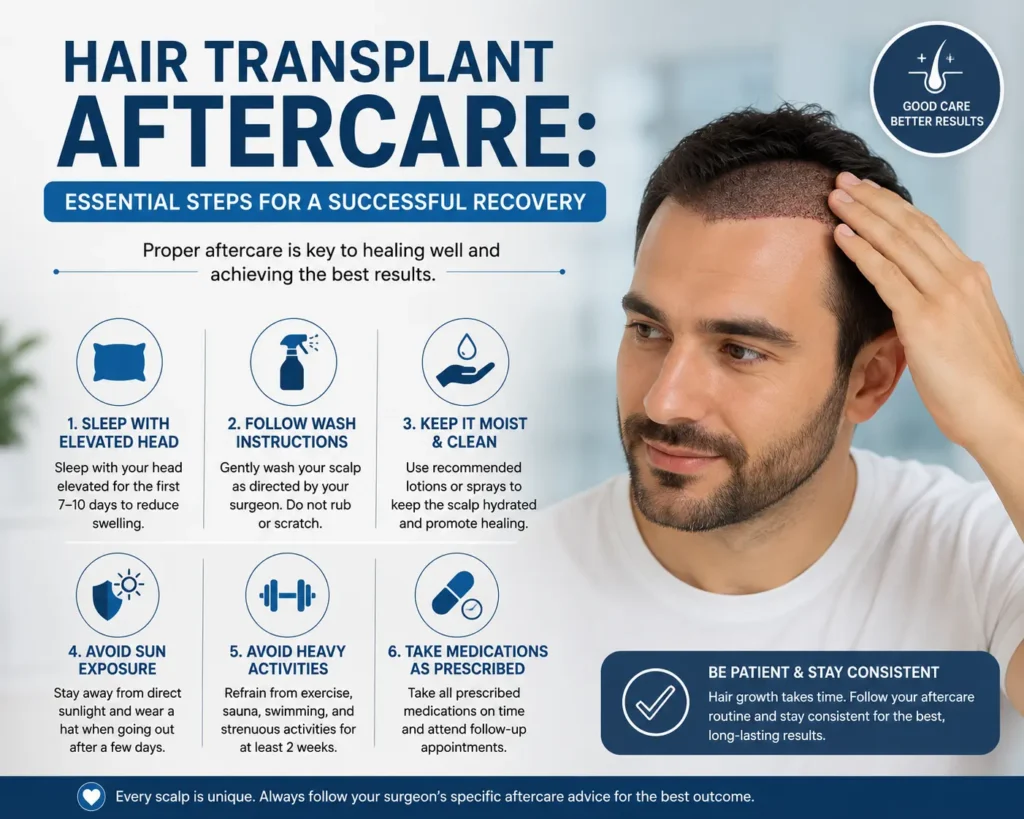
A successful hair transplant does not end when you leave the clinic; it begins with the recovery process that follows. Hair transplant aftercare plays a crucial role in protecting newly implanted grafts, supporting healthy healing, and helping you achieve the best possible long-term results. While modern hair transplant procedures have become highly advanced, the weeks after surgery remain a critical period that can directly influence the final outcome.
Whether you have undergone an FUE, FUT, DHI, beard, or eyebrow transplant, understanding the correct aftercare routine can make a significant difference. This comprehensive guide explains everything you need to know about hair transplant aftercare, from the first 48 hours to the final stages of hair growth, helping you protect your investment and maximise your results.
Why Aftercare Makes or Breaks Your Hair Transplant Results
Surgery creates a window of possibility. Aftercare is what you do with it. When follicles are transplanted, they go through a period of vulnerability that most patients underestimate. They need to form new vascular connections, stabilise within the recipient tissue, and eventually re-enter the growth cycle. That process takes weeks, and it is not particularly forgiving of shortcuts.
Hair transplant aftercare exists to protect that process at every stage. The instructions are about sleeping position, product choice, washing technique, and sun exposure. It all maps back to how healing tissue actually behaves and what transplanted follicles need to survive and thrive in their new location.
Hair Transplant Aftercare: Day by Day Timeline
One of the most useful things you can do before leaving the clinic is to understand what each stage of recovery actually looks like. The hair transplant aftercare timeline below gives you a realistic picture of what to expect and when.
Days 1–3: The Most Vulnerable Window
Nothing should touch the recipient area. No hands, no pillow pressure, no water. Sleep with your head elevated at roughly 45 degrees; a travel pillow works well for this. Swelling is common from day two onwards and tends to settle around the forehead. It looks worse than it is, and elevation helps keep it from spreading. Avoid bending forward at the waist during this phase.
Days 4–7: Scabbing Begins
Small crusts will form around each graft. Leave them entirely alone. Your clinic will likely introduce a saline spray or prescribed solution around this point, which keeps the scalp surface from drying out without putting any grafts at risk of displacement.
Days 7–14: Scabs Start to Lift
The crusting will begin to loosen and shed on its own. Gentle washing typically becomes possible somewhere around day seven, depending on your specific hair transplant aftercare instructions and how the healing is progressing. The donor area usually clears ahead of the recipient zone.
Weeks 3–4: Shedding Sets In
The transplanted hairs will, in all likelihood, fall out during this window. It is unsettling if you are not prepared for it, but it is a normal part of the cycle. The follicles are resting, not dying. Growth will come.
Months 3–6: Early Regrowth
Thin, fine hairs begin to emerge. Patchy and uneven at first; that is expected at this stage.
Months 9–12: Results Take Shape
The majority of patients reach something close to their final density by the end of this period. This is when a fair assessment of outcomes becomes possible.
When to Start Washing After a Hair Transplant
A few questions come up more reliably after a procedure, such as when to start washing. And it matters more than people realise. Washing too early can pull grafts out before they have any grip. Leaving it too long allows the crust to accumulate in ways that can actually obstruct follicle recovery.
The standard advice at our clinic is to keep the recipient area dry for the first 48 to 72 hours. From around day three or four, a gentle saline mist is usually introduced. A proper wash using a suitable hair transplant aftercare shampoo typically begins somewhere between day seven and day ten, guided by the technique used and how things are looking.
Best Aftercare Products and Shampoos
What you put on your scalp during recovery is not a minor detail. Some products actively support healing. Others contain ingredients that can irritate post-procedure skin, throw off the scalp’s pH balance, or physically disturb follicles that have not yet anchored properly.
Hair transplant aftercare products that are worth using share a few common characteristics: fragrance-free, sulphate-free, paraben-free, and formulated with a pH that does not stress sensitive skin. The aim is to clean gently, support the healing environment, and introduce nothing unnecessary.
As a rule, anything with alcohol, added fragrance, or exfoliating agents needs to be avoided for at least three months post-procedure. Standard shop-bought shampoos, even the ones marketed as sensitive or gentle, are rarely appropriate during this phase.
Aftercare Medications You May Be Prescribed
Hair transplant aftercare medication is not the same for every patient. What ends up in your post-procedure bag depends on the technique, the scale of the work, and your own health background. That said, a few categories appear consistently across most plans.
- Antibiotics are given almost universally for the first few days. They reduce the infection risk at both donor and recipient sites during the period when the scalp is most open to bacterial entry.
- Anti-inflammatory medication helps manage swelling, particularly around the forehead, where fluid tends to collect after scalp procedures.
- Minoxidil is often brought back into the routine a few weeks post-procedure to support the regrowth phase. Timing varies by individual and clinician preference.
- Finasteride may be recommended for patients dealing with androgenetic alopecia, helping to slow ongoing pattern loss in areas the transplant did not address.
Aftercare for FUE, FUT, and DHI Procedures
The broad recovery principles are consistent regardless of technique, but the practical differences are worth understanding before you go home.
- FUE: FUE aftercare covers a spread of small, circular extraction points across the donor zone. Because there is no linear incision, there is no sutured wound to manage, and recovery tends to move faster. That said, you do need to clean the full donor area carefully, given the number of individual sites involved. FUE hair transplant aftercare generally allows a return to light activity sooner than strip-based procedures.
- FUT: FUT hair transplant after care adds a layer of donor wound management that FUE does not require. The linear incision at the back of the scalp is closed with sutures or staples, which are removed around ten to fourteen days post-procedure. That wound site needs careful attention during healing to give the scar the best chance of settling well.
- DHI: DHI hair transplant aftercare sits closest in character to FUE aftercare, since the Choi implanter technique still involves individual extraction and placement. The recipient area tends to show slightly less surface disruption, which some patients find makes the first few days a little more comfortable.
Beard and Eyebrow Transplant Aftercare
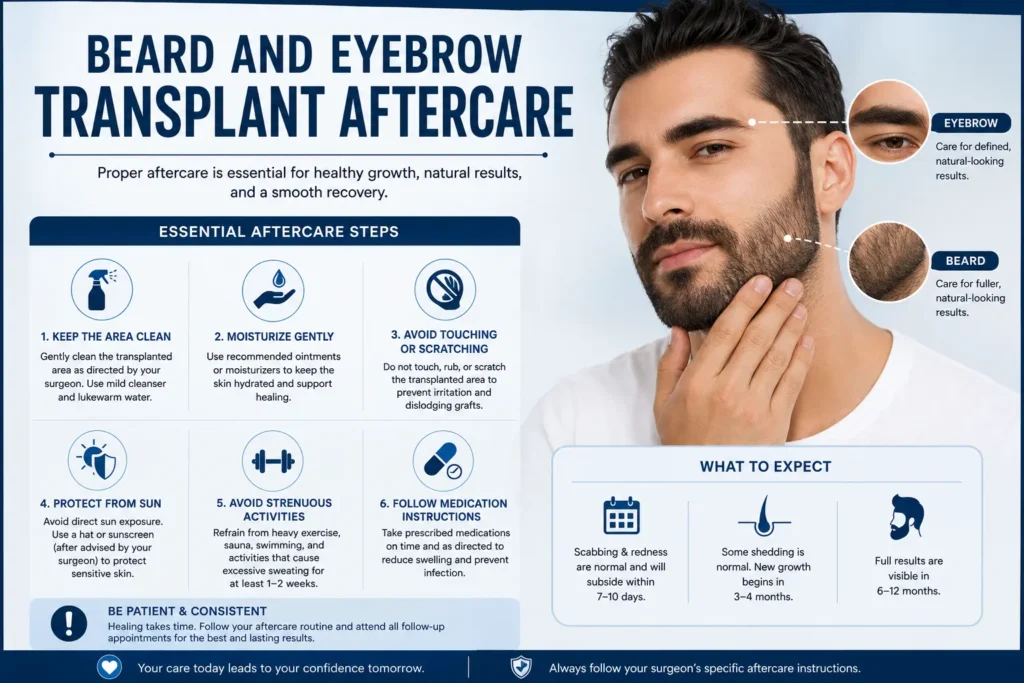
Beard transplant aftercare and eyebrow transplant aftercare call for the same foundational approach as scalp recovery, but both areas bring their own complications simply by virtue of where they sit on the face.
With a beard transplant, the face is constantly in motion. Talking, eating, changing expressions; it all creates subtle tension across the skin. For the first ten days, shaving is completely off the agenda, and keeping meals on the simpler side reduces unnecessary stretching around the mouth and jaw. It sounds like a small thing. It genuinely is not.
Eyebrow transplants require a particular kind of vigilance because the habits that could cause damage, such as rubbing your eyes, resting your forehead on your hand, pressing your face into a pillow, are deeply ingrained and easy to do without thinking. Sleep position is something worth adjusting consciously for the first week or two.
Sexual Activity After a Hair Transplant
Hair transplant aftercare sexual activity is one of those topics that does not always make it into the pre-discharge conversation, which leaves patients guessing. It should not be awkward. It is a practical question with a practical answer.
The concern is physiological, not moral. Elevated heart rate and increased blood pressure, both of which accompany physical exertion, create conditions that can stress healing graft sites in the days immediately following a procedure. Minor bleeding, increased swelling, and disruption to fragile new tissue are all possible if things are pushed too soon.
Most clinics advise waiting at least ten to fourteen days before resuming strenuous activity of any kind, sexual activity included. After that point, assuming healing is on track, a gradual return is generally fine. If you are unsure where you stand at the two-week mark, a quick message to your clinic takes sixty seconds and saves you the worry of having guessed wrong.
Common Mistakes to Avoid
- Scratching when the scabs start to itch. The itch is confirmation that healing is underway. Giving in to it risks lifting grafts that are not yet secure.
- Going back to the gym in the first week. Even moderate cardiovascular effort raises blood pressure enough to cause bleeding at graft sites. Two to three weeks away from training is the minimum that most clinicians stand behind.
- Sleeping flat without elevation during the first week. Fluid accumulates around the graft sites when the head is level with the body and the swelling that results is notably worse.
- Stopping the aftercare routine when shedding begins. Shock loss looks alarming. It is also normal. Abandoning your recovery routine at that point does not help; it makes things harder.
- Skipping sun protection outdoors. UV exposure on healing skin can cause irritation and affect pigmentation around individual graft sites in ways that are difficult to reverse.
Aftercare Kit: What Should Be in It?
Having the right things within reach during the first few weeks removes a surprising amount of stress from the process. A solid hair transplant aftercare kit typically covers the following:
- The prescribed saline spray or cleansing solution from your clinic
- A sulphate-free, fragrance-free hair transplant aftercare shampoo approved for post-procedure use
- Antibiotics and anti-inflammatory tablets as prescribed
- A soft pillow cover and travel neck pillow to make elevated sleeping workable
- A loose-fitting cap for outdoor use, once the first few days have passed
- Any additional topical hair transplant aftercare products your clinician has specifically recommended
Start Your Hair Restoration Journey with Expert Care!
Every successful transplant depends on more than the procedure itself. The right guidance, personalised aftercare plan, and ongoing support can significantly improve your healing experience and final results. At The Skin and Hair Clinic, our specialists provide comprehensive support before, during, and after your treatment to help you achieve natural-looking, long-lasting hair growth.
FAQs About Hair Transplant Aftercare
What does hair transplant aftercare involve in the first week?
The first week is focused almost entirely on protecting the grafts from anything that could move or infect them. Keep the recipient area dry for the first 48 to 72 hours, sleep with your head raised, apply prescribed sprays or solutions as directed, and keep your hands away from the scalp. This early stretch is the most consequential part of the entire hair transplant aftercare timeline.
What is the best hair transplant aftercare shampoo available in the UK?
The most suitable options are sulphate-free, fragrance-free, and pH-balanced for sensitive, post-procedure skin. Your clinic should supply one directly or point you to a specific product. A number of reputable hair transplant aftercare products UK ranges have been developed for exactly this purpose. If you are not sure what to use, ask before you try to find an equivalent on your own.
Is FUE aftercare different from FUT aftercare?
There are real differences. FUE hair transplant aftercare involves managing multiple small donor extraction points with no linear wound. FUT hair transplant after care adds the responsibility of looking after a sutured incision at the back of the scalp until the stitches are removed at around ten to fourteen days. The recipient area is managed similarly in both cases, but the donor zone needs technique-specific attention.
When can I exercise after a hair transplant?
Light walking is generally fine after the first week. Anything more demanding; gym sessions, running, sport, or any activity that pushes your heart rate up significantly, is best avoided for at least two to three weeks. Your clinician will give you a clearer timeline based on how your specific recovery is progressing rather than a one-size-fits-all date.
How long does the full hair transplant aftercare timeline take?
The active recovery phase, where careful washing, product restrictions, and limited activity are part of daily life, typically runs for four to six weeks. The broader hair transplant aftercare timeline for visible results is a longer commitment; most patients see their final density settle somewhere between nine and twelve months, and that is the point at which a genuine assessment of the outcome becomes meaningful.