Losing your hair is rarely just a physical thing. For most people, it quietly affects confidence, changes how they start their morning, and shifts how they feel walking into a room. Whether the hair loss started suddenly with bald patches or happened slowly over time, you probably want clear answers instead of a long list of possible causes.
This guide walks you through everything we cover at our Liverpool clinic when it comes to alopecia treatment. The goal is to help you understand your options clearly so you can make a decision that feels right for you. So read until the end!
What Is Alopecia?
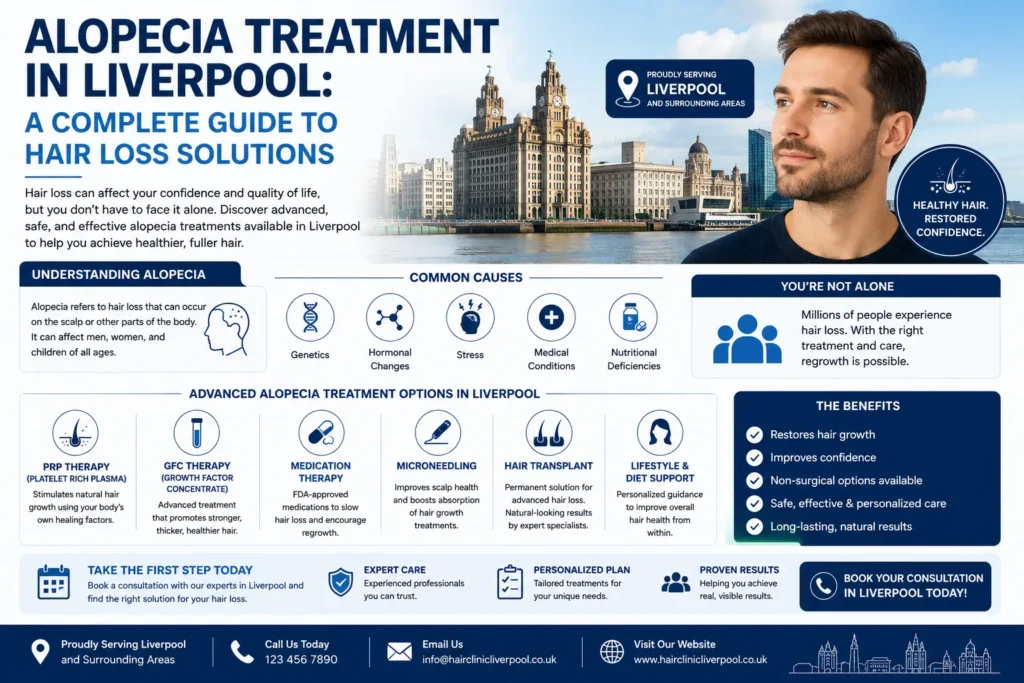
Alopecia is the medical term for hair loss and affects millions of people across the UK. It can appear as small bald patches, gradual thinning, or more extensive hair loss, depending on the underlying cause. It can show up at any age and affect men, women, and children alike.
What varies significantly is the cause. Some forms involve the immune system turning on healthy follicles. Others develop from repeated physical strain on the hair, hormonal changes, nutritional gaps, or simply genetics. That distinction matters enormously, because the right treatment for alopecia depends entirely on what is actually causing the loss in the first place.
Getting a proper diagnosis before anything else is not just a formality; it genuinely shapes everything that follows.
Types of Alopecia We Treat
Our Liverpool clinic sees a wide range of hair loss presentations. The most frequently encountered types include the following.
Alopecia Areata: This is an autoimmune disorder in which the immune system mistakenly attacks normal hair follicles. This causes the hair to fall out in sudden patches on the scalp or sometimes the eyebrows, beard or body.
Androgenetic Alopecia: This type of hair loss, which is often referred to as male or female pattern baldness, is the most common form of hair loss. It is largely driven by the genes and the body’s response to hormones, which leads to the slow thinning of the hair around the crown or a receding hairline.
Traction Alopecia: This type is caused by repeated tension from tight hairstyles like braids, high ponytails, and extensions. When caught early, it tends to respond well to treatment.
Telogen Effluvium: A form of diffuse shedding that can feel quite alarming, typically triggered by significant stress, illness, surgery, or a hormonal shift such as postpartum changes. It is usually temporary but benefits from support.
Scarring Alopecia: A rarer group of conditions where ongoing inflammation permanently damages follicles, replacing them with scar tissue. Early intervention here is especially important.
What Causes Alopecia
There is no single answer. Alopecia development is caused by many factors. Some of the more common causes include:
- Autoimmune activity, most notably in alopecia areata
- Sensitivity to dihydrotestosterone (DHT) in pattern baldness
- Prolonged physical or emotional stress
- Deficiencies in iron, zinc, vitamin D, or ferritin
- Underactive or overactive thyroid function
- Hormonal fluctuations, including postpartum and perimenopausal changes
- Long-term use of tight hairstyles or chemical processing
Alopecia Treatment Options at Our Liverpool Clinic
One of the most important things to understand about alopecia treatment is that there is no single approach that suits everyone. What works well for one patient may offer little benefit to another, depending on the type of alopecia involved, how long it has been present, and the overall condition of the scalp.
At our Liverpool clinic, treatment plans are built around your specific assessment, not a standard format. Treatment options we include:
Platelet-Rich Plasma (PRP) Therapy
The procedure includes taking blood from your arm, processing it to intensify the growth factors in your platelets that are there naturally, and placing it in the regions of the scalp with the most active hair loss. It acts by reactivating hair follicles that have been asleep, increasing the blood flow to the scalp, and making the hair growth phase last longer.
The method is among the best recognized non-invasive techniques for treating alopecia. It has shown good results in cases of androgenetic alopecia and early-stage alopecia areata.
Exosome Therapy
Exosomes are signalling molecules derived from stem cells that communicate regenerative instructions to surrounding cells. When introduced to the scalp via micro-needling or fine injection, they prompt follicle cells to repair and become active again. This is a newer option gaining real credibility in clinical settings, particularly for patients who have not responded well to more conventional approaches.
Topical and Oral Medications
Depending on what the diagnosis reveals, prescription-strength topical agents such as minoxidil may be recommended. For alopecia areata treatment, corticosteroids, whether applied to the skin, injected directly into affected patches, or taken orally, are often used to reduce the immune response that is attacking the follicles.
Low-Level Laser Therapy (LLLT)
This uses specific wavelengths of light to encourage cellular activity within the scalp. It is completely painless, requires no recovery time, and is commonly used alongside other treatments to support and extend results.
Scalp Micropigmentation (SMP)
For patients with more permanent hair loss, or those wanting to improve the visual appearance of density while undergoing regenerative treatment, SMP creates the impression of a closely shaved head or fuller-looking hair using precise pigment application.
Best Treatment for Alopecia Areata
Because alopecia areata is rooted in immune system dysfunction, treating it requires a slightly different approach compared with other types of hair loss. Simply stimulating the scalp is unlikely to be enough on its own. The immune activity targeting the follicles needs to be addressed at the same time.
In practice, the best treatment for alopecia areata at our clinic typically brings together intralesional corticosteroid injections and regenerative therapies like PRP or exosomes. The injections work to suppress the localised immune attack, while the regenerative element provides the biological signals the follicles need to begin producing hair again.
Systemic medication or onward referral to a dermatologist may be the more appropriate path. The plan we recommend is always based on what we find during your assessment; nothing is predetermined.
Traction Alopecia Treatment
Traction alopecia treatment is most simple when the condition has not yet progressed to follicle scarring. The first and most important step is always removing whatever has been causing the tension, whether that is tight braiding, extensions, or consistently tight styling along the hairline.
Once the source is dealt with, the focus shifts to supporting the follicles in recovering. Depending on how much damage has occurred, this may involve PRP, topical minoxidil, or exosome therapy to reactivate follicles that have been weakened but not permanently lost. Where prolonged tension has caused scarring, a different conversation about surgical options may be warranted.
Timing genuinely matters with this type. A follicle that is dormant but structurally intact has a far better chance of recovering than one that has been neglected for years.
Who Is a Suitable Candidate for Alopecia Treatment?
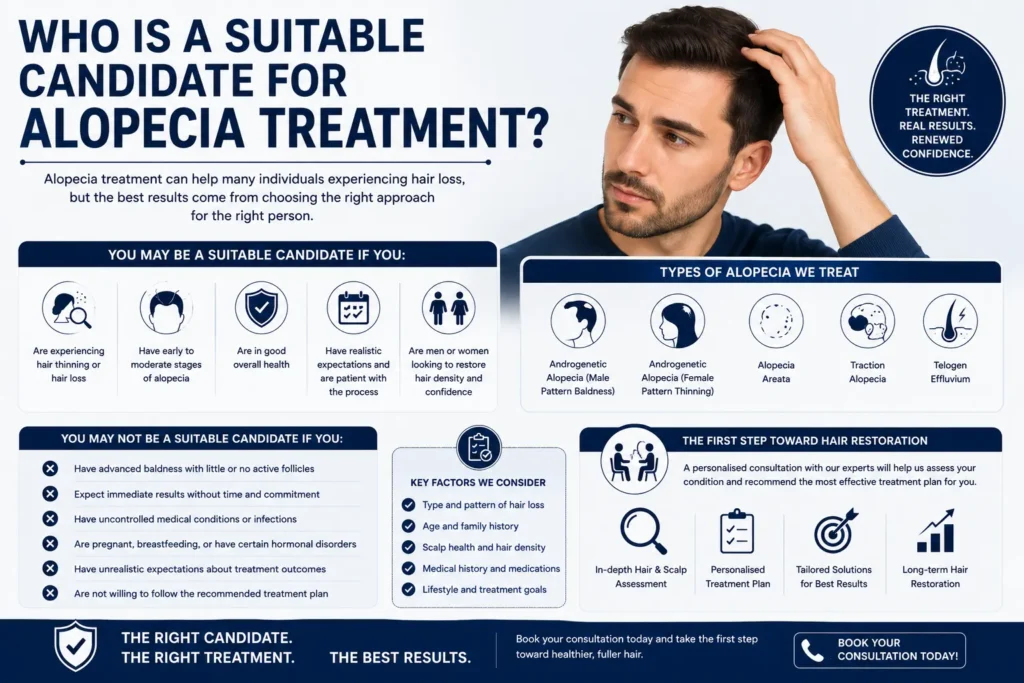
Most people experiencing noticeable hair loss are worth assessing. That said, patients who tend to get the most from non-surgical alopecia treatment at our Liverpool clinic are generally those with:
- Early to moderate thinning or patchy hair loss
- A confirmed or suspected alopecia diagnosis
- Hair loss linked to hormonal changes, stress, or nutritional factors
- Traction alopecia that has not yet led to permanent follicle damage
- A wish to improve regrowth following a previous hair transplant
Patients with advanced scarring, significant underlying health conditions, or those who are pregnant will receive clear, honest guidance during their consultation.
What to Expect at Your First Appointment?
When looking for an alopecia clinic near me, attending that first appointment can feel like a big step. Here is what it looks like in practice at our Liverpool clinic.
Step 1: Consultation and History
Your clinician will ask about your hair loss in depth, like when it started, how it has changed, and any treatments you have already tried. It also involves relevant aspects of your health history, including medications, stress levels, and diet.
Step 2: Scalp Examination
Your scalp will be physically examined, usually using trichoscopy, a specialist imaging method to have a very close look at the health of hair follicles, scalp condition, and any signs of inflammation or scarring at a very early stage.
Step 3: Diagnosis and Treatment Plan
After the assessment is completed, your clinician will provide a clear diagnosis and a treatment plan. This will consist of the proposed approach, a genuine estimate of when results could be seen, and a full breakdown of costs before anything is booked.
Step 4: Beginning Treatment
Some treatments can start on the same day as your first appointment. Others, depending on what is indicated, may be arranged for a follow-up visit.
Alopecia Treatment Cost in Liverpool
Alopecia treatment cost varies depending on a number of factors: the type of alopecia you have, the treatment approach selected, how large the affected area is, and how many sessions are required to achieve the outcomes you are aiming for.
Alopecia areata treatment cost, for example, can differ considerably between a simple course of corticosteroid injections and a more comprehensive programme combining PRP and exosome therapy over several months.
What remains consistent across all our Liverpool consultations is transparency. Alopecia treatment cost is always broken down clearly before you commit to anything. There are no vague estimates and no surprises further down the line.
For those who have been searching for alopecia treatment UK-wide, our Liverpool clinic addresses patients from across the North West and further afield. We offer flexible appointment scheduling to make attendance as simple as possible, regardless of where you are travelling from.
Why Choose The Skin and Hair Clinic for Alopecia Treatment in Liverpool?
There are practical reasons our patients keep coming back, and why many travel specifically to our clinic rather than opting for something closer to home.
- Genuine clinical expertise across the full spectrum of alopecia types
- Treatment plans built around your specific assessment, not a pre-set menu
- Access to advanced regenerative options, including PRP and exosome therapy
- Transparent, itemised pricing is discussed before any treatment starts
- Consistent support throughout your treatment journey, not just at the first visit
- A reputation for delivering the best treatment for alopecia areata and androgenetic alopecia under one roof
Hair loss affects more than appearance; it affects how people feel daily. Our consultations are built around listening properly before recommending anything.
FAQs About Alopecia Treatment
What is the most effective treatment for alopecia areata in the UK?
For mild to moderate cases, intralesional corticosteroid injections combined with PRP therapy are among the most clinically supported options available through alopecia treatment in UK clinics. The best treatment for alopecia areata in more advanced presentations may involve systemic medication or immunotherapy, which we can discuss and refer for where appropriate.
Can traction alopecia be reversed?
In many cases, yes. Traction alopecia treatment works best when the condition is identified early, before any scarring has developed. Removing the cause and supporting the follicles with PRP or topical treatment gives a realistic chance of regrowth for most patients.
How long does alopecia treatment take to show results?
Many patients notice reduced shedding and a healthier-feeling scalp within six to eight weeks. More visible hair regrowth typically develops over a three to six-month period. A planned course of sessions tends to produce more sustained results than a single treatment.
What does alopecia treatment cost in Liverpool?
Alopecia treatment cost is tailored to each patient and depends on the treatment type, number of sessions, and the area being treated. A full, itemised breakdown is provided at your initial consultation before any commitment is made.
Is alopecia treatment suitable for women?
Absolutely. Alopecia hair loss treatment is well-suited to women experiencing pattern thinning, alopecia areata, telogen effluvium, or traction alopecia. Treatment plans are always built around the specific type and pattern of loss rather than a generic approach.