
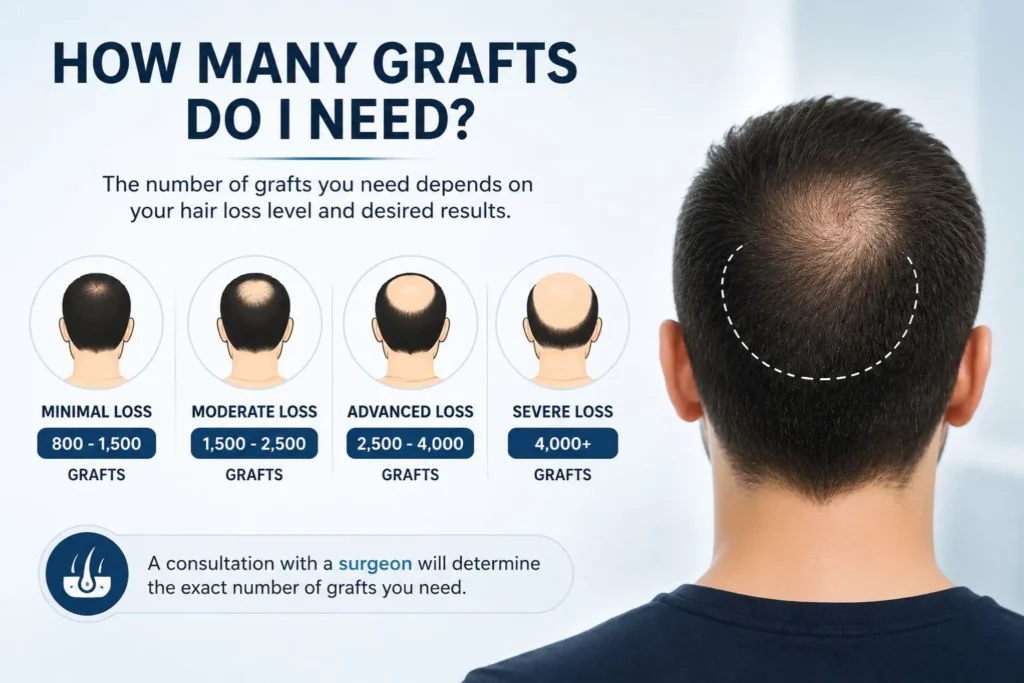
The number of grafts you’ll need is determined by your hair loss pattern, scalp density, and how much coverage you want. Being aware of this ahead of time may help you save quite a bit of time, money, and disappointment.
Did you know? According to the NHS, a hair transplant is suitable for people with permanent baldness, the type that runs in families.
One of the most frequently searched questions before making a booking is: how many grafts do I need for a hair transplant? At The Skin and Hair Clinic, the first and foremost way to find the answer is through a thorough clinical consultation. This guide will give you a clear picture of what to expect.
Table of Contents
Key Takeaways
- Hair graft requirements are dependent upon the level of hair loss, availability of donor hair, and desired coverage goals.
- Each graft generally consists of several hairs, so the actual effect on hair volume is more than what one would expect purely by counting grafts.
- Typically, tackling the hairline problem involves the least amount of grafts, whereas working on a large bald patch or the whole top of the head might need many more.
- Most people only have between 6,000 and 8,000 donor hair grafts that can be harvested over their lifetime.
- Professional scalp evaluation provides more accurate graft estimates than online hair graft calculators.
What is a hair graft, exactly?
Understanding the basics of what hair grafts actually are can be helpful before you start counting them.
In essence, a hair graft is also known as a follicular unit, i.e., a small bunch of hairs that occur naturally. Each unit contains 1 to 4 individual hairs. So when an expert performs a hair transplant of 2,000 grafts, what is actually happening is thousands of individual hairs are being moved — not just 2,000 strands.
This difference is significant. That means, it is false that the number of grafts equals the number of hairs gained. A 2,000-graft hair transplant can produce between 3,000 and 6,000 hairs, based on the follicular unit size.
How graft density affects your results
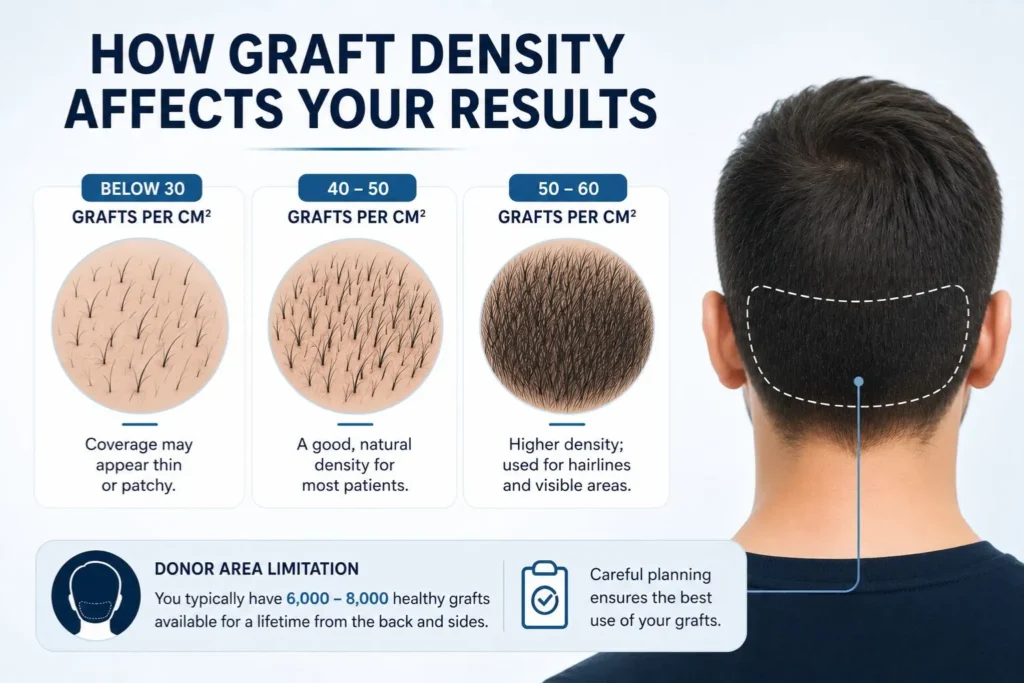
Usually, surgeons target placing 40 to 60 grafts per cm in the recipient area. This is the typical range to achieve a natural-looking and full result:
- Below 30 grafts per cm²: Coverage may appear thin or patchy.
- 40 to 50 grafts per cm²: A good, natural density for most patients.
- 50 to 60 grafts per cm²: Higher density; used for hairlines and visible areas.
There is also a restriction in the number of your do
nor area grafts. Generally, a person has 6,000 to 8,000 healthy grafts available from the back and sides of the scalp. This is your total resource for a lifetime. Because of this, making a plan is very important.
Understanding the Norwood scale and graft requirements
The Norwood Scale classifies male pattern baldness into seven stages. This system is the most popular one for giving an approximate number of transplanted hair follicles a patient will need.
Here is a general overview:
| Norwood Stage | Hair Loss Pattern | Estimated Grafts Needed |
| Stage 1 | Minimal recession | 0 (no treatment needed) |
| Stage 2 | Slight temple recession | 600 to 1,000 |
| Stage 3 | Noticeable recession or early crown | 1,000 to 1,500 |
| Stage 4 | Significant loss at the front and crown | 1,500 to 2,500 |
| Stage 5 | Large bald area joining the front and the crown | 2,500 to 3,500 |
| Stage 6 | Extensive loss across the top | 3,500 to 5,000 |
| Stage 7 | Most severe baldness | 5,000+ |
These are estimates. Actual requirements vary based on scalp laxity, hair caliber, and the area being treated.
Graft count by treatment area: a quick reference table
One of the most useful ways to understand graft requirements is by looking at specific zones. Use this as a hair graft calculator reference guide:
| Treatment Area | Approximate Size (cm²) | Grafts Required |
| Hairline restoration | 20 to 30 cm² | 600 to 1,500 |
| Temples | 10 to 15 cm² | 300 to 600 |
| Mid-scalp | 30 to 40 cm² | 1,200 to 2,000 |
| Crown baldness | 40 to 80 cm² | 1,500 to 3,000 |
| Full top restoration | 100+ cm² | 3,000 to 5,000+ |
Hairline restoration usually calls for a smaller number of grafts compared to crown restoration. A hairline that is receding may require only 600 to 1,500 grafts, but the grafts for crown baldness may be 3,000 or more due to the larger surface area.
What a 2,000 or 3,000-graft hair transplant cover
These are two of the most common procedure sizes. Here is what they generally address:
A 2,000-graft hair transplant: who is it for?
It has been found that a 2,000-graft hair transplant can be suitable for patients at Norwood Stages 3 to 4. Such a procedure often covers:
- A receding hairline with moderate temple loss
- Early crown thinning
- A combination of hairline and mid-scalp work
At roughly 40 to 50 grafts per cm², 2,000 grafts can cover approximately 40 to 50 cm² of scalp, enough for meaningful, visible improvement.
A 3,000-graft hair transplant: greater coverage
A 3,000-graft hair transplant can effectively meet the needs of a person with a Norwood Stage 4 to 5 scalp. It can address:
- More advanced frontal recession
- Moderate to significant crown thinning
- Combined front and crown restoration in a single session
This is one of the most popular hair restoration session sizes in the UK.
How your donor area limits everything
The donor area refers to the parts of your scalp, which are the back and sides, and are usually not affected by hair loss caused by male pattern balding. This is where grafts are harvested
Key facts about donor area grafts:
- On average, patients have a total of 6,000 to 8,000 grafts in total.
- If the donor area density is not high enough, it might limit the amount of treatment.
- FUE hair transplant individually extracts grafts one by one, leaving the donor area looking natural and undetectable after the procedure.
- The FUT (strip method) can provide a large number of grafts for hairline from just one session.
A doctor will thoroughly examine your donor area grafts before suggesting a graft count. Taking too many can leave the donor site looking sparse, which is something that no one desires.
Using a hair graft calculator: helpful but not definitive
Online hair graft calculators can provide you with an idea of how many grafts you may need based on your Norwood stage and the size of the area. They are useful for initial research. But they cannot account for:
- Your hair’s natural thickness and caliber
- Scalp laxity and overall skin condition
- The angle and direction of your existing hair
- Future hair loss progression
Always treat calculator results as a starting point, not a final answer,
Find out your exact graft count now!
The only really accurate method to figure out your graft count is by having a professional face-to-face examination in the clinic. A doctor will look at your scalp, measure your donor area, and come up with a tailored plan. No calculator, no blog, and no online quiz can substitute this step.
Make an appointment at The Skin and Hair Clinic now and get an honest, straightforward evaluation by experts who are registered with the GMC. Take the first step towards a fuller head of hair. You deserve to feel confident again.
Frequently Asked Questions
1. How many hair grafts do I need for a full head of hair?
It roughly takes 5,000 or more grafts to restore a whole head of hair for severe hair loss cases (Norwood Stage 6 to 7). Then again, patients with less advanced stages usually require a lot less, typically between 1,000 and 3,500 grafts.
2. Are 2,000 grafts sufficient for a hair transplant?
When it comes to mild to moderate hair loss (Norwood Stages 3 to 4), a 2,000-graft hair transplantation would generally be enough to recreate the hairline and make the thinning areas denser. Your surgeon will confirm this at the consultation.
3. How many grafts can be transplanted in one session?
Usually, most salons have the option to safely transplant between 2,000 and 4,000 grafts during one session. Some well-advanced FUE can even go as far as 5,000 grafts; Yet, these figures are not fixed and depend on the patient’s donor area and the capacity of the surgical team
4. How many hairs are 3,000 grafts?
A 3,000-graft hair transplant can produce about 5,000 to 9,000 individual hairs because each follicular unit is made up of 1 to 4 hairs. The actual number depends on the natural structure of your follicular units.
5. Can a hair graft calculator tell me exactly how many grafts I need?
A hair graft calculator is capable of giving a rough estimate; it cannot analyze the quality of the donor area, hair thickness, scalp condition, or predict future hair loss. Only a surgeon’s face-to-face examination can provide an accurate number.