
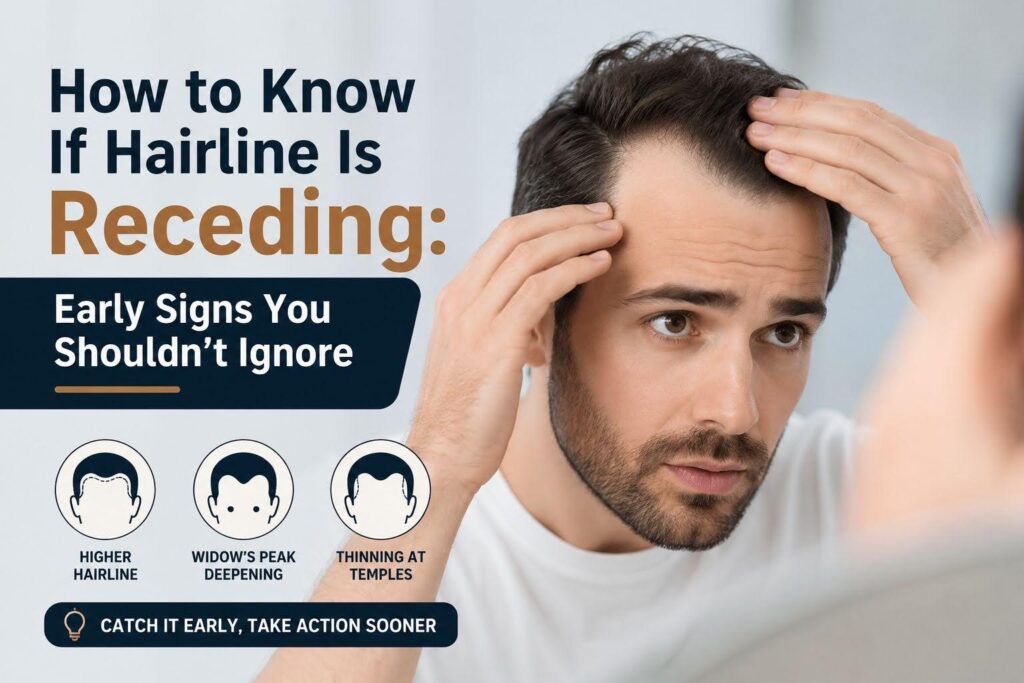
Wondering how to know if your hairline is receding usually starts with a moment in the mirror, a photo that looks different, or a parent who spotted it before you did. The honest answer is that a receding hairline shows up as thinning at the temples, a higher forehead, and an M or V shaped pattern rather than a straight line. Not every change is permanent hair loss, though. Some hairlines simply mature with age and settle a centimetre or two higher without ever going further. This guide covers the early signs worth watching, how to test your own hairline at home, and what’s actually worth doing about it.
Mature hairline or receding hairline? Know the difference first
Most people who search for signs of a receding hairline are actually seeing a mature hairline, a normal shift that happens to almost everyone in their 20s and 30s as a childlike, very low hairline settles into an adult shape. The two can look confusingly similar at first glance.
| Feature | Mature hairline | Receding hairline |
| Shape | Even, symmetrical | Uneven, often M or V shaped |
| Progression | Settles, then stops | Keeps moving back over months/years |
| Temple hair | Stays reasonably dense | Thins and miniaturises |
| Family history | Not necessarily relevant | Often runs in the family |
| Timing | Usually one gradual shift | Continues past the expected settling point |
Bottom line: a hairline that settled once and stopped is likely just mature. One that keeps creeping back, particularly at the temples, deserves closer attention.
The early signs of a receding hairline
Temple thinning before anything else
Hair at the corners above your temples starts looking finer, shorter, or noticeably less dense than the rest of your scalp. This is usually the very first sign, and it’s easy to miss unless you’re looking under strong light.
An M or V shaped pattern forming
The sides recede faster than the centre, leaving a peak of hair in the middle, one of the clearest markers of genuine recession, as opposed to a hairline that’s simply matured evenly.
Your forehead looks larger, and unevenly so
The gap between your eyebrows and your hairline grows over time. It’s subtle month to month, which is why photos beat memory. Recession also doesn’t always move symmetrically, so a shifting parting or one side sitting noticeably higher is a meaningful clue too.
Wispy, miniaturised hairs at the front
Thick, long hairs get replaced by short, soft, almost baby-fine strands. This miniaturisation tends to happen before hair actually falls out, so it’s an early warning rather than a late-stage sign.
More visible scalp under bright light or when wet
Lower density at the front means more skin shows through, especially when hair is wet or lit from above. It’s one of the easiest checks to do in the shower.
How to check your own hairline at home
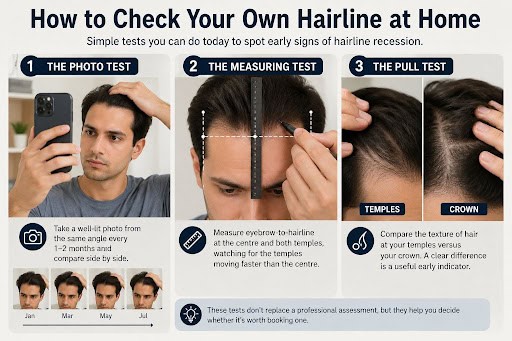
You don’t need a clinic visit for a reasonable first read. A few simple habits, done consistently, tell you far more than a single glance ever will.
- The photo test: take a well-lit photo from the same angle every one to two months and compare side by side.
- The measuring test: measure eyebrow-to-hairline at the centre and both temples, watching for the temples moving faster than the centre.
- The pull test: compare the texture of hair at your temples versus your crown. A clear difference is a useful early indicator.
None of these replace a proper in-person assessment, but they help you decide whether it’s worth booking one.
What actually causes a receding hairline
For most men, the underlying driver is androgenetic alopecia, inherited sensitivity to a hormone called DHT, which shrinks follicles at the front and temples faster than elsewhere. Women can experience a receding pattern too, though it’s less common and worth getting checked rather than assumed, since it sometimes points to a different cause. Stress, smoking, and harsh styling don’t usually start recession on their own, but they can accelerate a pattern already underway.
In practice, what we tend to see at The Skin and Hair Clinic is people waiting far longer than they need to before getting a proper opinion, unsure if what they’re noticing counts as “real” recession. Getting that clarity early, even when the answer is reassuring, saves a lot of unnecessary worry.
Common misconceptions worth clearing up
Myth: “A receding hairline always means you’ll go bald.”
Reality: recession can stop or progress very slowly for years. Genetics, treatment, and how early it’s caught all affect the outcome.
Myth: “Hats or certain shampoos cause it.”
Reality: everyday styling doesn’t trigger androgenetic alopecia. The exception is habits that pull on hair constantly, like very tight ponytails, which cause a separate issue called traction alopecia.
Myth: “Nothing can be done once it starts.”
Reality: options range from topical treatments to in-clinic procedures, and starting earlier generally means more choice, not less.
What tends to help
Once you’ve noticed genuine signs rather than a settling mature hairline, the usual next step is a GP or trichologist consultation to confirm the cause. From there, options range from topical or oral treatments to, for more established recession, procedures like an FUE hair transplant, which redistributes hair from denser areas to thinning ones. The right choice depends on how far things have progressed and what result you actually want. It’s worth deciding with a professional rather than guesswork.This information has been medically reviewed by Dr Jyotsana Kumari to ensure it is clear and clinically informed
The takeaway
A receding hairline announces itself early and quietly, through temple thinning, an emerging M-shape, and finer hair at the front, long before it’s obvious to anyone else. Catching those signs early simply gives you more options. If you’re genuinely unsure which side of the mature-versus-receding line you’re on, book a consultation with The Skin and Hair Clinic for a clear answer instead of guessing in the mirror.
FAQs
Q: How can I tell if my hairline is receding or just maturing?
A: A mature hairline settles once and stays put, while a receding one keeps moving back over months or years, especially at the temples. Comparing photos a few months apart is the most reliable home check.
Q: At what age does a hairline usually start receding?
A: Changes linked to androgenetic alopecia can begin in the late teens to late 20s, though it varies widely and family history is the strongest predictor. Women tend to notice changes later, often around menopause.
Q: Can a receding hairline grow back on its own?
A: Hair lost to androgenetic alopecia doesn’t typically regrow without treatment, since the follicles miniaturise rather than disappear. Temporary thinning, like stress-related shedding, can reverse naturally once the trigger passes.
Q: Is a receding hairline the same as male pattern baldness?
A: A receding hairline is often the first visible stage of male pattern baldness, but the two aren’t identical, since pattern baldness also typically involves crown thinning. Seeing one doesn’t automatically mean the other follows.
Q: Does stress cause a receding hairline?
A: Stress alone doesn’t usually start pattern-related recession, but it can worsen shedding where a genetic pattern already exists. It’s more commonly linked to a separate, often temporary condition called telogen effluvium, which causes diffuse thinning rather than a receding shape.