Reviewed by Dr. Jyotsna Kumari
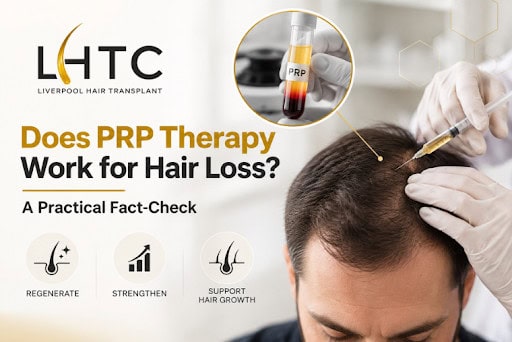
Hair thinning can happen gradually, making it difficult to know which treatment could genuinely help. PRP therapy has become a recognised option for people looking to support hair growth without surgery. If you are asking, does PRP work for hair loss, the answer is that research suggests it may help some people, although results can vary and it is not a guaranteed solution.
Did You Know? PRP involves taking a small blood sample, processing it to concentrate the platelet-rich plasma and then injecting the plasma into areas affected by hair loss. The British Association of Dermatologists states that some research suggests PRP may provide a benefit for certain people, although results can be unpredictable and further research is needed.
The Skin & Hair Clinic offers PRP hair treatment as part of its hair restoration services, alongside surgical options such as FUE and FUT hair transplants.
Key Takeaways
- PRP involves taking concentrated platelets from your own blood and injecting them into thinning areas of the scalp.
- Research suggests PRP may support hair density and growth in some people, but results are not the same for everyone.
- The suitability of PRP treatment can depend upon the cause and stage of hair loss.
- Some sessions may be suggested and it may take time for improvements to be seen.
- A good assessment can help to find out the cause of hair loss and work out which treatment might work.
How Does PRP Therapy Work for Hair Loss?
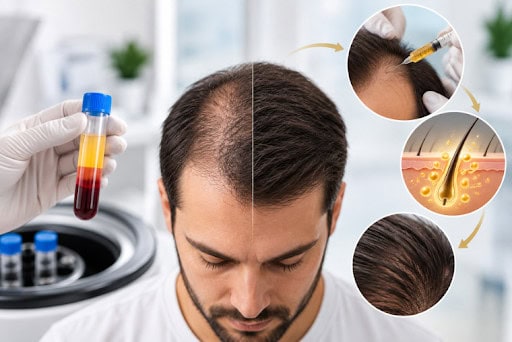
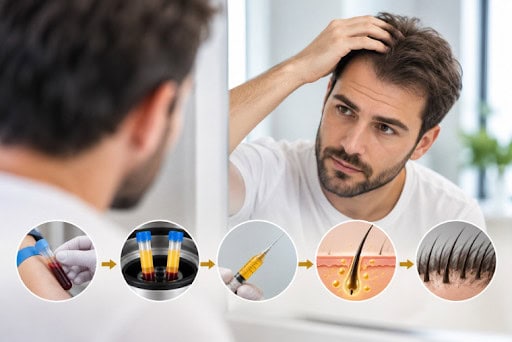
Platelet-rich plasma (PRP) is derived from a small sample of your blood. The sample is processed to isolate the plasma, which is richer in platelets. Then this is injected into specific areas of the scalp.
Platelets have factors that are part of the repair and healing of tissues. PRP is thought to feed the environment of existing hair follicles, which could help some fragile follicles to grow thicker or healthier hair.
The treatment is generally looking to treat existing follicles, not to create new ones where they no longer exist. That’s why the cause and stage of hair loss is important when considering treatment.
Who May Benefit From PRP?
PRP may be considered for people with certain types of thinning, particularly when hair follicles are still present in the affected areas. It may be discussed for male or female pattern hair loss after the cause of thinning has been assessed.
Several factors can influence the expected response:
- The type and stage of hair loss
- The condition of the existing follicles
- The extent of thinning
- General health and individual response
- The treatment schedule recommended by the clinician
A proper assessment is useful before choosing any hair loss treatment. Sudden or unexplained shedding may require investigation rather than immediately moving to PRP.
What Does the Evidence Say About PRP?
Research into PRP for hair loss has produced encouraging findings in some studies, particularly around hair density and thickness. However, the evidence is not completely consistent.
Different studies use different methods for preparing PRP, injection techniques and treatment schedules. These differences make it difficult to give every patient the same expected result.
The British Association of Dermatologists currently describes the research as limited and says that any benefit can be unpredictable. This means PRP should be viewed as a possible treatment option rather than a guaranteed way to regrow lost hair.
How Long Does PRP Take to Show Results?
PRP does not produce instant hair growth. Any improvement develops gradually as the follicles respond to treatment.
A course of treatment may involve several sessions spaced over a period of time. Your clinician can explain the schedule that may be suitable for your situation.
Patience is important because changes in hair density can take months to become noticeable. Regular follow-up can also help assess how your hair is responding.
PRP vs Hair Transplant: What Is the Difference?
PRP supports existing follicles, while a hair transplant physically moves follicles from a donor area to areas affected by permanent hair loss.
Sometimes people use PRP hair transplant as a search term but PRP and hair transplantation are two different treatments. PRP does not replace transplanted hair follicles.
Some people might talk about PRP in combination with surgical restoration, depending on the individual situation. A doctor can tell if one treatment or a combination of options is the right fit.
Is Plasma Hair Restoration Right for You?
The term plasma hair restoration is often used to describe PRP-based treatment for thinning hair. The important point is to understand exactly what treatment is being offered and what results it can realistically provide.
PRP may be worth discussing if you have gradual thinning and existing follicles that could potentially respond to treatment. It may be less suitable when extensive hair loss has left areas with little or no viable hair.
What Should You Ask Before PRP?
Selecting a PRP treatment begins with determining if it is right for your hair loss. A consultation gives you the chance to talk about your hair and scalp, to find out what the treatment involves and to set realistic expectations before you go ahead. Asking the right questions can also help you weigh PRP against other options that may be available.
Before treatment, ask questions such as:
- What is causing my hair loss?
- Am I suitable for PRP?
- How many sessions may I need?
- When could I expect to see changes?
- What results are realistic for my hair?
- Are there other treatments I should consider?
Start Your Journey Towards Fuller, Healthier-Looking Hair
Understanding whether PRP work for hair loss is only the beginning. The next step is finding out whether PRP could be suitable for your type and stage of hair thinning.
At The Skin & Hair Clinic, our experienced medical team can assess your hair and scalp and discuss the treatment options available to you. Whether you are considering PRP, a hair transplant or another form of hair restoration, a consultation can help you understand what may work best for your needs.
Book your consultation today and take the first step towards addressing your hair loss with a treatment plan suited to you.
FAQs
Q: Does PRP regrow hair permanently?
PRP does not guarantee permanent regrowth. Results will vary from person to person and will depend on such factors as the type and stage of hair loss.
Q: How many PRP treatments are needed?
The number of sessions will depend upon your hair loss and how your follicles respond. Your doctor will advise on an appropriate treatment schedule.
Q: Does PRP hurt?
A few people have mild discomfort from the shots. Your clinician can advise you on what to expect and talk about ways to make treatment more comfortable.
Q: Is PRP a substitute for hair transplant?
PRP and hair transplantation are not one and the same. PRP is to support the existing follicles . Transplantation is to move follicles to areas that need more coverage.
Q: Is PRP suitable for women with hair loss?
PRP might be considered for women with certain types of thinning hair. Suitability is determined by the cause and pattern of hair loss.