Reviewed by Dr. Jyotsna Kumari
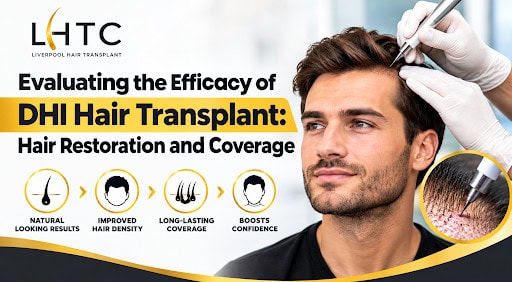
When comparing hair transplant techniques, it is easy to get caught up in names, devices, and marketing claims. For patients considering DHI, the more useful question is what the technique can actually achieve: how effective is DHI hair transplant, how well transplanted follicles survive, how naturally they can be placed, and whether the resulting coverage meets the patient’s expectations.
DHI uses an implanter device to place follicular unit grafts into the recipient area. Research on implanter-based hair transplantation has shown encouraging results. In a PubMed-indexed study involving 11 patients, the mean survival rate of transplanted hairs reached 92% at six months, although the study evaluated the KNU implanter rather than modern DHI as a standardized procedure. The same study reported a 90.4% mean hair survival rate at 12 months.
The Skin & Hair Clinic in Liverpool offers direct hair implantation alongside FUE, FUT and PRP. In this article, we’ll look at what the research actually tells us about DHI hair transplant procedures, including graft survival, hair density, coverage, and the factors that can affect the final result.
Key Takeaways
- DHI uses a hollow-needle implanter pen to place follicles directly into the scalp without pre-made incisions.
- Published research puts graft survival for implanter-based techniques at around 90 to 97% under good conditions.
- Graft density matters as much as survival rate, and packing follicles too tightly can actually reduce how many take hold.
- DHI tends to suit patients wanting a no-shave option or tighter control over hairline design.
- Surgeon skill and clinic conditions affect outcomes at least as much as the technique itself.
What Is a DHI Hair Transplant?
DHI transplant procedures use a specialised tool, often called a Choi implanter pen, to extract and place follicles in a single motion. Instead of a surgeon opening recipient sites first and inserting grafts afterward, the follicle sits loaded in the pen and goes straight into the scalp. That difference sounds small, but it changes two things that matter for the outcome: how long the graft is left outside the body, and how much control the surgeon has over the angle and depth of each placement.
Reducing the time a follicle spends outside the scalp, known as ischemia time, is one of the reasons implanter-based techniques are associated with strong survival figures in published research.
How Effective Is DHI Hair Transplant Compared to Other Techniques?

Survival rate is the number most people fixate on, and the research here is genuinely encouraging. Multiple published studies place DHI graft survival in the 90 to 97% range at twelve months, which sits at the higher end of what’s reported for hair transplant techniques generally. Standard FUE typically comes in a little lower, often cited between 85 and 95%, though the gap between techniques tends to be smaller than the gap between a skilled surgeon and an inexperienced one.
What’s less often mentioned is that survival rate alone doesn’t tell the whole story. A technique that survives well but is used to overpack a small area can still produce a patchy or unnatural-looking result. Effectiveness has to be judged on density and appearance too, not survival percentage in isolation.
Does Graft Density Affect DHI Results?
Yes, and this is one of the more counterintuitive parts of the research. It would be reasonable to assume that packing in as many follicles as possible produces the fullest result, but the data doesn’t support that. Studies tracking survival at different graft densities found that around 30 follicular units per square centimetre gave the best outcome, while pushing density up to 40 or 50 units per square centimetre caused survival rates to drop noticeably.
This matters practically because a DHI transplant marketed on “maximum density” isn’t automatically the better choice. A surgeon planning density around what the scalp can actually support tends to produce a more reliable long-term result than one chasing the highest possible graft count in a single session.
Is DHI the Right Choice for Every Patient?
- Not necessarily. DHI has genuine strengths, but it isn’t automatically the best fit for every case.
- It suits patients who want to avoid shaving the recipient or donor area.
- It gives more precise control over hairline angle and direction, which matters for frontal hairline work.
- It can take longer per session than FUE, since placement is done graft by graft.
- For very large areas needing high graft counts, FUT or FUE may allow a faster overall session.
- The technique still depends heavily on the surgeon’s experience with the implanter pen specifically.
- A consultation is really the only way to know which technique matches a particular pattern of hair loss and coverage goal.
Why Surgical Skill Still Decides the Outcome
The implanter pen is a precise tool, but it doesn’t remove the need for surgical judgement. Deciding on graft density, planning the hairline, and managing how long follicles wait before implantation all come down to the team performing the procedure. At The Skin & Hair Clinic, DHI hair transplant procedures are carried out by GMC-registered surgeons within a CQC-regulated facility, with density and placement planned around each patient’s donor supply rather than a fixed target number.
This is worth raising directly in a consultation, since the research is fairly consistent on one point: the technique sets the ceiling for what’s possible, but the surgeon’s planning decides how close a result gets to that ceiling.

Questions to Ask About DHI Before Choosing It
- What graft density are you planning for my scalp, and why?
- How does that compare with what you’d recommend for FUE in my case?
- How much experience does the surgical team have specifically with implanter-pen technique?
- Will I need to shave the donor or recipient area for this procedure?
- How long will the session take given the graft count I need?
- What survival rate have your DHI patients typically achieved?
Book a Consultation to Discuss DHI Hair Restoration
Understanding how effective a DHI hair transplant really is means looking past the headline survival percentages and considering how density, planning and surgical skill work together. The technique has a strong evidence base behind it, but the result still depends on how it’s applied to an individual scalp.
Ready to find out if DHI is the right fit for your hair loss pattern? Book a consultation with The Skin & Hair Clinic to discuss direct hair implantation and how it compares with your other options. Call the clinic on 0151 280 3248 or visit 203-205 Rose Lane, Liverpool, L18 5EA to get started.
FAQs
Q1: How effective is a DHI hair transplant compared to FUE?
Both techniques report strong graft survival, with DHI often cited slightly higher at 90 to 97% versus 85 to 95% for standard FUE. In practice, surgeon skill tends to matter more than the small gap between the two techniques.
Q2: Does DHI leave less scarring than other methods?
DHI generally produces very fine, scattered marks similar to FUE, since it doesn’t require a linear strip incision. Scarring is minimal with either technique when performed well.
Q3: Can DHI be done without shaving my head?
Yes, this is one of DHI’s main advantages. The implanter pen allows follicles to be placed between existing hairs, which is why it’s often chosen by patients who want a no-shave procedure.
Q4: Is more graft density always better with DHI?
No. Research shows survival rates actually fall once density is pushed too high, so a surgeon working within safe density limits tends to get better long-term results than one aiming for the maximum possible graft count.
Q5: How long does it take to see full results from a DHI hair transplant?
Most patients see meaningful growth from around four to six months, with fuller results continuing to develop up to twelve months after the procedure.