
Reviewed by Dr. Jyotsna Kumari

Two patients want the same thing: a hairline that looks like it was never touched. One researches FUE. The other finds DHI and reads about better angles and a more natural result. Those claims need context before they mean much. A 2024 retrospective study in BMC Surgery followed 158 men treated with FUE and found that over 90% of hair follicles survived, with more than 85% of patients reaching a follicle survival rate above 95% at 12 months. That sets the benchmark any technique has to match.
The study looked at FUE, not DHI, so it does not show that DHI is better. It does show how high survival can go with careful handling. DHI hair restoration is built around the same priority, and a published study on implanter placement concluded that minimal graft handling reduces the time grafts spend out of the body. Whether that translates into greater hairline precision is what this blog looks at.
Hair Transplant Survival: The Numbers at a Glance
| Measure | Result |
| Study | Retrospective study, BMC Surgery, November 2024 |
| Technique studied | FUE (follicular unit extraction) |
| Setting | Medical Cosmetology Department, First Affiliated Hospital of Xi’an Medical University |
| Patients | 158 men with androgenetic alopecia |
| Treatment period | January 2016 to December 2020 |
| Follicle survival | Over 90% |
| Patients with survival above 95% at 12 months | More than 85% |
What Makes DHI Different From Standard FUE?
DHI is a variation of FUE, so the two share the same starting point: individual follicular units are taken from the donor area with a small punch. The difference sits at the implantation stage. In conventional FUE, grafts are typically placed with forceps. DHI uses an implanter pen, such as the Choi pen, to place each graft instead.
The result is a different way of handling the graft between harvest and placement, and a different way of controlling where each follicle ends up.
Why the Implanter Pen Matters for Precision
Supporters of the pen argue that it gives the surgeon more control over the angle and depth of each graft. At the frontal hairline, where a slight mismatch in direction shows up close, that control is the case for DHI.
The research behind it is still limited. A study of implanters in 104 FUE patients reported good results in all but two patients over 8 to 18 months. Its authors also noted that no objective assessment of regrowth was carried out. That makes the precision claim a reasonable argument, not a proven advantage.
Does DHI Actually Improve Hairline Results?
The frontal hairline is where precision matters most. A natural hairline starts with single-hair follicular units at the very front, followed by two-, three-, and sometimes four-hair units behind them. That pattern is what gives the edge its soft, irregular look.
Getting it right depends on placing each unit exactly where the design calls for it. DHI supporters point to the implant as a way to place single-hair and grouped units with fine control. Whether a surgeon achieves that comes down to planning and skill, and the technique name does not guarantee it.
How Does Reduced Graft Handling Time Affect Results?
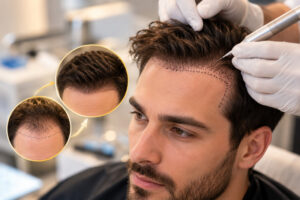
Graft survival depends on several factors, including hydration, cold temperature, infection prevention, and mechanical trauma. The time between harvesting and implantation also matters. A study of direct hair transplantation, in which grafts were implanted as soon as they were harvested, reported time out of the body of between 1 and 5 minutes. It also noted that shortening that transit time improves graft survival.
The study of implanter placement reached a similar view, concluding that minimal graft handling and less time out of the body should help results. An early study of a Korean implanter reported survival by total hairs of 92.0% at 6 months and 90.4% at 12 months.
It is worth keeping this in proportion. The 2024 study shows that FUE with careful handling already reaches over 90% follicle survival. None of the studies cited here compare DHI directly against FUE. DHI’s clearest argument is control over where and at what angle each graft goes, which matters most in small, detail-sensitive areas like the hairline.
Who Is a Good Candidate for DHI Hair Restoration?
DHI is not automatically the better pick for every patient. A few things shape whether it suits a case:
- Donor hair quality, since robust terminal hairs survive better than weaker, finer ones
- Size of the treatment area, and whether the goal is a detailed hairline or broader coverage
- Whether you are comfortable with shaving, which is worth asking about at consultation
- How much you value fine placement against the number of grafts in a single session
- Realistic expectations about session length, which your surgeon can estimate for your case
Why DHI Isn’t Automatically the Right Fit for Everyone
The right technique comes down to what is being treated, how much donor hair is available, and what the patient wants. A good surgeon explains why a method fits your case. The name of the technique should not be the reason.

What Should You Ask Before Choosing DHI?
A few questions separate a strong DHI transplant provider from one leaning on marketing language:
- How much hands-on DHI experience does the surgeon have, separate from general FUE experience?
- What is the typical out-of-body time for grafts during their procedures?
- Can they show before-and-after hairline results specifically, not just density results?
- What graft count is realistic for your donor area in a single session?
- How do they handle single-hair placement at the hairline versus denser placement further back?
Why the Answers Matter More Than the Technique Name
FUE is described in the clinical literature as a laborious, time-consuming procedure with a long learning curve for the surgeon. The authors of the implanter study also said the result ultimately depends on how gently grafts are handled. A rushed or inexperienced DHI session will not beat a well-executed FUE session because of the name attached to it. Provider skill is the biggest variable either way.
Find Out If DHI Is the Right Fit for Your Hairline
DHI hair restoration is built on careful graft handling and controlled placement, both of which the research links to graft survival. Whether it is the right choice for you depends on donor density, how much area needs treating, and what you are trying to achieve.
The Skin & Hair Clinic in Liverpool offers a free consultation with a GMC-registered specialist team to assess whether DHI or standard FUE fits your hairline goals better. Book your free consultation to get a clear, personalised recommendation.
FAQs
Q1: Is DHI more expensive than standard FUE?
Pricing depends on the clinic, the graft count, and the technique used. A consultation gives you a quote based on your own case rather than a generic estimate.
Q2: Does DHI hurt more than FUE?
FUE procedures, including those that use an implanter, are carried out under local anaesthetic. Your surgeon can explain what to expect during and after your own procedure.
Q3: Can DHI be used to fill in a large bald area, or just the hairline?
The answer depends on the size of the area, your donor supply, and your goals. A specialist can assess these at consultation and recommend the method that fits.
Q4: How long does a DHI procedure typically take compared to FUE?
Session length depends on graft count and the surgeon’s technique. FUE in general is described as time-consuming. Ask for an estimate based on your own graft count.
Q5: Is the best DHI hair transplant always better than FUE for everyone?
No. The 2024 study found over 90% follicle survival with FUE. Survival depends heavily on graft handling and surgeon skill, not on the technique name.The right option depends on your case.