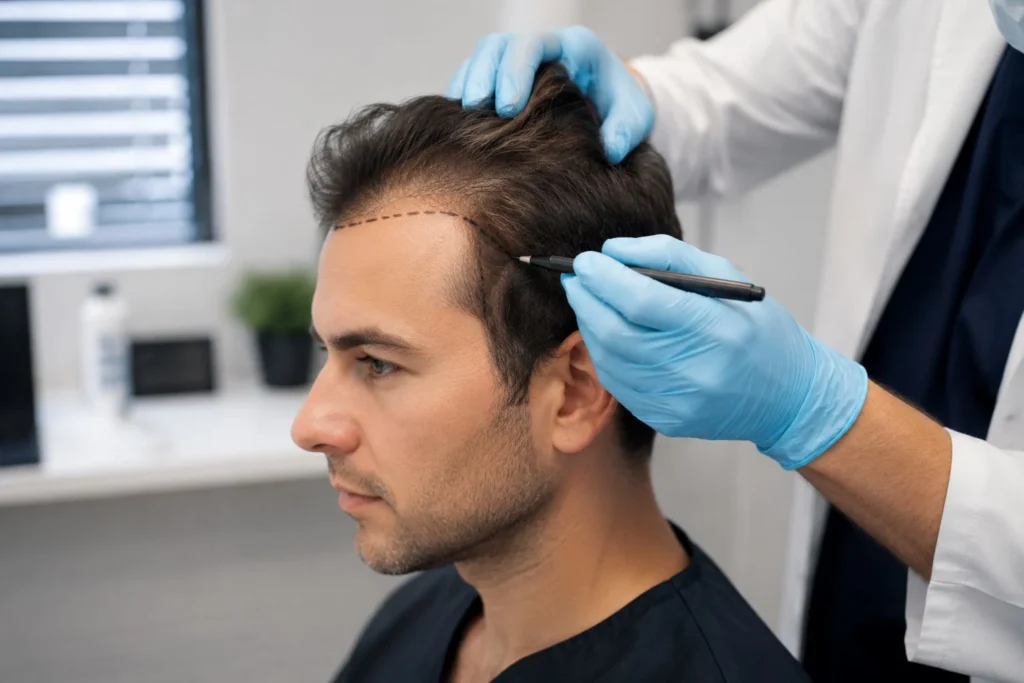
Yes, you can get a hair transplant without shaving your head, thanks to a technique called unshaven FUE (sometimes called U-FUE or no-shave FUE). Instead of clearing your scalp, the surgeon works around your existing hair, trimming only small hidden sections at the donor site rather than the whole head. It’s become one of the most requested options at UK clinics, largely because it lets patients recover without anyone at work or the gym clocking that they’ve had anything done. It isn’t right for everyone, though, and there are real trade-offs worth understanding before you book a consultation.
Table of Contents
How an unshaven hair transplant actually works
A standard FUE (Follicular Unit Extraction) transplant usually involves shaving the donor area, typically the back and sides of the head, down to a few millimetres so the surgeon can see each follicle clearly under magnification. With the unshaven version, that step is either skipped entirely or reduced to thin, concealed strips.
Donor area: Rather than shaving the whole back and sides, the surgeon works through narrow channels cut into the existing hair, extracting follicles one at a time while the hair around them stays long enough to comb over the site. In some clinics this is done using a partial shave or “fade” technique, where only the hair closest to the scalp is trimmed and the rest is left to fall naturally over it.
Recipient area: The top of the head, where the new grafts go, generally doesn’t need shaving at all. The surgeon implants follicles directly between the hairs that are already there. This is one reason the technique appeals to people topping up density or filling a receding hairline rather than treating widespread baldness.
The trade-off is time. Working around existing hair is slower and more technically demanding than clearing the area first, so sessions typically take longer and cost more for the same number of grafts.
Who unshaven FUE actually suits
This method isn’t a universal upgrade on the standard procedure. It’s a specific tool for a specific problem. It tends to work best for:
- People with mild to moderate hair loss, such as a receding hairline or thinning crown
- Anyone who can’t take visible time off, whether that’s a client-facing role, a public-facing job, or simply not wanting colleagues to know
- Patients who’ve already had one transplant and want a top-up without shaving hair that’s since grown back in
It’s a poorer fit for advanced baldness (Norwood 5 and above), where the graft count needed often exceeds what unshaven techniques can comfortably deliver in one sitting. Most UK clinics cap no shave hair transplant sessions at somewhere under 2,000 to 2,500 grafts, though this varies by surgeon and by how much donor hair you have to work with.
Unshaven FUE vs standard FUE vs DHI
| Unshaven FUE | Standard (shaved) FUE | DHI | |
| Shaving required | Minimal or none | Full donor area, sometimes recipient too | Minimal, similar to unshaven FUE |
| Recovery visibility | Very discreet | Obvious for 1 to 2 weeks | Very discreet |
| Typical graft ceiling | Under roughly 2,000 to 2,500 | 3,000 to 4,500+ in a session | Similar to unshaven FUE |
| Procedure time | Longer | Shorter | Longest of the three |
| Cost | Higher per graft | Lower per graft | Highest per graft |
| Best suited to | Mild to moderate loss, discretion priority | Extensive loss, larger sessions | Precision hairline design, discretion priority |
if discretion matters more than graft volume, unshaven FUE or DHI make sense. If you’re dealing with extensive hair loss and want the most grafts placed as efficiently as possible, standard FUE is usually the more practical, and cheaper, route.
Common misconceptions about unshaven transplants
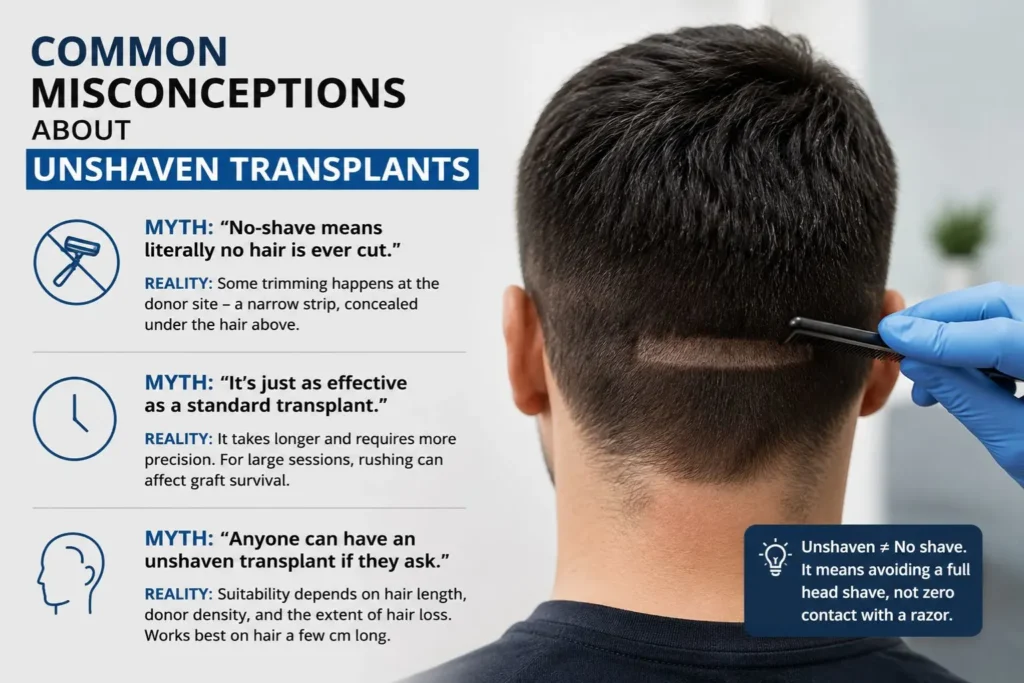
Myth: “No-shave means literally no hair is ever cut.”
Reality: some trimming almost always happens at the donor site, even if it’s just a narrow strip a few millimetres wide, concealed under the hair above it. “Unshaven” refers to avoiding a full head shave, not zero contact with a razor.
Myth: “It’s just as effective as a standard transplant, only more convenient.”
Reality: because the surgeon is working around existing hair, extraction and implantation both take longer and require more precision. For very large sessions, this can mean lower graft survival if the clinic rushes to compensate for time, which is why choosing an experienced surgeon matters more here than with standard FUE.
Myth: “Anyone can have an unshaven transplant if they ask for it.”
Reality: suitability depends on hair length, donor density, and how much loss needs covering. A short buzz cut, for instance, doesn’t leave enough length to conceal donor sites, so the technique works best on hair that’s already a few centimetres long.
What recovery looks like
Because the donor area isn’t fully shaved, redness and scabbing are far less visible in the days after surgery. Most patients say they could return to normal social situations within a few days rather than the one to two weeks often recommended after a full shave. The transplanted area on top still needs the usual care: avoiding direct sun, sweat, and pressure on the scalp for the first fortnight, and steering clear of tight hats or helmets until a surgeon confirms it’s safe.
In practice, what clinics typically find is that patients choose unshaven FUE specifically to avoid the “obvious transplant” look during the two to three weeks when scabbing is most visible, not because it changes the underlying healing timeline. The follicles themselves heal at broadly the same rate regardless of how much hair was shaved to reach them.
What it costs in the UK
Because unshaven FUE takes longer per graft and demands more surgical skill, UK clinics typically charge more per graft than for standard shaved FUE. The exact premium varies by clinic, surgeon experience, and graft count, so it’s worth getting a specific quote rather than assuming a fixed figure. At The Skin and Hair Clinic, pricing is discussed openly during consultation once a surgeon has assessed your donor area and mapped out a realistic graft count.
Questions to ask before you book
A good consultation should cover more than price, especially if you’re weighing up a hair transplant without shaving head as your preferred route. Worth asking your surgeon:
- How many unshaven or minimal-shave procedures have you personally performed?
- What’s the maximum graft count you’d recommend doing in one unshaven session for my case?
- Will any part of the donor or recipient area need shaving, even lightly?
- What does my specific hair length and density mean for how concealed the donor sites will be?
Getting straight answers to these tells you more about whether a clinic is right for you than any before-and-after gallery.
The takeaway
An unshaven hair transplant lets you address mild to moderate hair loss without anyone clocking that you’ve had it done, but it comes with a lower graft ceiling, a longer procedure, and a higher price tag than standard FUE. If discretion during recovery matters more to you than treating extensive baldness in one sitting, it’s worth raising with a surgeon at consultation. The team at The Skin and Hair Clinic can assess your hair length, donor density, and goals to tell you honestly whether unshaven FUE is the right fit, or whether a different approach would serve you better.
Frequently Asked Questions
Q: Can you get a hair transplant without shaving any hair at all?
A: In most cases, a small amount of trimming happens at the donor site even with unshaven techniques, though it’s kept short enough to stay hidden under surrounding hair. Very few clinics can genuinely avoid touching a razor entirely, and those that claim otherwise are worth questioning closely.
Q: How many grafts can you get with an unshaven hair transplant?
A: Most UK clinics recommend staying under roughly 2,000 to 2,500 grafts for unshaven procedures, though this depends on your donor density and the surgeon’s experience. Larger graft counts are usually better suited to standard shaved FUE, where the surgeon has full visibility of the donor area.
Q: Is a no-shave hair transplant more expensive than a normal one?
A: Yes, unshaven FUE typically costs more per graft than standard shaved FUE because it takes longer and requires greater surgical precision. The exact difference varies between clinics, so it’s best confirmed at consultation.
Q: Does hair grow back faster after an unshaven transplant?
A: No, the biological healing timeline for the transplanted follicles is roughly the same regardless of shaving method. What differs is how visible the recovery is to other people, not how quickly the grafts themselves take.
Q: Is unshaven FUE suitable for advanced baldness?
A: It’s generally not the best option for advanced hair loss, since the technique works best for smaller graft counts addressing mild to moderate thinning. Someone with extensive baldness usually needs more grafts than unshaven techniques can comfortably deliver in one session.
Q: What’s the difference between unshaven FUE and DHI?
A: Both avoid a full head shave, but DHI uses a specialised implanter pen to place grafts one at a time without pre-making incisions, which can allow for more precise hairline design. Unshaven FUE follows the more traditional extract-then-implant process, just without shaving the whole scalp first.
Q: Will people be able to tell I’ve had a hair transplant if I choose unshaven FUE?
A: Most patients find the signs are minimal to unnoticeable within the first week, since there’s no shaved patch to draw attention. Some redness or tiny scabs may be visible up close for a few days, but they’re easy to conceal with your existing hairstyle.