
Reviewed by Dr. Jyotsna Kumari
When hair first starts thinning, most people are not thinking about surgery. They are usually looking for ways to slow hair loss, maintain existing growth, and possibly improve hair density before the problem becomes more noticeable. This is where platelet rich plasma hair treatment has attracted attention as a non-surgical option.
Research suggests that PRP may help improve hair density in people with androgenetic alopecia. A 2024 systematic review and meta-analysis of 13 randomized clinical trials involving 431 patients found an average increase of 27.55 hairs per cm² compared with control groups. However, the researchers rated the evidence as low quality and noted substantial differences between the studies, including treatment methods and outcomes.
The Skin & Hair Clinic in Liverpool offers platelet rich plasma hair treatment as one of its non-surgical options, alongside FUE, FUT and DHI. But whether PRP can actually prevent early-stage baldness is a more specific question. The treatment may support hair density and reduce the appearance of thinning, but current research does not establish that it can permanently stop the progression of androgenetic alopecia.
This article explains how PRP works, what the research shows about hair growth and density, how early treatment may fit into a hair-loss plan, and what patients should realistically expect from the procedure.
Key Takeaways
- A platelet rich plasma hair treatment uses a concentrated portion of the patient’s own blood to stimulate follicles that are weakening but still alive.
- Clinical trials show PRP can raise hair density, and the effect tends to be strongest when treatment starts early.
- PRP works on follicles that are shrinking, not on ones that have already stopped producing hair altogether.
- It isn’t a one-off fix. Most patients need a course of sessions, then maintenance treatments to hold onto the result.
- Whether PRP is the right call comes down to a proper scalp assessment, not guesswork.
What Is a Platelet Rich Plasma Hair Treatment?
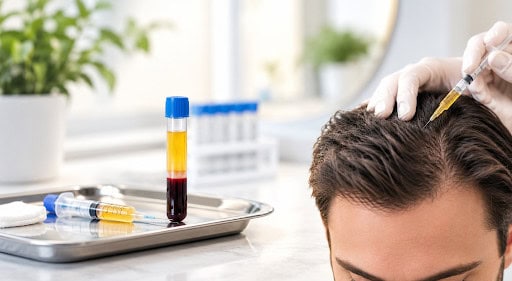
A small blood sample is taken from the arm and spun in a centrifuge, separating out the platelet-rich layer. That concentrated plasma, loaded with growth factors, is then injected into the areas of the scalp showing thinning. The goal isn’t to add anything new to the scalp. It’s to wake up follicles that are still functioning but producing progressively finer, weaker strands with each growth cycle.
That’s really the whole logic behind calling it plasma hair restoration rather than a treatment for full baldness. It only has something to work with where follicles are still active, which puts it in a completely different category from a bald patch with no follicle activity left at all.
What Does PRP Actually Do for Early-Stage Hair Loss?
Follicles don’t vanish the moment pattern hair loss begins. They shrink gradually, cycle through growth and shedding faster than they should, and produce thinner hair with each pass, which is why thinning looks progressive rather than sudden. PRP’s growth factors are thought to support these weakening follicles and keep them in their growth phase for longer instead of pushing them toward shedding early.
Age plays into this too. A frequently cited 2016 study found that patients under 40 tend to respond better to PRP than older patients, which fits with the idea that the treatment needs active follicle function to work with in the first place.
What Does the Research Say About PRP and Hair Density?
The research isn’t perfectly consistent, and it’s worth saying that plainly rather than glossing over it. A randomized, placebo-controlled trial published in the Journal of the American Academy of Dermatology found PRP-treated areas gained around 20 hairs per square centimetre, but the placebo-treated areas in the same study also improved somewhat, which shows the results aren’t entirely clear-cut.
Still, the broader evidence leans in PRP’s favour. Several systematic reviews, including the meta-analysis mentioned earlier, have found statistically significant density gains at both three and six months compared with placebo. Taken together, the research supports PRP as a genuinely effective option for building density, even though the size of that effect varies from one trial to another.
Is PRP a Cure or a Preventative Measure?
Neither, honestly, and that’s an important distinction to make before anyone starts treatment. PRP doesn’t touch the genetic or hormonal process driving pattern baldness, and it can’t restart follicles that have already shut down. What it can do is support follicles that are still working, which is why it’s better described as a way to slow early thinning than a permanent solution on its own.
At this clinic, and most others, PRP hair treatment is positioned as part of an ongoing plan rather than a single appointment. Getting a result usually means a course of sessions to begin with, followed by maintenance visits spaced out over the following months.
Who Is a Good Candidate for PRP?
PRP suits some situations far better than others.
- Early to moderate thinning, where the follicles involved are still active
- Patients who want to try a non-surgical route before considering a transplant
- Those looking to support healing or density alongside an existing FUE or FUT procedure
- Patients confirmed to have genuine androgenetic alopecia rather than another cause of hair loss
- Anyone without a blood or clotting condition that would rule the treatment out
It’s a poor match for a scalp that’s already completely bald. There’s nothing left there for the treatment to work on.
Why a Proper Consultation Matters Before Starting PRP
Not every case of thinning responds the same way to PRP, which is exactly why a scalp assessment has to come before treatment, not after. At The Skin & Hair Clinic, platelet rich plasma hair restoration is offered by a GMC-registered medical team who look at the pattern and stage of hair loss first, rather than treating PRP as something that works the same for everyone.
That step matters because PRP given to the wrong patient, someone whose follicles have already gone dormant, for example, is unlikely to do much at all. That mismatch is often the real reason people come away disappointed with the treatment.
Questions to Ask Before Starting PRP
- Is my hair loss at a stage where PRP is likely to help?
- Realistically, how many sessions will I need before I see a change?
- How long do results typically last between maintenance sessions?
- Would PRP work better paired with another treatment in my case?
- What results have similar patients at this clinic actually seen?
- What happens if PRP doesn’t produce a noticeable change for me?
Book a Consultation to Discuss PRP for Early Hair Loss
Knowing what a platelet rich plasma hair treatment can and can’t do makes it far easier to judge whether it’s worth starting. How well it works comes down to timing, consistency with sessions, and whether the follicles being treated still have some activity left to build on.
Ready to find out if PRP fits your stage of hair loss? Book a consultation with The Skin & Hair Clinic to talk through plasma hair restoration and whether it belongs in your treatment plan. Call the clinic on 0151 280 3248 or visit 203-205 Rose Lane, Liverpool, L18 5EA to get started.
FAQs
Q1: Can a platelet rich plasma hair treatment stop baldness completely?
No. It can support follicles that are still active and slow down visible thinning, but it doesn’t reverse the underlying cause of pattern baldness or bring back follicles that have already stopped working.
Q2: How many PRP sessions are usually needed?
Most plans start with a short course of sessions a few weeks apart, then move to periodic maintenance visits to keep the results in place.
Q3: Does PRP work better at certain stages of hair loss?
Yes. It tends to work best on follicles that are still active but weakening, which is why it’s generally recommended early rather than for advanced or fully bald areas.
Q4: Is PRP painful?
Most patients describe mild discomfort during the injections rather than real pain, and numbing cream is often used beforehand to keep the session comfortable.
Q5: Can PRP be combined with a hair transplant?
Yes. It’s often used alongside FUE or FUT, either to support healing afterwards or to help maintain density in areas the surgery didn’t cover.