
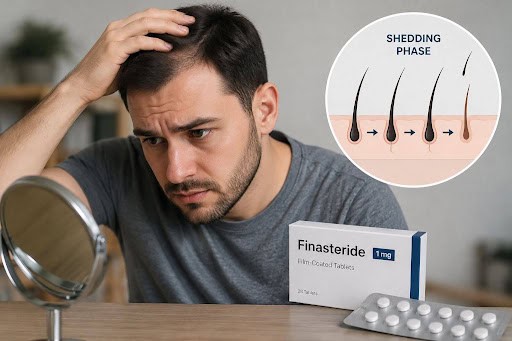
Yes, finasteride can cause hair loss, but only in the short term, and it’s usually a sign the treatment is working rather than failing. Many men starting finasteride for pattern hair loss notice more hairs in the shower or on their pillow within the first few months, which understandably feels alarming. This is known as the “finasteride shed,” and it happens because the drug is pushing weak, miniaturised follicles into a fresh growth cycle. It’s temporary, it’s well documented, and in most cases it resolves on its own within a matter of months.
That said, not every case of shedding on finasteride is the “good” kind, and knowing the difference matters. Below, we’ll break down what’s actually happening in your follicles, how long you should expect this phase to last, and the warning signs that suggest something other than a normal shed.
What is the finasteride shed, exactly?
The finasteride shed refers to a temporary increase in hair fall that some people experience after starting the medication, usually within the first one to three months. It’s not new hair loss in the traditional sense. It’s the shedding of existing hairs that were already thin, weak, or in a resting phase, making room for stronger regrowth.
In practice, what we typically see with clients at The Skin and Hair Clinic is a noticeable but short-lived increase in daily hair fall, followed by a period where shedding tapers off and finer regrowth becomes visible. It’s rarely dramatic enough to create bald patches, but it’s often enough to make someone question whether they’ve made the wrong decision. Understanding why it happens tends to ease that worry considerably.
How long does finasteride shedding last?
Finasteride shedding typically lasts between one and three months, with most people noticing it settle down by the six-month mark. Full stabilisation and visible new growth can take anywhere from six to twelve months, since hair growth cycles are naturally slow and finasteride works gradually rather than instantly.
This timeline lines up with how the hair growth cycle itself functions. Hair doesn’t grow in a straight line. It moves through growth (anagen), transition (catagen), and resting (telogen) phases, and a change in hormone activity can nudge a batch of follicles to shift phases at the same time. That’s what creates the temporary bump in shedding before things settle.
If shedding is still heavy well past the twelve-month point, it’s worth revisiting with a prescriber or hair loss specialist, since ongoing loss beyond that window isn’t typical of a standard finasteride shed.
Why finasteride causes shedding before it causes growth

Finasteride works by blocking the enzyme 5-alpha reductase, which converts testosterone into dihydrotestosterone (DHT), the hormone largely responsible for shrinking hair follicles in male pattern baldness. Lowering DHT levels doesn’t just stop further miniaturisation; it can actively encourage dormant or weakened follicles to re-enter an active growth phase.
When a large number of follicles shift phases at once, the older, weaker hairs they were holding onto get pushed out to make room for new ones. It’s a bit like clearing out old growth before new growth. This is why the shed, while unwelcome, is generally viewed by dermatologists as a positive early sign rather than a red flag.
Did you know? Not everyone who takes finasteride experiences a noticeable shed. Some people move straight into a stable or improving phase without ever clocking extra hair fall. It depends on how many follicles were already miniaturised before treatment started.
Finasteride shedding vs. ongoing hair loss: how to tell the difference
The clearest way to separate a normal shed from a genuine problem is the timeline and the pattern. A finasteride shed tends to peak early, plateau, then improve, and it doesn’t keep getting steadily worse month after month. Ongoing hair loss, by contrast, continues or accelerates well past the point where a shed should have resolved.
Myth: “If finasteride is shedding my hair, it’s not working for me.”
Reality: In most cases, shedding is a sign the medication is actively affecting your follicles, not evidence of failure. The real concern is loss that persists well beyond the typical three-to-twelve-month window without any sign of new, finer regrowth.
A few things can point toward a cause other than the expected shed:
- Hair loss that’s still worsening after 12 months on the medication
- Loss concentrated in a pattern that doesn’t match typical male or female pattern baldness
- Accompanying symptoms like scalp itching, redness, or flaking
- Sudden, patchy loss rather than gradual thinning
Genetics, stress, thyroid issues, iron deficiency, and other underlying conditions can all cause hair shedding independently of finasteride, and it’s not unusual for more than one factor to be at play at once. This is where a proper in-person assessment earns its keep, rather than guessing based on what’s happening in the shower drain.
Other finasteride side effects to know about
Beyond shedding, finasteride for hair loss side effects can extend to a small set of other potential effects, most of which are reversible if the medication is stopped. According to the NHS, these can include reduced libido, difficulty achieving an erection, and a smaller ejaculate volume, though the majority of users don’t experience these effects at all.
Some men also report mood changes while on finasteride, and this is an area where ongoing research and monitoring by prescribers is genuinely important. If you notice low mood, anxiety, or anything that feels out of character after starting treatment, that’s worth flagging to whoever prescribed it rather than pushing through quietly.
It’s worth remembering that most finesteride side effects, however the word gets spelled or searched for, tend to be dose-related and reversible rather than permanent. Prescribers will usually reassess your dose or suggest stopping the medication altogether if side effects outweigh the benefits for you personally.
Finasteride side effects in women
Finasteride isn’t licensed for use in women who are or could become pregnant, largely because of the risk it poses to a developing male foetus if handled or ingested during pregnancy. For postmenopausal women using finasteride off-label for female pattern hair loss, side effects can include changes to libido, mood fluctuations, and, similarly to men, a temporary shedding phase in the early months of treatment.
Because the evidence base for finasteride in women is smaller than it is for men, any use in female patients should be closely supervised by a prescriber who can weigh the individual risks and benefits properly.This information has been medically reviewed by Dr Jyotsana Kumari to ensure it is clear and clinically informed
What to do if the shedding feels excessive
If shedding feels heavier than expected, the first step is simply to keep track of it rather than react immediately. Taking photos of your hairline and crown every few weeks gives you an objective record to compare against, since memory alone tends to exaggerate how bad things feel day to day.
Pro tip: Count roughly, don’t obsess. A rough sense of “more than usual” over several weeks is far more useful than counting individual hairs on a bad day, which tends to fuel anxiety without adding real information.
If shedding continues well past the expected window, or you’re not seeing early signs of finer regrowth, it’s worth booking in with a specialist rather than switching treatments or stopping altogether on your own. Combining finasteride with other approaches, including non-surgical hair loss treatments like topical minoxidil or low-level laser therapy, can sometimes produce better and steadier results than finasteride alone, particularly for more advanced thinning.
For those who’ve already lost significant density before starting treatment, an FUE hair transplant is sometimes discussed as a complementary option once shedding has stabilised, rather than a replacement for medical treatment.
Final thoughts
A finasteride shed can feel like a setback, but for most people it’s actually an early signal that the medication is doing its job. The key is watching the timeline: shedding that peaks, then eases within six to twelve months, is normal; shedding that keeps building without any sign of new growth deserves a proper look.
If you’re a few months into treatment and unsure whether what you’re seeing is a normal shed or something worth addressing, book a consultation with The Skin and Hair Clinic. A hands-on assessment will tell you far more than guesswork ever will.
FAQs
Q: Can finasteride cause hair loss to get worse before it gets better?
A: Yes, a temporary increase in shedding is common in the first one to three months of finasteride use. This happens as weaker, miniaturised hairs are pushed out to make room for new growth. It typically resolves within six to twelve months as the medication takes full effect.
Q: Does finasteride cause shedding in everyone who takes it?
A: No, not everyone experiences a noticeable shed on finasteride. Some people move into stable or improving hair growth without any obvious increase in hair fall. Whether you shed depends largely on how many follicles were already miniaturised before you started treatment.
Q: What’s the right finasteride dose for hair loss?
A: The standard finasteride dose for male pattern hair loss is 1mg daily, taken orally. Higher doses aren’t typically more effective for hair loss and are more associated with side effects, so it’s important to follow your prescriber’s specific guidance rather than adjusting the dose yourself.
Q: Is finasteride effective for a receding hairline specifically?
A: Finasteride for hairline recession tends to be less predictable than its effect on crown thinning, since hairline follicles can behave differently. It can still slow or partially reverse hairline recession in some cases, but results vary more at the front of the scalp than at the crown.
Q: What are the most common finasteride side effects in women?
A: The most reported side effects of finasteride in females include libido changes, mood fluctuations, and an initial shedding phase similar to what men experience. Finasteride isn’t suitable for women who are or could become pregnant, and any use in women should be medically supervised.
Q: How do I know if my shedding is normal or a sign of a problem?
A: Normal finasteride shedding peaks early, plateaus, and then improves within six to twelve months. If hair loss keeps worsening beyond that window, or you notice scalp irritation, patchy loss, or no sign of regrowth, it’s worth getting assessed by a specialist rather than assuming it will resolve on its own.
Q: Should I stop finasteride if I notice shedding?
A: In most cases, no. Stopping during the expected shedding window can interrupt the process before you see the benefits. If shedding feels unusually heavy or prolonged, speak with your prescriber before making any changes, since they can assess whether it’s a typical shed or something else.