
Reviewed by Dr. Jyotsna Kumari
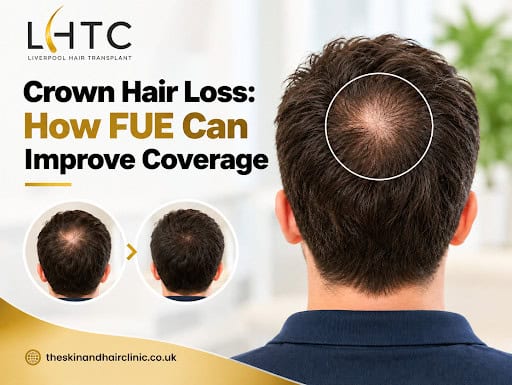
Crown hair loss is usually spotted by someone else first. A partner, a friend, a barber, or a photo taken from above that nobody asked for. By the time it shows up in the mirror, the thin patch has often been growing for a while, and the swirl of hair that used to hide it doesn’t anymore.
A retrospective analysis of 820 men who had FUE for advanced baldness, published on NCBI’s PMC database, found that 94% were satisfied with the results at 12 months, while 62% wanted another sitting to increase coverage or density. That study covered advanced baldness in general, not only the crown. Most patients were happy with the result, and many still wanted more. That is a useful reality check when you are weighing up crown hair loss treatment options.
Why Is Crown Hair Loss Different From a Receding Hairline?
The crown, also called the vertex, is a more complicated area to transplant than the front of the scalp, because the hair there may follow a whorl pattern. A professional body for hair restoration surgeons also notes that the crown takes more hair to reach acceptable coverage and density than any other area of the scalp, because grafts must change direction sharply to recreate the whorl.
What Is the Whorl, and Why Does It Matter?
Hair at the crown does not grow in a straight line. It spirals around a central point called the whorl. To get a natural look, the surgeon has to implant follicles according to the natural direction of hair growth. Direction and angle are two of the four indicators the aesthetic result depends on, alongside donor site selection and survival of the implanted follicles. Get the direction wrong and the transplant looks like a patch instead of a natural crown.
What Can Crown Hair Loss Treatment Do Before Surgery?
Surgery is not always the first step. Hair loss is a symptom, not a diagnosis, so the first job is to find the cause. For pattern hair loss, two drugs are recognised as effective: topical minoxidil, and finasteride tablets for men.
- Finasteride carries a trade-off. A systematic review found moderate-quality evidence that it increases hair count, along with an increased risk of sexual dysfunction. Discuss this with a doctor first.
- Both treatments need to continue. The benefit of finasteride or minoxidil is lost when treatment stops.
- PRP therapy is another option. A meta-analysis of nine randomised trials found that PRP increased hair density at 3 and 6 months compared with placebo.
Why Stability Matters Before a Transplant
Native hair around a transplant can keep thinning. In one review of transplant complications, 26 patients were unhappy because of the loss of existing non-transplanted hair. For younger patients, a surgeon may advise waiting, because the donor area may not prove stable, and medical therapy is described as the most reasonable course for early loss. A consultation shows how fast your own pattern is moving.
How Does FUE Improve Crown Coverage?
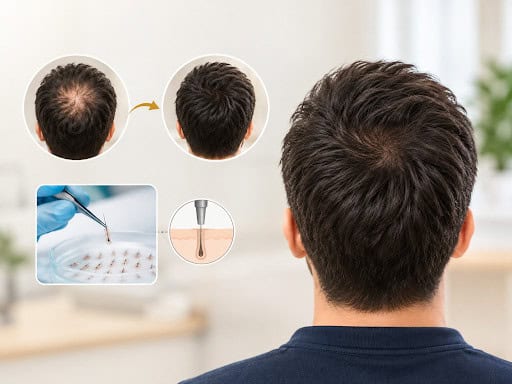
FUE takes individual follicular units from the donor area at the back of the scalp and places them in the thinning area. Because it does not remove a strip, it avoids the linear scar that comes with strip surgery, which is why many men who wear their hair short prefer it.
Why the Surgeon’s Planning Matters More Than the Method
The look of a transplant depends on four things: where the donor hair comes from, the direction and angle of the grafts, the density, and how many follicles survive. In a 2024 study of 158 men, over 90% of follicles survived with FUE. Survival is only one piece of the result, so ask any surgeon how they plan direction in the crown specifically.
How Many Grafts Does the Crown Need?
It depends on the size of the bald area and how much donor hair is available. In advanced baldness there is often a mismatch between donor supply and the area to cover. Where safe donor hair is limited, some surgeons add beard or body hair. A surgeon can only give you a reliable figure after examining your scalp. A number quoted over the phone without that is a guess.
Why a Second Session Is Common
In the 820-case study, 62% of patients wanted another sitting for more coverage or density. That can come down to donor limits, planning for future loss, or wanting a fuller result than one session delivers. A good surgeon will explain this upfront and plan the donor supply carefully.
What the Evidence Shows at a Glance
| Study | Patients | What was reported |
| FUE in advanced baldness (Norwood 5 to 7), retrospective, 2012 to 2017 | 820 men | 94% satisfied at 12 months. 62% wanted another sitting for more coverage or density |
| FUE in male androgenetic alopecia, BMC Surgery 2024 | 158 men | Over 90% follicle survival. Satisfaction rates above 98% and a complication rate below 6% |
| Aesthetic indicators in hair transplantation | Expert review | Natural results depend on donor selection, direction and angle, density, and follicle survival |
Who Is a Good Candidate for FUE in the Crown?
FUE tends to suit patients who tick most of these boxes:
- Hair loss that has slowed or stabilised, confirmed over time
- Enough healthy donor hair at the back and sides of the scalp
- Realistic expectations about density, since many patients in the 820-case study still wanted more
- A scalp healthy enough for surgery
- A willingness to continue medical treatment to protect the hair around the transplant
What Does Recovery and Growth Look Like for the Crown?
Transplanted hairs commonly fall out within six weeks of surgery, and strenuous exercise is usually avoided for at least three weeks. In one textbook account, new hair begins to grow at 3 to 4 months, looks pleasing at around 6 months, and the final result shows at around 12 months. Plan for a year, not a few weeks, and ask your surgeon what your own crown is likely to do.

What Does an Affordable FUE Hair Transplant Really Mean?
An affordable FUE hair transplant should mean fair pricing for a procedure planned and performed properly, with clear costs and no surprises later. It should not just mean the lowest number on a quote. Ask what the quote includes before comparing clinics:
- Is the price per graft, or a total for the whole procedure?
- Does it include consultation, medication, and aftercare?
- Who will perform the surgery, and who will be in the room?
- What happens if you need a second session later?
- Are follow-up appointments included?
Why the Cheapest Quote Can Cost More Later
Donor hair is limited, and the supply of safe donor hair is a recognised constraint in advanced baldness. A poorly planned crown can use up donor hair that a later procedure would have needed. Paying for careful planning at the start is usually the better use of a limited resource.
Why Choose FUE Hair Transplant in Liverpool?
Choosing an FUE hair transplant Liverpool patients can visit in person makes the process easier. You can meet the surgical team before deciding, have your scalp assessed face to face, and return for follow-up without travelling far or relying on remote check-ins. That ongoing contact matters for crown work, since results build slowly over about a year.
Book a Crown Assessment Before You Decide
Crown hair loss rarely stays the same size. The sooner it is assessed, the more donor hair and native hair there is to work with.
The Skin & Hair Clinic in Liverpool offers a free consultation with a GMC-registered specialist team, including a scalp assessment, donor density check, and a personalised graft estimate for your crown. Book your free consultation to find out what FUE could realistically do for your coverage.
FAQs
Q: Can FUE completely cover a bald crown?
It can improve coverage a lot, but expect to plan carefully. The crown needs more hair than other areas to reach acceptable density, and 62% of patients in one study wanted a second sitting for more coverage.
Q: How many FUE sessions does a crown usually need?
Some patients are happy after one. In the 820-case study, 62% wanted another sitting. A surgeon can give a better estimate after assessing your scalp.
Q: Is a crown hair transplant harder than a hairline transplant?
Generally, yes. The crown can be a complicated area because hair follows a whorl pattern. Ask how many crown cases your surgeon has treated.
Q: When will I see results in the crown?
Shedding usually happens within about six weeks. New growth typically begins at 3 to 4 months, with the final result evident at around 12 months.
Q: Should I treat my hair loss medically before having a transplant?
Often, yes. Minoxidil and finasteride are effective against pattern hair loss, and surgeons may advise stabilising loss before surgery. A specialist will advise what suits you.