
Reviewed by Dr. Jyotsna Kumari
Platelet-rich plasma (PRP) has become one of the most searched non-surgical treatments for thinning hair, but not all PRP is prepared the same way. Two centrifugation techniques single spin and double spin produce plasma with different platelet concentrations, and clinics don’t always explain which protocol they use or why it matters.
Did you know? In a split-scalp study of women with female pattern hair loss, the side treated with double-spin PRP showed significantly higher terminal hair density on trichoscopy than the side treated with single-spin PRP.
If you’re weighing up single spin vs double spin PRP for hair loss before booking a course of treatment, understanding how each method is prepared, what peer-reviewed research actually shows, and what to look for in a PRP hair clinic will help you make a more informed decision. This guide breaks down both techniques and reviews the current clinical evidence on which one supports better hair density outcomes.
Key Takeaways
- Single-spin PRP uses one centrifugation cycle; double-spin PRP adds a second spin to further concentrate platelets and remove excess plasma.
- Clinical findings are mixed: some trials report a higher platelet yield with double-spin protocols, while a 2025 systematic review found single-spin PRP produced slightly better hair density outcomes though the difference was not statistically significant.
- Platelet concentration alone doesn’t determine results. Injection technique, session frequency, and the patient’s stage of hair loss all influence outcomes.
- There is currently no single standardised PRP protocol for hair loss, which is one reason results vary between clinics and between studies.
- The information below is drawn from peer-reviewed clinical trials and systematic reviews (linked throughout), rather than marketing claims, so you can weigh the evidence for yourself.
What Is PRP for Hair Loss?
Platelet-rich plasma is prepared by drawing a small sample of the patient’s own blood and spinning it in a centrifuge to separate and concentrate platelets, which release growth factors such as PDGF, VEGF, and TGF-β. These are injected into the scalp to support the natural hair growth cycle. PRP is used mainly for androgenetic alopecia (pattern hair loss) in its early-to-moderate stages, where follicles are miniaturised but still active; it cannot regrow hair from follicles that are already dormant or scarred. If you’re researching PRP hair restoration, the preparation method your clinic uses is one of the first things worth asking about, since it directly affects the concentration of growth factors delivered to the scalp.
What Is Single-Spin PRP?
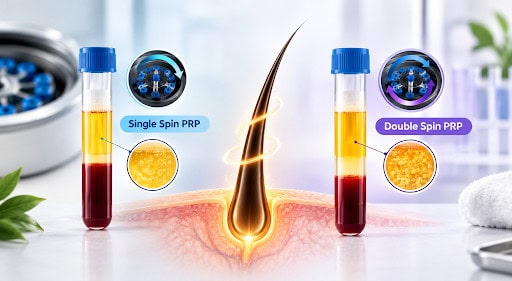
Single-spin PRP involves one centrifugation cycle, typically run at moderate-to-high speed for around 10 to 15 minutes. This separates red blood cells from the plasma layer, producing PRP with a platelet concentration broadly 3 to 6 times that of whole blood. It’s quicker to prepare, needs a smaller blood draw, and is the simpler of the two protocols to standardise in a clinic setting, since it involves only one processing step.
What Is Double-Spin PRP?
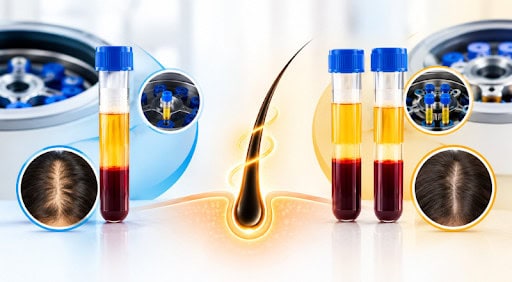
Double-spin PRP adds a second centrifugation step after the first. The initial spin separates plasma from red blood cells; the second spin further concentrates the platelets by removing most of the platelet-poor plasma. This can push the final platelet concentration considerably higher, with some protocols aiming for concentrations above 1,000,000 platelets per microlitre, a threshold proposed by early PRP researchers as clinically meaningful. The trade-off is a longer preparation time, a smaller final injectable volume, and more steps where technique can vary between operators.
Single Spin vs Double Spin PRP for Hair Loss: Key Differences
The table below summarises how the two protocols compare. Many PRP hair clinic providers choose their default protocol based on equipment, session length, and clinician preference as much as on published data so it’s worth asking your practitioner directly which method they use and why.
| Aspect | Single-Spin PRP | Double-Spin PRP |
| Centrifugation steps | One spin | Two spins |
| Typical prep time | Roughly 10–15 minutes | Roughly 20–30 minutes |
| Platelet concentration | Moderate (around 3–6x whole blood) | Generally higher; some protocols aim above 1,000,000 platelets/µL |
| Blood volume required | Lower | Higher, to allow for the second spin |
| Preparation complexity | Simpler, fewer processing steps | More steps, more operator-dependent variability |
| What the evidence shows | One 2025 meta-analysis found slightly better hair density, not statistically significant | Some RCTs report higher platelet counts and follicular unit counts |
What Does the Clinical Evidence Actually Say?
Overall, the research comparing single-spin and double-spin PRP for hair loss is mixed and still fairly limited. Some trials report higher platelet counts or follicular unit counts with double-spin preparation, which fits the basic logic that a second spin concentrates platelets further. Other trials and a 2025 pooled meta-analysis found no statistically significant advantage for double-spin PRP, and even a slight edge for single-spin PRP on hair density. A key limitation across this body of research is the lack of a standardised preparation protocol: centrifuge speed, spin duration, activator use, and injection technique all vary between studies, which makes direct comparisons difficult. This is echoed by professional bodies PRP for hair loss is generally considered a promising but not yet fully standardised treatment, with evidence graded as encouraging rather than conclusive.
Which Method Works Better for Hair Loss?
Based on the current evidence, neither single-spin nor double-spin PRP has a clearly proven, clinically significant advantage over the other for treating pattern hair loss. Differences reported between the two methods in individual studies are often small and not statistically significant once you look at the confidence intervals. What tends to matter more in practice is consistency: a well-run multi-session protocol (typically three to four initial sessions, four to six weeks apart, with periodic maintenance), a clinician experienced in scalp injections, and realistic patient selection PRP works best on follicles that are miniaturised but still active, not on areas of complete, long-standing hair loss. Be cautious of any clinic marketing one method as dramatically superior to the other without citing the trial it’s based on.
Choosing a PRP Hair Clinic
Because platelet concentration is only one variable among several, the choice of clinic matters as much as the choice of spin protocol. When comparing providers for best PRP hair restoration results, look for:
- Registration with the relevant healthcare regulator (in the UK, this is the Care Quality Commission) and clear information about who performs the procedure.
- Transparency about their PRP preparation method, equipment, and typical platelet yield, rather than vague marketing language.
- A proper in-person assessment of your hair loss pattern and stage before recommending a treatment course.
- Realistic expectations set from the outset, including that results typically take several months to become visible and that PRP works best alongside, not instead of, other evidence-based treatments where appropriate.
You can find more detail on how our team approaches PRP hair treatment, including consultation and aftercare, on our hair loss treatments page.
Ready to Talk to a PRP Specialist?
If you’re considering PRP for thinning hair, the most useful next step is a proper in-person assessment rather than choosing a protocol based on marketing claims alone. Our team can talk you through how we prepare and administer PRP, what results are realistic for your stage of hair loss, and how it fits alongside other treatments.
Frequently Asked Questions
Q1: Is double-spin PRP always better than single-spin PRP for hair loss?
Not necessarily. Some trials report higher platelet counts with double-spin PRP, but a 2025 meta-analysis of randomised controlled trials found no statistically significant difference in hair density outcomes between the two methods, with single-spin PRP showing a slight (non-significant) edge. The evidence overall is mixed rather than conclusively favouring one method.
Q2: How many PRP sessions are usually needed to see results for hair loss?
Most protocols involve an initial course of three to four sessions spaced roughly four to six weeks apart, followed by maintenance sessions every three to six months. Visible improvement in hair density typically takes several months, as it depends on the natural hair growth cycle.
Q3: Does PRP for hair loss hurt, and what are the side effects?
PRP injections can cause mild discomfort during the procedure, and short-term side effects such as scalp tenderness, redness, or mild swelling at injection sites are common but usually resolve within a few days. Because PRP uses your own blood, the risk of allergic reaction is low.
Q4: Is PRP for hair loss available on the NHS?
PRP for hair loss is not routinely available on the NHS and is not currently recommended in NICE guidance. It’s generally offered as a private, minimally invasive treatment, and PRP preparation kits are regulated as medical devices rather than licensed medicines in the UK.
Q5: How do I find out which PRP method a clinic uses?
Ask directly during your consultation. A transparent clinic should be able to tell you whether they use a single-spin or double-spin protocol, roughly what platelet concentration it produces, and why they chose that approach for hair loss treatment specifically.
Q6: Can PRP be combined with other hair loss treatments like minoxidil or finasteride?
Yes. PRP is often used alongside topical minoxidil or oral finasteride as part of a broader hair loss management plan, rather than as a standalone replacement for these treatments. Your clinician can advise on the most suitable combination based on your hair loss pattern and medical history.