Reviewed by Dr. Jyotsna Kumari
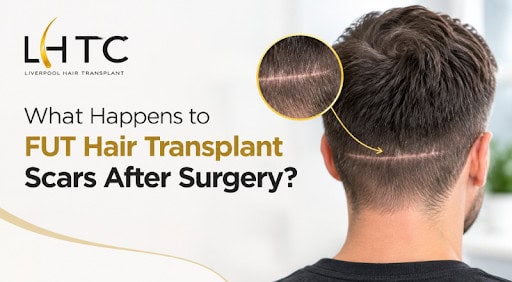
If you are considering a FUT hair transplant, the hair growth is only part of the picture. Many patients also want to know what will happen to the scar at the back of the scalp once the surgery is over. Will it stay visible? Will it become thinner and lighter? And how long does it take before the scar settles?
Unlike FUE, which leaves multiple small extraction marks, Follicular Unit Transplantation (FUT) involves removing a strip of hair-bearing skin from the donor area, leaving a linear scar. A PubMed-indexed study confirms that FUT typically produces a linear donor-area scar, although its final appearance can vary between patients.
This blog will explain what FUT hair transplant scars can look like during each stage of healing, which factors can affect its final appearance, and what you can do during recovery to support proper scar healing.
Key Takeaways
- A FUT scar is the linear mark left behind once the donor strip is removed and the wound closed.
- Its final width depends on strip size, closure method, scalp laxity, and how well aftercare is followed.
- Trichophytic closure lets hair grow directly through the scar line, which is what makes it hard to spot once regrowth fills in.
- The scar looks worse in the first two weeks and keeps softening for close to a year.
No FUT scar disappears completely, but a well-managed one can be almost impossible to see.
What Causes a FUT Hair Transplant Scar?
During FUT, the surgeon removes a strip of scalp tissue from the back of the head, then separates it into individual follicular units under magnification before implanting them into the thinning areas. Once the strip comes out, the two edges of the donor wound are stitched back together. That stitch line is the scar patients end up with.
FUE works differently. Follicles are lifted out one at a time, so instead of one line there are hundreds of tiny, scattered dots that fade far more easily into the surrounding hair. FUT still holds an advantage for some patients though, since a single strip can yield a large graft count in one sitting, which matters for anyone covering a wide area of thinning.
What Affects How a FUT Scar Heals?
A few things decide whether a scar ends up barely visible or noticeably wide.
- Strip width. A narrower strip almost always heals into a finer line.
Scalp laxity. Looser scalp skin closes with less tension, and less tension generally means a cleaner scar. - Closure technique. How the surgeon handles the wound edges matters as much as the surgery itself.
- Aftercare habits. Skipping rest, scratching the area, or returning to heavy activity too soon can widen the eventual scar.
- Personal healing tendency. Some people scar more than others regardless of technique, and that’s largely down to genetics and skin type.
Two patients can have the identical procedure and still heal differently, which is why a scar prediction only really works once a surgeon has assessed the individual scalp.
What Happens During FUT Scar Recovery?
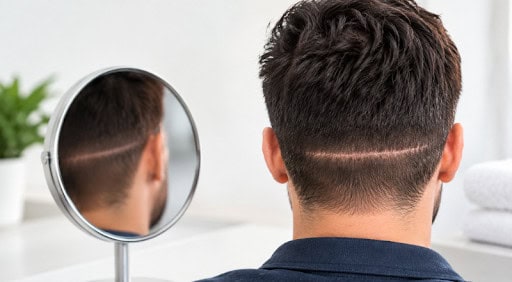
The scar doesn’t settle overnight. It changes shape and colour as the weeks pass.
- Days 1 to 14: the incision sits raised, pink or red, and mild crusting is normal. This is the stage that worries most patients, even though it’s expected.
- Weeks 2 to 8: swelling drops off, redness fades, and the line starts flattening against the scalp.
- Months 3 to 6: the scar keeps maturing and loses more of its colour.
- Months 6 to 12: most patients reach the final result here, a thin pale line that hair growth largely covers.
The Skin & Hair Clinic builds a full year of aftercare into its FUT package for exactly this reason, checking on the donor area at each stage rather than leaving patients to guess how healing is going.
Do FUT Scars Ever Fully Disappear?
No, and it’s worth being upfront about that rather than promising something surgery can’t deliver. Once tissue is cut and stitched, some permanent mark remains. What changes is how visible that mark stays.
Trichophytic closure is the technique that makes the biggest difference here. The surgeon trims one edge of the wound before closing it, which allows hair to grow straight through the healed line instead of around it. Ask about this directly during a consultation, since it’s often the deciding factor between a scar that hides under regrowth and one that shows even at shorter hair lengths.
How to Care for a FUT Scar After Surgery
The healing window is where patients have the most control over the final result.
- Leave the donor area alone. Scratching or picking at it slows healing and can widen the scar.
- Wash the scalp only once the clinic confirms it’s safe to do so.
- Hold off on strenuous exercise and heavy lifting until cleared.
- Keep the area out of direct sun while it’s still healing.
- Turn up to every follow-up appointment, even if things seem fine.
- Call the clinic straight away if swelling, discharge or pain feels off.
Why Surgical Technique Matters for Scar Appearance
The scar isn’t an unavoidable side effect that just happens the same way every time. It’s shaped by decisions the surgeon makes before a single incision is cut. At The Skin & Hair Clinic, procedures are performed by GMC-registered surgeons inside a CQC-regulated facility, and strip width, wound tension and closure method are all planned around the specific patient rather than applied as a default.
This is why a proper consultation carries more weight than comparing headline prices. Scalp laxity, hair density and the number of grafts required all shape how the surgeon approaches the donor strip, and that planning is what ultimately decides how the scar turns out.
Questions to Ask About FUT Scarring Before Surgery
- What closure technique will you use in my donor area?
- How wide will the strip likely need to be for my case?
- What does my personal healing timeline look like?
- Will my usual hairstyle cover the scar comfortably?
- What happens if the scar ends up wider than planned?
- What aftercare and follow-up comes with the procedure?
These questions get far more useful answers than anything a general guide can offer, because they’re specific to your scalp.
Book a Consultation to Discuss FUT Recovery
Knowing what to expect from a FUT scar makes the decision between techniques a lot less daunting. Strip width, closure method, aftercare and individual healing all play into the final result, and a consultation is really the only way to know how those factors apply to you specifically.
Ready to talk it through? Book a consultation with The Skin & Hair Clinic to discuss follicular unit transplantation, FUT transplant recovery and what your own donor scar is likely to look like. Call the clinic on 0151 280 3248 or visit 203-205 Rose Lane, Liverpool, L18 5EA to get started.
FAQs
Q1: How long does it take for a FUT scar to heal?
The scar looks its worst in the first couple of weeks, then keeps softening and fading over several months. Most patients see the final result by around the one-year mark.
Q2: Can a FUT scar be completely invisible?
Not completely, since it’s permanent tissue. But with trichophytic closure, hair grows directly through the line, and most people can’t spot it once regrowth fills in.
Q3: Does strip width affect how visible the scar is?
Yes. Studies on FUT donor sites have consistently linked wider strips to wider scars, which is why surgeons plan the strip size around each patient’s scalp laxity and graft requirements.
Q4: Is FUT scarring painful during recovery?
Most patients describe tightness rather than real pain, and clinics typically manage this with guidance and support through the first stretch of healing.
Q5: What should I do if my FUT scar looks unusually wide or raised?
Get in touch with your clinic without delay. That’s exactly what follow-up appointments are for, and a surgical team can step in early if a scar isn’t healing the way it should.