
Reviewed by Dr. Jyotsna Kumari
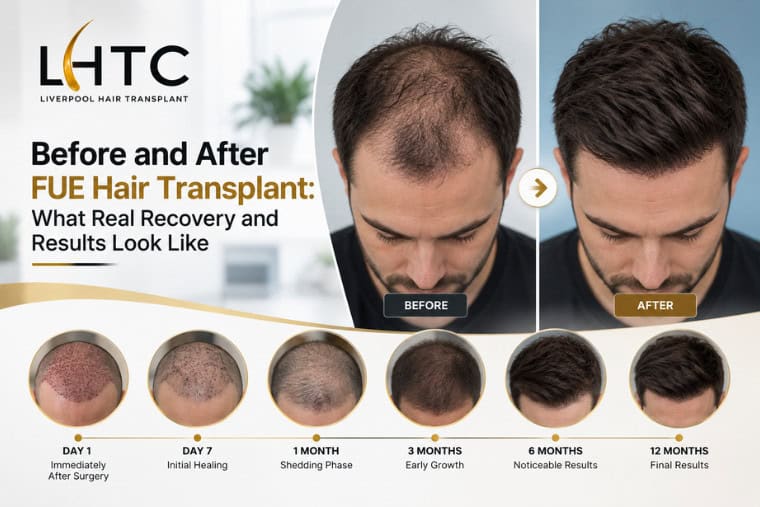
Seeing a before-and-after photograph can make a hair transplant seem like a simple change from thinning hair to fuller growth. The months between those two photographs tell a much bigger story. Healing, temporary shedding and gradual new growth all form part of the process.
Anyone researching before-and-after FUE hair transplant results should look beyond the final photograph and understand how the hair changes during recovery.
Did You Know? The NHS explains that transplanted hair often falls out after a few weeks before growing back later. New hair usually starts appearing from around four months, while the full result can take 10 to 18 months to develop. The NHS also advises taking particular care of transplanted hair during the first two weeks because the grafts are not yet secure.
The Skin & Hair Clinic provides FUE hair restoration in Liverpool, with patient results showing different stages of hair growth after treatment.
Key Takeaways
- The FUE results take time to appear and cannot be assessed within the first weeks.
- Skin redness, scabbing, and shedding may appear as part of early recovery.
- Hair regrowth will begin to become noticeable within several months after the procedure.
- The hair may grow thicker and mature as time passes.
- It is easier to compare pictures before and after when the time span, treatment area, and initial degree of hair loss are known.
What Do Before and After FUE Hair Transplant Photos Really Show?
A before photograph usually shows the original hairline, density and areas affected by hair loss. An after photograph may show anything from early growth to a more mature result, depending on when it was taken.
This is why the timeframe is important when looking at before-and-after hair transplant photographs. A picture taken three months after treatment will look very different from one taken 12 months later.
Photos should ideally be compared using similar lighting, camera angles and hair lengths. This gives a clearer idea of how much the hair has actually changed.
What Happens Between the Before and After Photos?
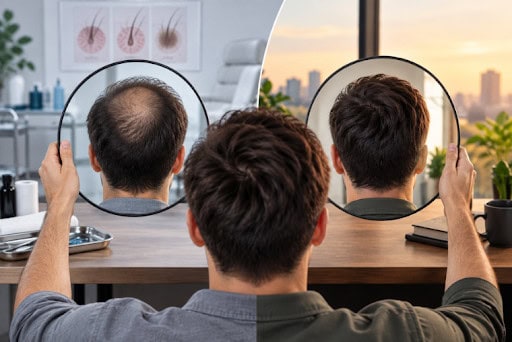
First 2 Weeks: Early Healing
The scalp begins healing immediately after treatment. Some redness, swelling, sensitivity and small scabs can occur around the transplanted follicles.
During this stage:
- Follow the washing instructions provided by your medical team.
- Avoid scratching or rubbing the transplanted area.
- Protect the grafts from pressure and knocks.
- Follow advice about exercise and other activities.
The NHS advises being particularly careful with transplanted hair during the first two weeks.
Weeks 2 to 12: Temporary Shedding
Transplanted hairs can fall out a few weeks after treatment. This can be worrying when looking in the mirror, but shedding can form part of the normal hair growth cycle after transplantation.
The follicles remain in the scalp and can later produce new hair.
Months 4 to 6: Early New Growth
New hairs can begin appearing after several months. At first, they may look fine or uneven, so the result may still look different from the final outcome.
Months 6 to 12: Increasing Density
New hair growth becomes more noticeable, and over time, the hair may appear thicker. The overall shape and coverage become easier to assess during this period.
Months 12 to 18: Maturation
Hair can continue to develop after the first year. The NHS states that full results can take 10 to 18 months.
What Do Real FUE Treatment Results Look Like?
When reviewing FUE treatment results, look beyond how much hair has been added. A natural result also depends on how the new hair blends with existing growth.
Useful things to compare include:
- Hairline shape
- Density in the treated area
- Direction of hair growth
- Coverage of thinning areas
- Appearance of the donor area
- How naturally the transplanted hair blends with existing hair
The amount of improvement can vary between patients. A person with extensive hair loss may have a different outcome from someone with mild recession, even when similar numbers of grafts are used.
What Can Affect Your Results?
Several factors can influence the final appearance. The amount and quality of donor hair are important, as are the cause of hair loss, existing hair density and individual healing.
Hair thickness, texture and colour can also affect how dense the scalp appears. Existing non-transplanted hair may continue to thin depending on the underlying cause of hair loss.
Realistic expectations are therefore important when comparing photographs.
What Is FUE Hair Transplant Recovery Like?
FUE hair transplant recovery involves caring for the scalp during the early healing period and then allowing the transplanted follicles time to produce new hair.
The treatment itself uses follicular unit extraction, where individual grafts are removed from the donor area and placed into tiny openings in the recipient area.
The recovery period is much longer than the procedure itself because hair growth takes months to develop.
How Should You Compare Hair Transplant Before and After Photos?
A hair transplant before-and-after comparison is most useful when you know what happened between the two images.
Check:
- How many months passed between the photographs
- Whether the same lighting and camera angle were used
- How much hair loss was present before treatment
- Which areas were treated
- How many grafts were used, where this information is available
- Whether the photograph shows an early or mature result
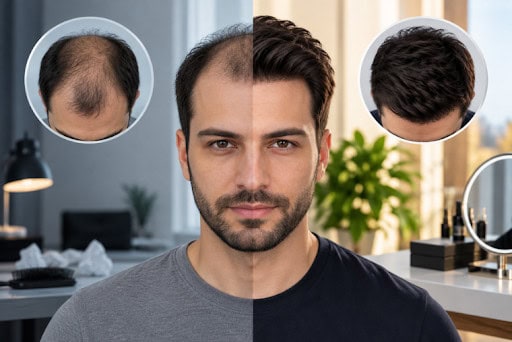
The clinic’s results gallery includes documented patient cases showing hair restoration outcomes at different stages, including FUE cases at six, nine and 12 months.
What Is a FUE Hair Transplant?
A FUE hair transplant involves removing individual hair follicles from a donor area, usually at the back or sides of the scalp, and placing them into areas affected by hair loss.
The NHS explains that individual grafts are removed one by one during FUE and placed into small openings in the scalp. The technique leaves multiple tiny scars rather than a single linear scar.
Are FUE Results Permanent?
Follicular transplantation is supposed to give hair a lasting effect, but this does not necessarily mean that all hair will stay in its place. The hair around the transplanted area can still thin out depending on the reasons for hair loss.
That is why the need for long-term follow-up and consultation may become necessary after treatment.
Ready to Explore Your FUE Hair Transplant Results?
Before-and-after photographs can help you understand what hair restoration may look like, but they cannot predict exactly how another person’s hair will grow. Your donor supply, hair characteristics, existing density and healing can all influence the outcome.
The Skin & Hair Clinic can assess your hair loss and donor area and explain what you may expect from FUE treatment, including recovery and the time needed for new growth. Looking at before and after fue hair transplant results can also help you understand how changes may develop over the months.
Book a consultation to discuss your hair loss and learn whether FUE could be suitable for you.
FAQs
Q: How long does it take to see FUE hair transplant results?
New growth can start appearing from around four months, while the full result can take 10 to 18 months.
Q: Does transplanted hair shed after FUE?
Yes. Transplanted hairs often shed after a few weeks before new growth begins.
Q: When will FUE results look natural?
The appearance develops gradually. Hair can become thicker and more mature over several months, so early photographs do not show the final result.
Q: Are FUE hair transplant results permanent?
Transplanted follicles can provide long-term growth, although existing non-transplanted hair may continue to thin.
Q: How can I compare FUE before-and-after photographs?
Look at the timeframe, lighting, camera angle, treatment area, starting level of hair loss and whether the photograph shows an early or mature result.