Reviewed by Dr. Jyotsna Kumari

Hair restoration has changed considerably, giving people more options for dealing with thinning hair and bald patches. Many patients now look beyond simply replacing lost hair and want a procedure that can create a natural-looking hairline and work carefully around existing hair. DHI has gained attention for its direct implantation technique and the level of control it can provide during treatment.
Did You Know? The NHS states that new hair can usually start appearing around four months after a hair transplant, while full results may take 10 to 18 months to develop.
This is why patients should allow time for the transplanted follicles to settle and grow rather than expecting an immediate change.
The Skin & Hair Clinic offers DHI, FUE and FUT hair transplant procedures in Liverpool. For people researching DHI hair replacement, understanding how the technique works, its potential benefits and how it compares with other options can help when deciding what to discuss during a consultation.
Key Takeaways
- DHI uses a direct implantation technique to place individual follicles into areas affected by hair loss.
- The technique can give the clinical team control over the direction, angle and placement of grafts.
- DHI and FUE share a similar extraction process, but the implantation stage is different.
- Suitability depends on factors such as donor hair, hair loss pattern and the area being treated.
- Results develop gradually, so patients should have realistic expectations about growth and recovery.
What Is DHI Hair Replacement?
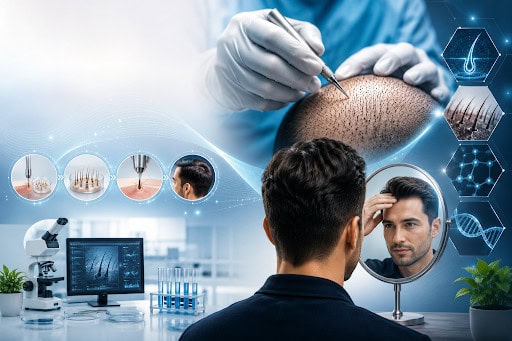
DHI stands for Direct Hair Implantation. The technique involves removing individual follicular units from a donor area before placing them directly into areas affected by hair loss.
A specialised Choi implant pen is used during the implantation stage. The clinic explains that this allows the team to control the depth, direction and angle of individual hairs during placement.
The technique is designed to create a natural distribution of transplanted hair while working around existing follicles.
How Does a DHI Hair Transplant Work?
A DHI treatment generally consists of multiple phases:
- A consultation to assess the severity and pattern of hair loss
- Treatment area and hairline arrangement
- Harvesting of individual follicles from the donor area
- Putting grafts into an implantation device
- The follicles are put directly into the indicated areas
- Instructions for self-care during your recovery after surgery
The exact number of grafts needed will vary from patient to patient. Therefore, before planning the hair transplant procedure, the donor area and the thinned areas should be assessed.
What Makes DHI Different?
The only difference is the way the follicles are implanted. Instead of inserting grafts into pre-made recipient channels, DHI uses an implanter device to insert grafts directly.
This could potentially give power over:
- The angle of each follicle.
- Direction of hair growth
- Individual placement of graft
- Density in certain areas
- Taking care of existing hair
These considerations can be especially important when creating or refining a hairline.
What Are the Potential Benefits of DHI?
DHI may be considered by patients who want precise follicle placement and careful work around existing hair. The technique can also be useful for areas where density and hair direction need careful planning.
The Skin & Hair Clinic describes DHI as suitable for detailed hairline work and offers the treatment alongside FUE and FUT.
It is worth remembering that the technique does not guarantee a particular result. Hair characteristics, donor supply, existing hair loss and the skill of the surgical team can all affect the final appearance.
DHI vs FUE Hair Transplant: What Is the Difference?
DHI and FUE are sometimes presented as completely separate treatments, but there is an important distinction. FUE refers mainly to the extraction of individual follicular units, while DHI describes a direct implantation method.
| Feature | DHI | FUE |
| Follicle extraction | Individual grafts | Individual grafts |
| Implantation | Direct implantation | Grafts placed into prepared sites |
| Placement control | High | High |
| Suitable areas | Depends on patient needs | Depends on patient needs |
| Treatment choice | Based on clinical assessment | Based on clinical assessment |
Neither technique is automatically right for every patient. A consultation can help determine which option fits the pattern of hair loss and available donor hair.
What Should You Expect During DHI Hair Transplant Recovery?
The early healing period can involve redness, swelling or small scabs around the treated area. Patients should follow the aftercare instructions given by their clinical team and avoid unnecessary touching of the grafts.
The NHS advises patients to take particular care of transplanted hair during the first two weeks because the grafts are still becoming secure.
The recovery period can vary, so patients should ask their clinic what they can expect based on their procedure.
When Will You See DHI Hair Restoration Results?
Hair growth takes time. During the initial healing period, some transplanted hairs may shed before new growth begins. Then there are gradual changes over the next several months.
NHS guidelines state that complete results may take 10 to 18 months.
This timing is important for evaluating the efficacy of the treatment. Photographs taken at different times can be compared to provide a more complete picture of the gradual development.
How to Choose a Clinic for DHI Treatment
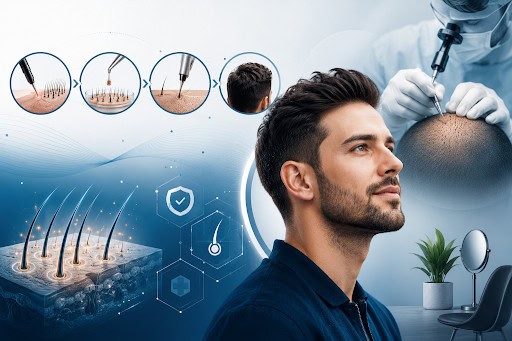
Before booking, check the clinic’s medical credentials, surgical experience, patient results and aftercare arrangements. It is also worth asking who will carry out the procedure and how your treatment plan will be decided.
The Skin & Hair Clinic has GMC-registered doctors and provides DHI, FUE and FUT services in Liverpool.
Questions to Ask Before Choosing DHI
Before agreeing to treatment, consider asking:
- Am I suitable for DHI?
- How many grafts may I need?
- Why has DHI been recommended?
- Would FUE be suitable for me?
- Who will perform the procedure?
- What aftercare is included?
- When should I expect to see new growth?
These questions can help you understand the treatment before making a decision.
Ready to Explore Your DHI Hair Restoration Options?
DHI can be an option for suitable patients who want careful control over how individual follicles are placed. Understanding the procedure, recovery period, expected growth and differences between DHI and FUE can help you decide what to discuss during a consultation.
The Skin & Hair Clinic provides DHI hair transplantation in Liverpool alongside FUE and FUT procedures. To discuss your hair loss, suitability and treatment choices, call 0151 280 3248 or visit 203-205 Rose Lane, Liverpool, L18 5EA to arrange a consultation.
FAQs
1. What is DHI hair replacement?
It is a hair restoration technique where individual follicles are extracted and implanted directly into areas affected by hair loss using a specialised implantation device.
2. Is DHI better than FUE?
Neither technique is automatically better for every patient. The right option depends on the pattern of hair loss, donor hair and treatment requirements.
3. How long does DHI recovery take?
Early healing varies between patients. Redness and small scabs can occur, while new hair growth takes several months.
4. When will DHI results become visible?
New hair can begin appearing around four months after transplantation, while full results may take 10 to 18 months.
5. Who can have DHI treatment?
Suitability depends on factors such as hair loss pattern, donor hair availability, scalp condition and the areas requiring treatment. A clinical consultation is needed to assess suitability.