
Losing your hair in your 20s is genuinely distressing, and it’s more common than most people realise. But getting a hair transplant at 20 is, in most cases, the wrong move at the wrong time. The core problem isn’t the surgery itself; it’s the unpredictability of hair loss at that age. Acting too soon can leave you worse off than if you’d waited, with an unnatural appearance and fewer options for correction down the line. Here’s what you actually need to know before making any decisions.
Did you know? Research published in the Journal of the American Academy of Dermatology found that men who begin experiencing hair loss before the age of 21 are statistically more likely to develop more advanced baldness (Norwood Stage 5–7) over their lifetime than those who begin losing hair in their 30s. This makes the case for caution in early-onset loss even stronger not weaker.This information has been medically reviewed by Dr Jyotsana Kumari to ensure it is clear and clinically informed.
Why hair loss in your 20s is different from hair loss in your 40s
Male pattern baldness (the most common cause of hair loss in young men) is driven by a sensitivity to DHT (dihydrotestosterone), a hormone derived from testosterone. In your 20s, this process has usually just begun. The Norwood Scale, the standard framework for classifying male hair loss, runs from Stage 1 (no visible loss) to Stage 7 (severe loss across the crown and temples). Most men in their early 20s presenting with noticeable thinning are only at Norwood Stage 2 or 3.
The critical issue: no one, not even a highly experienced surgeon, can predict with certainty where on that scale you’ll eventually land. A 21-year-old at Norwood Stage 3 might stabilise there, or might progress to Stage 6 over the next decade. That uncertainty is precisely why the minimum age for hair transplant surgery is a topic taken seriously by reputable clinics in the UK.
The real risks of getting a hair transplant under 25
The “island effect”: why it haunts young patients
When a surgeon transplants hair into a receding area, those grafted follicles are permanent. They come from the donor zone at the back and sides of the scalp (a region that is largely DHT-resistant and tends to retain hair for life). The native hair surrounding the transplanted area, however, is not protected. If that hair continues to fall out after surgery (which is likely in a young, still-progressing patient), you can end up with patchy, isolated tufts of transplanted hair surrounded by bald scalp. This is sometimes called the “island effect,” and correcting it requires additional grafts, if you have any left.
Whether the original procedure was carried out as an FUE hair transplant or a strip-based approach, the island effect can still occur, because the risk comes from ongoing native hair loss rather than the harvesting method itself.
Depleting your donor supply too early
Every person has a finite number of viable donor follicles. A typical patient might have somewhere between 4,000 and 8,000 usable grafts in their lifetime, depending on scalp laxity, hair density, and hair characteristics. If you use 2,000 grafts at age 21 addressing early recession, and then your hair loss continues significantly over the next 15 years, you may simply not have enough donor hair left for a second procedure to address the new loss. You’ve spent a limited resource on a problem that wasn’t finished yet.
The hairline placement problem
Surgeons designing a hairline for a 20-year-old face a difficult trade-off. A naturally low, youthful hairline looks appropriate now, but in 15 years, if the hair behind it has receded substantially, that low transplanted hairline will look anatomically inconsistent. Experienced surgeons typically plan hairlines with the patient’s likely future appearance in mind, which means younger patients are often advised against aggressive, low hairline reconstruction.
What age do most reputable UK clinics recommend?
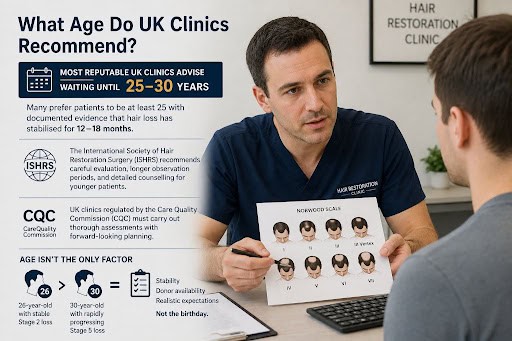
Most established hair restoration clinics in the UK advise waiting until at least 25 to 30 years of age before considering a hair transplant, and many prefer patients to be at least 25 with documented evidence that their hair loss has stabilised over a period of 12 to 18 months.
The International Society of Hair Restoration Surgery (ISHRS), a globally recognised body for professional standards in hair restoration, acknowledges that younger patients require particularly careful evaluation, longer observation periods, and detailed counselling about the progressive nature of their condition. In the UK, clinics regulated by the Care Quality Commission (CQC) are expected to conduct thorough assessments that include this kind of forward-looking planning.
That said, age alone isn’t the deciding factor. A 26-year-old with stable Norwood Stage 2 loss and strong donor density may be a better candidate than a 30-year-old with rapidly progressing Stage 5 loss. The key variables are stability, donor availability, and realistic expectations. Not the birthday.
What you should actually do instead (the smart action plan for your 20s)
Start with medication: it works better than most people think
The two most clinically validated treatments for male pattern baldness are finasteride and minoxidil, and both are worth taking seriously long before you consider surgery.
Finasteride (sold as Propecia and available in generic form) works by blocking the conversion of testosterone to DHT, the hormone responsible for follicle miniaturisation. According to clinical studies cited by the NHS, approximately two-thirds of men taking finasteride see no further hair loss, and some experience partial regrowth. It requires a prescription and carries potential side effects that should be discussed with a GP or dermatologist. It’s also most effective when started early in the hair loss process, which means your 20s is actually the ideal time to begin.
Minoxidil (the active ingredient in Regaine) is a topical treatment applied directly to the scalp. It increases blood flow to follicles and can slow or halt loss in many users. It’s available over the counter and can be used alongside finasteride.
Neither treatment is permanent. Stopping either medication typically leads to resumed shedding within months, but they can buy significant time, stabilise loss, and potentially reduce the number of grafts needed if surgery becomes appropriate later.
Get a proper clinical assessment, not just a free online consultation
One thing that’s worth stating plainly: many clinics offering free online consultations have a commercial incentive to recommend surgery. A thorough, honest assessment requires an in-person examination of your scalp, a family history discussion, and ideally a trichoscopy or scalp biopsy to rule out non-androgenetic causes of hair loss.
At The Skin and Hair Clinic, consultations are structured around long-term outcomes, not just immediate treatment options. Understanding your full picture your pattern of loss, your family history, your donor density is what allows for a plan that actually holds up over time. This is also where surgeons weigh up whether an FUT hair transplant, with its strip harvesting method and typically higher graft yield per session, might suit a patient’s donor characteristics better than other approaches, should surgery ever become appropriate.
Document your hair loss for 12–18 months
If you’re in your early 20s and noticing thinning, the single most useful thing you can do before any clinical intervention is to photograph your hair consistently same lighting, same angles, every three months. This documentation helps clinicians assess the rate of progression, which is often as important as the current state of loss. A patient showing six months of standardised photos demonstrating stable hairline and density is in a very different position from one with no documentation at all.
Hair transplant age 20s: what the Norwood Scale tells you (and what it doesn’t)
The Norwood Scale is useful for communicating the extent of hair loss, but it has limitations. It doesn’t account for the speed of progression, the density of remaining hair, or donor zone quality all of which matter enormously for surgical planning. Two men at Norwood Stage 3 may have completely different surgical prospects depending on those variables.
What the Norwood Scale does usefully illustrate is that male pattern baldness is a progressive condition. There’s no natural plateau that’s guaranteed to hold. This is precisely why most hair restoration surgeons particularly in the UK where clinical standards are comparatively high insist on documented stability before proceeding with surgery in young men.
Common misconceptions about hair transplants for young men
Myth: “Getting a hair transplant early means I’ll have more hair for longer.”
Reality: A transplant doesn’t add hair it redistributes existing donor hair. Using grafts before your loss has stabilised may give a temporary improvement while leaving you with fewer options later when you need them more.
Myth: “Hair transplant technology is so advanced now that early surgery isn’t risky.”
Reality: FUE and FUT techniques have advanced significantly, but neither procedure can account for future hair loss in the native (non-transplanted) follicles. The surgery is technically sophisticated; the uncertainty of progression is biological and outside any surgeon’s control.
Myth: “If I’m on finasteride, it’s safe to have a transplant young.”
Reality: Finasteride significantly reduces the risk of continued loss, but it doesn’t eliminate it. Many surgeons prefer to see at least 12 months of stability on medication before considering surgery as a next step, even for patients already using finasteride.
Take Control of Your Hair Loss Today
If you’re losing hair in your 20s, the urgency you feel is understandable but acting on it surgically before the right conditions are met can create problems that are far harder to fix than the original hair loss. The smart path is to start medication, document your pattern over time, and get a thorough clinical assessment from specialists who will give you an honest picture rather than an easy booking.
At The Skin and Hair Clinic, the starting point is always understanding where your hair loss is going, not just where it is now. That kind of long-term thinking is what produces results that still look natural a decade from now.
FAQ
Q: What is the minimum age for a hair transplant in the UK?
There is no legal minimum age for hair transplant surgery in the UK, but the vast majority of reputable clinics will not perform the procedure on patients under 25, and many prefer patients to be closer to 30. The concern is not age itself but the stability of hair loss young patients whose baldness is still progressing are at significant risk of poor long-term outcomes regardless of the technical quality of the surgery.
Q: Can I get a hair transplant at 20 if my hair loss is severe?
Severity alone doesn’t make surgery appropriate at 20. In fact, more advanced early-onset hair loss in your 20s may be a stronger argument against immediate surgery it often signals that progression will continue significantly, which means any grafts used now may be insufficient as the loss develops. The priority at this stage is stabilisation through medication and close clinical monitoring.
Q: What’s the difference between a hair transplant under 25 and one at 30?
The main difference is predictability. By 30, most men have a clearer picture of their eventual pattern of hair loss, making it easier for a surgeon to plan a result that will still look natural in 20 years’ time. A transplant at 25 or under requires much longer-term planning and a more conservative approach including avoiding aggressive hairline lowering that might look unnatural later.
Q: What should I look for in a hair transplant clinic if I’m in my 20s?
The most important green flag is a clinic that tells you to wait. Any clinic that enthusiastically recommends surgery to a 20-year-old without a thorough assessment and documented stability should be avoided. Look for clinicians regulated by the CQC, affiliations with the ISHRS, and a consultation process that explores non-surgical options before surgical ones.