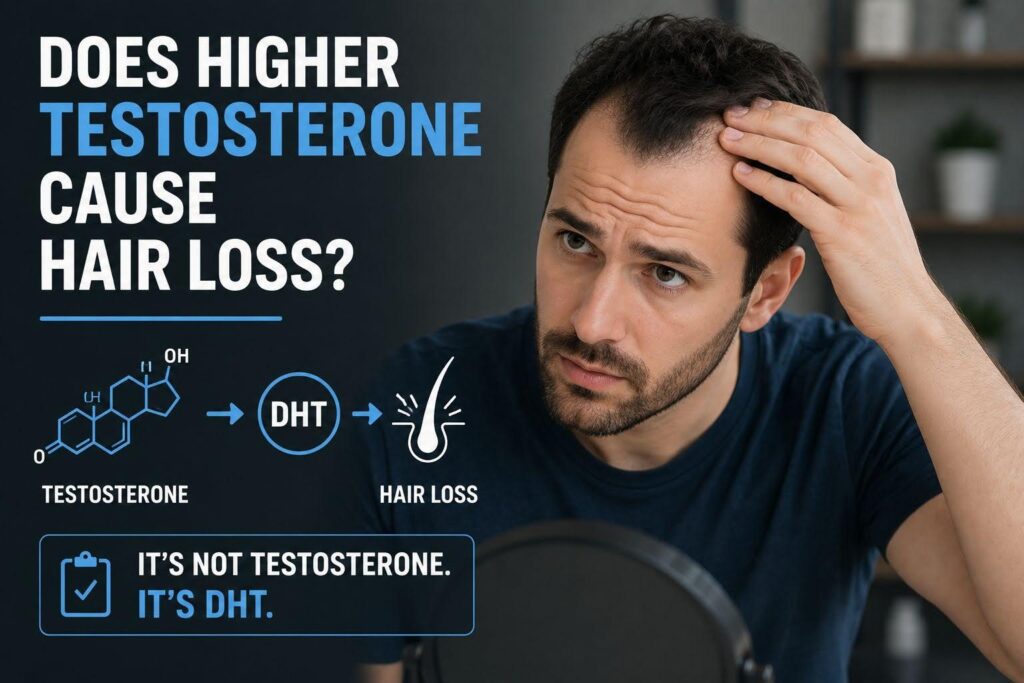
No, higher testosterone alone doesn’t cause hair loss. Your genes decide how your follicles react to it, and that changes everything.
So, does higher testosterone cause hair loss? Not directly. The real trigger is a testosterone by-product called DHT, and how sensitive your hair follicles are to it. This single fact flips the old “more testosterone equals more baldness” myth on its head.
Did you know? According to the NIH, a study comparing bald and non-bald men found no major difference in their total testosterone levels.
If you’ve noticed thinning strands and blamed your hormones, you’re not entirely wrong. But the story is more nuanced than a simple hormone count.This information has been medically reviewed by Dr Jyotsana Kumari to ensure it is clear and clinically informed.
Key Takeaways
- Muscle gain and bone density increase due to testosterone levels. Yet one can still be prone to balding even with high levels.
- The reason why some people are more susceptible to balding while others are not lies in follicle sensitivity to DHT, which your genes dictate.
- In men diagnosed with low testosterone hair loss, there is generally no typical hairline recession but thinning hair over the whole scalp.
- Demonstration of regrowth of hairs with PRP (Platelet Rich Plasma) is due to it activating the dormant hair follicles and increasing the blood supply to the scalp.
- Identifying the exact cause of hair loss early allows timely treatment, improving results and preventing further follicle damage.
What Is the Real Link Between High Testosterone and Balding?
Testosterone itself doesn’t target bald spots, but a small amount of it turns into dihydrotestosterone (DHT) by the action of the 5-alpha-reductase enzyme. This conversion takes place only in the immediate vicinity of the follicle.
DHT finds its way to and joins with receptors in follicles inherited to be very sensitive. It is mainly through the activity of DHT that gradual shrinkage of hair follicles occurs. Hair grows back thinner, shorter, and weaker with each cycle. Eventually, some follicles stop producing hair altogether.
Can High Testosterone Cause Hair Loss Directly?
Many people ask, Can high testosterone cause hair loss on its own? Rarely. Men with naturally high testosterone but low DHT sensitivity often keep a full head of hair. Meanwhile, men with average testosterone but high follicle sensitivity can bald early. Genetics, not hormone volume, calls the shots here.
How Does Testosterone Thinning Hair Actually Happen?
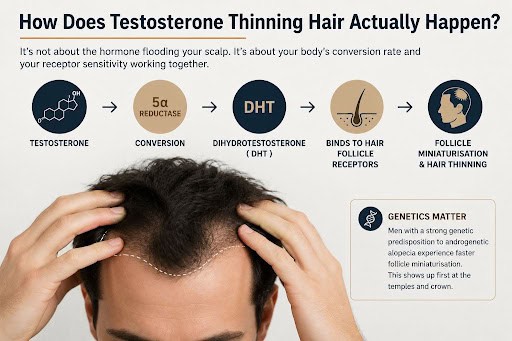
Here’s where it gets specific. Testosterone thinning hair isn’t about the hormone flooding your scalp. It’s about your body’s conversion rate and your receptor sensitivity working together.
Men with a strong genetic predisposition to androgenetic alopecia experience faster follicle miniaturisation. This shows up first at the temples and crown. Recognising the pattern early makes a real difference, and you can read more about the early signs of a receding hairline to catch it sooner.
Does Low Testosterone Hair Loss Work Differently?
Interestingly, low testosterone hair loss is also common, just through a different route. Low hormone levels can disrupt your hair growth cycle. Strands may become brittle, dry, and prone to shedding.
Understanding Low Testosterone Thinning Hair
Low testosterone thinning hair often looks diffuse rather than patterned. It spreads across the scalp instead of receding at set points. Fatigue, low mood, and reduced muscle mass often accompany it. If you notice these signs together, a hormone check is worth it.
Testosterone Levels vs Hair Loss Risk
| Hormone Profile | Typical Hair Impact | Key Driver |
| High testosterone, low DHT sensitivity | Minimal hair loss | Genetics |
| Average testosterone, high DHT sensitivity | Pattern baldness | Follicle receptors |
| Low testosterone | Diffuse thinning, weak strands | Hormonal imbalance |
| High DHT locally | Faster miniaturisation | Enzyme activity |
What Are Your Treatment Options?
Actually, it is perfectly normal for hair to get thin gradually as we get older. But that doesn’t mean that you have to accept it as the natural way. In fact, there are several ways you can fight back against this hair problem that will make you feel good, not just because you are getting rid of the symptom but also because the causes are being treated.
- Medicines that block DHT cause a reduction in the rate of follicle miniaturisation.
- The application of minoxidil results in an increase in the amount of oxygen and nutrients being carried out through tiny blood vessels in the skin to support new hair growth on the scalp.
- Protein, amino acids, vitamins, minerals, etc., in a diet have an impact on the hair’s life cycle by promoting the phase of hair growth.
- Dealing with stress will help lower hair loss that can be attributed to hormonal imbalances.
PRP Hair Treatment: Does It Help?
PRP hair treatment basically employs your own blood platelets as a stimulus to reawaken the dormant follicles for hair regrowth. A specialist first takes a small amount of your blood, then processes it, after which the resultant plasma is injected into areas of the scalp where the hair has gotten thinner. With this procedure, many individuals observe noticeably thick hair regrowth after months. It is quite a gentle procedure, and also it can work very satisfactorily with other hair treatments.
Is Testosterone for Hair Loss Ever Recommended?
Using testosterone for hair loss seems contradictory at first, yet it is mostly men who have low testosterone levels. Fixing a very real testosterone deficiency can not only rejuvenate hair condition but also enhance hair vitality. Still, one’s entire body reacts to any kind of supplement, and because of this, it has to be done under a doctor’s guidance. Self-medicating testosterone could result in side effects and potentially cause further hair loss, mostly in men genetically sensitive to hair loss, if they do not properly check the levels.
Common Mistakes Men Make
- Assuming shaving the head increases testosterone or promotes hair growth.
- Believing frequent gym workouts directly causes baldness.
- Ignoring early signs of hair thinning and hoping it will reverse naturally.
- Delaying treatment instead of addressing hair loss at the first signs.
- Waiting too long, reducing the chances of achieving the best treatment results.
Regain Thicker Hair with Personalised Treatment!
Guessing “does higher testosterone cause hair loss” wastes precious time your follicles don’t have. A proper diagnosis tells you whether genetics, DHT sensitivity, or a hormonal imbalance is behind your thinning hair. The Skin and Hair Clinic offers trichology assessments and tailored treatment plans, including PRP therapy, so you get a plan built for your exact hair loss cause, not a generic guess.
FAQs
Q: Does higher testosterone cause hair loss in every man?
No. It’s the genetic response to DHT that causes it, not the amount of testosterone. A good number of high testosterone-dominant men still have healthy, full heads of hair.
Q: Can high testosterone cause hair loss in women too?
Yes, but less common. High androgen levels in women can cause diffuse thinning, Most of all in hyper-androgenic conditions such as PCOS.
Q: Can low testosterone-related hair loss be fixed with treatment?
In many cases, yes. Getting your natural testosterone back with medically supervised treatment might help restore some hair volume. But every person responds differently.
Q: Is the PRP treatment good for hair thinning caused by hormones?
PRP can be good for the initial phases of hair loss. The treatment increases blood flow and revives inactive follicles. But the results require time and usually become visible after several months.
Q: Should I stop TRT if I notice testosterone thinning hair?
Don’t stop without medical advice. A doctor can adjust your dosage or add a DHT blocker instead of halting therapy abruptly.