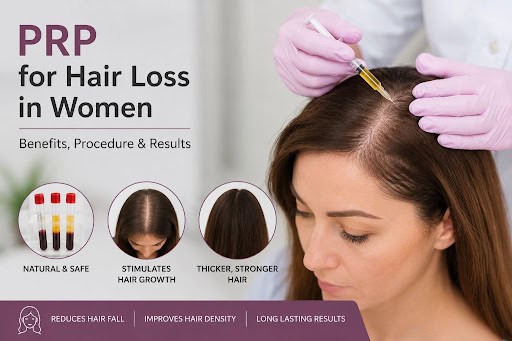
PRP for hair loss in women can thicken strands, boost density, and calm shedding, often within a few months. Here’s what actually happens once the needle touches your scalp.
Did you know? According to UCLA Health, female pattern hair loss affects roughly 40% of women by the age of 50.
That’s a huge number, yet most women never talk about it. PRP for hair loss in women has quietly become one of the go-to solutions. At The Skin and Hair Clinic, it’s usually the first question a new patient asks. Does this treatment really work, or is it just another wellness trend? In this blog, we will learn about PRP for hair loss in women, benefits, procedure, and results.
Key Takeaways
- PRP for hair loss in women uses your own blood to activate follicles naturally.
- Clinical research backs up real gains in hair density and thickness.
- Early-stage thinning tends to respond better than advanced scarring alopecia.
- Sessions are quick, minimally invasive, and need almost no downtime.
- Sticking with maintenance sessions is what makes the results last.
What Is Female PRP Hair Treatment?
Female PRP hair treatment starts with your own blood, not some lab-made serum. A nurse draws a small sample, much like a routine blood test. That sample then spins in a centrifuge to separate out the platelets. Those platelets carry growth factors your body already makes. The concentrated plasma goes straight back into your scalp.
How Platelet-Rich Plasma Hair Treatment Differs From Other Options
Tablets and topical serums sit on the surface, more or less. Platelet-rich plasma hair treatment works from the inside instead. It doesn’t hide thinning under fibres or sprays. It nudges your own follicles to do the growing.
PRP for Hair Loss: Does It Work?
Many people ask, “Does PRP for hair loss work?” Here is the clear answer: a 2024 systematic review pooled data from 21 randomised trials involving 628 women. It found PRP significantly improved hair density and thickness. Shedding also dropped noticeably among treated participants.
Results still vary from woman to woman, though. Some see modest change. Others notice a real difference within weeks. Age, hormones, and the underlying cause of loss all shift the outcome.
Does PRP Work for Hair Loss in Every Case?
Not really. Women catching thinning early tend to see the best response. Advanced scarring alopecia is a tougher case, and results there can be limited. A proper scalp check before you start sets realistic expectations from day one.
Key Benefits of PRP Shots for Hair Loss
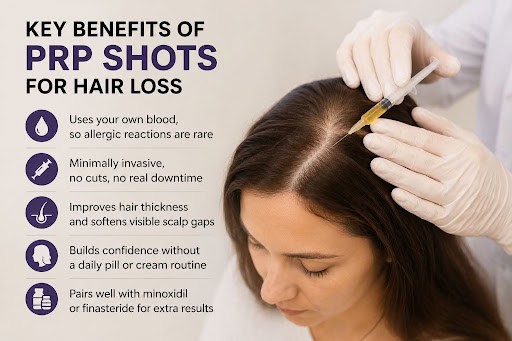
Why do so many women choose this route? PRP shots for hair loss bring a few clear advantages:
- Uses your own blood, so allergic reactions are rare
- Minimally invasive, no cuts, no real downtime
- Improves hair thickness and softens visible scalp gaps
- Builds confidence without a daily pill or cream routine
- Pairs well with minoxidil or finasteride for extra results
Hair Injections for Women: The Procedure Explained
Hair injections for women follow a fairly simple routine. First, a small vial of blood is drawn from your arm, quick and painless enough. Then a centrifuge spins it down to isolate the platelet-rich layer. Finally, a practitioner injects that plasma across the thinning patches.
What Happens During PRP Hair Treatment for Women Sessions
A typical PRP hair treatment for women session runs about 45 minutes. Numbing cream keeps things comfortable during the injections. Most women describe it as pricking, not real pain. You can head back to your day right after.
Results Timeline: What to Expect
Patience matters here, so here’s roughly what to expect along the way.
| Time After Treatment | What You Might Notice |
| 2 to 4 weeks | Reduced hair shedding |
| 6 to 8 weeks | Slightly thicker strands |
| 3 to 4 months | Visible new growth begins |
| 6 months | Noticeable density improvement |
| 12 months | Fuller, stronger results with maintenance |
Pro tip: Book maintenance sessions every four to six months. Consistency beats a single one-off treatment every time.
Who Should Consider This Treatment?
Women catching early female pattern hair loss usually benefit most. Postpartum thinning and stress-related shedding tend to respond well, too. Pregnant women, though, should hold off until after delivery. Anyone with a blood disorder should talk it through with a specialist first.
Common Mistakes Women Make With PRP
Many women expect miracles after just one session. Hair grows slowly, so patience really does pay off here. Skipping maintenance appointments is another common trap, and it weakens long-term results. Picking an unqualified provider to save a few pounds rarely ends well either.
Start Your Hair Restoration Journey Today!
Thinning hair doesn’t have to sit at the centre of how you see yourself. PRP for hair loss in women offers a natural, science-backed way forward, without drastic measures. Want guidance customized to your own scalp? Book a consultation with The Skin and Hair Clinic by visiting our website. Our team can also walk you through combining PRP with proven options like finasteride for female hair loss for stronger, longer-lasting results. This information has been medically reviewed by Dr Jyotsana Kumari to ensure it is clear and clinically informed.
FAQs
Q: Is PRP painful for hair loss treatment?
Most women feel mild pricking rather than real pain. Numbing cream keeps discomfort low throughout the session.
Q: How many PRP sessions do women need?
Most clinics recommend three to four initial sessions. These sit around four to six weeks apart.
Q: Does PRP regrow hair completely?
Not quite. PRP thickens existing hair and slows shedding effectively. It works best on follicles that are still active, not fully bald patches.
Q: Can PRP be combined with other hair loss treatments?
Yes, plenty of women pair PRP with minoxidil or finasteride. Combining treatments often gets better overall results.
Q: How long do PRP results last for women?
Results usually last six to twelve months per course. Maintenance sessions help keep that thicker, fuller look going.