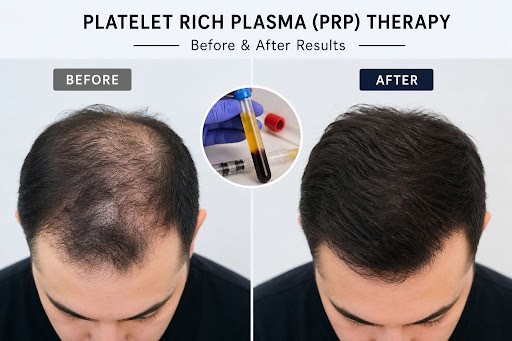
Most people notice something changing with PRP hair treatment within three to six months, and hair looks genuinely thicker by the one-year mark. Wondering what your own timeline could look like? Keep reading.
Did you know? A clinical study published in PMC found that PRP injections increased the mean hair count by around 62%, with thickness improving by nearly 59%, after just two sessions.
That’s not a small improvement. It’s an actual shift, and not just marketing spin. Anyone searching for Platelet Rich Plasma before and after photos usually wants proof before spending time and money on it. So this blog walks you through what actually happens, roughly week by week, so you know what to expect from PRP hair loss treatment.
Key Takeaways
- PRP hair loss treatment usually shows visible results between three and six months.
- Clinical studies report meaningful gains in hair count, thickness, and density.
- Three to four consistent sessions tend to produce the strongest PRP hair results.
- Early-stage hair loss generally responds faster than advanced balding does.
- Maintenance sessions help sustain your platelet-rich plasma before and after progress over the long run.
What Happens During Your PRP Journey
PRP therapy starts with your own blood, oddly enough. A small sample gets spun in a centrifuge, which separates out the platelet-rich layer. That concentrated plasma then gets injected into the thinning parts of your scalp. Growth factors inside it wake up dormant follicles and get blood flowing to areas that need it.
Once you understand What Is PRP Treatment, it’s easier to set realistic expectations for your platelet-rich plasma results.
Common Terms You’ll See in PRP Hair Results
- Anagen phase: The active growth stage of a hair follicle
- Trichogram: A scan that measures hair density and count
- Androgenetic alopecia: The medical term for pattern hair loss
- Follicular unit: A small cluster of hairs growing together
PRP Before and After: A Realistic Timeline
Results for platelet-rich plasma before and after don’t show up overnight, unfortunately. Your scalp needs time to respond to all those growth factors. Below is a general timeline, based on both clinical evidence and what patients tend to report.
| Timeframe | What You Might Notice |
| Weeks 1 to 4 | Less shedding, a bit less hair in the shower drain |
| Months 2 to 3 | Fine baby hairs are starting to poke through |
| Months 4 to 6 | Strands feel thicker, scalp coverage improves |
| Months 9 to 12 | Fuller density, particularly with three or more sessions |
Everyone’s timeline shifts a little depending on how severe the hair loss is and how their body responds.
PRP Hair Treatment Before and After: What the Data Shows
One study followed patients through three treatment cycles and reported an average gain of 18 hairs in the target area, with total hair density rising by nearly 28 hairs per square centimetre. A separate review found patient satisfaction scores averaging 7.29 out of 10, which suggests most people walk away genuinely pleased with the outcome.
These numbers matter because they show that PRP for hair loss before and after results are not just based on appearance alone. Clinical studies have shown measurable improvements in hair density, thickness, and growth, proving that PRP therapy can create real changes when used for suitable hair loss cases.
What makes these figures significant is that the results of PRP hair loss before and after hair regrowth are not simply based on subjective appearances. Evidence points to a significant reduction in hair fallout plus enhanced overall thickness and even hair regrowth. These effects show that PRP therapy is a valid, real treatment option for hair loss as well, with patients seeing actual hair changes.
Factors That Shape Your PRP Hair Before and After Outcome
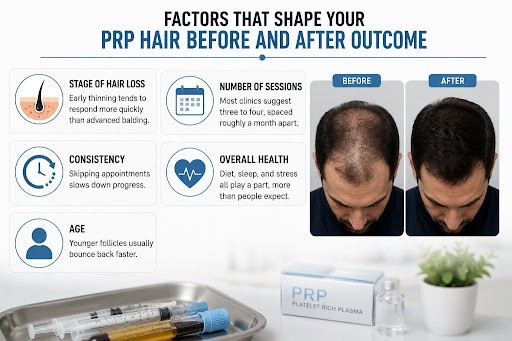
Not every scalp responds the same way, and that’s worth knowing. A handful of factors influence how strong your platelet-rich plasma hair results end up being.
- Stage of hair loss: Early thinning tends to respond more quickly than advanced balding
- Number of sessions: Most clinics suggest three to four, spaced roughly a month apart
- Consistency: Skipping appointments slows down progress
- Overall health: Diet, sleep, and stress all play a part, more than people expect
- Age: Younger follicles usually bounce back faster
PRP Hair Results Compared to Other Options
A lot of patients ask how PRP stacks up against surgery. If your hair loss is more advanced, it’s worth understanding the benefits of hair transplant surgery alongside PRP, since combining the two can sometimes deliver stronger, longer-lasting results. PRP also works well as a supporting therapy on either side of a transplant, helping grafts survive and keeping the scalp healthy.
Curious why so many people are switching to this treatment lately? PRP benefits for hair restoration cover the complete picture, from safety through to long-term maintenance.
A systematic review of the clinical evidence concluded that PRP is safe and effective for improving hair density, cutting down hair loss, and boosting patient satisfaction. That makes it one of the more evidence-backed non-surgical options out there right now.
Find the Right PRP Treatment for Your Hair!
Everyone experiences hair thinning and loss in their own way, and PRP therapy should be customised to the severity of one’s scalp condition, hair loss pattern, and goals. The Skin and Hair Clinic consultation will help you get answers about your suitability for PRP therapy and the level of improvement you can realistically achieve. Our dermatologists prepare customised therapy regimens to help you regrow thicker, healthier hair. Take the first step towards restoring your hair confidence with expert guidance. This information has been medically reviewed by Dr Jyotsana Kumari to ensure it is clear and clinically informed.
FAQs
Q: Is PRP hair treatment painful?
First of all, a topical anaesthetic cream will help with numbing the area, which makes the process as painless as possible one may still feel a slight pinch or soreness at the injection site.
Q: How many PRP sessions will I need?
Experts usually advise starting off with three to four sessions and then having maintenance injections at intervals of 6 to 12 months for optimal results.
Q: Do we have PRP for any type of hair loss?
It shows the maximum effect for hair thinning and mild balding due to androgenetic alopecia. A combination of PRP with a hair transplant may be necessary when it comes to completely bald spots.
Q: Are PRP hair before and after results permanent?
They last longer with maintenance sessions. Skip the upkeep, and hair loss can gradually creep back over time.
Q: When will I start seeing PRP hair treatment results?
Most people report experiencing much less hair shedding after one month. The increase in hair thickness and decrease in hair loss are generally more evident over a two- to three-month period. Maximum results can be reached right after the completion of the prescribed number of courses of the therapy and continue improving during a period of up to one year.