That’s a lot of people and thus they are concerned about hair restoration vs hair transplant, and which actually works. In this blog, we will understand what the difference between hair transplant and hair restoration is, and which one to choose. So, read until the end!
Did you know? According to the National Council on Aging, 6.5 million men and 8 million women in the UK are dealing with hair loss right now.
Key Takeaways
- Hair restoration vs hair transplant really comes down to how severe your loss is, your budget, and how permanent you want the fix to be.
- Non-surgical hair restoration works well for early thinning, but it needs ongoing use to keep working.
- A transplant offers permanent results from a single procedure.
- Costs differ quite a bit: restoration means paying repeatedly, transplants mean one bigger payment.
- Getting a proper diagnosis first is the real starting point, whichever treatment you end up choosing.
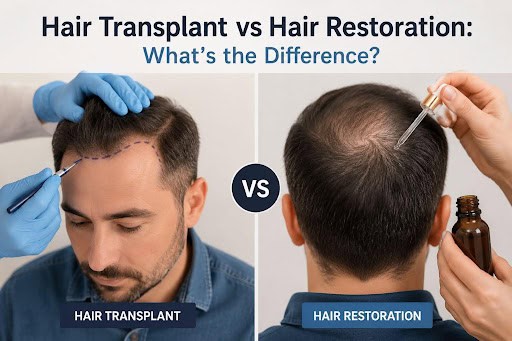
A hair transplant is a surgical procedure that permanently moves healthy hair follicles to thinning or bald areas. Hair restoration is a broader term that includes both surgical and non-surgical treatments, such as PRP therapy and medications, designed to reduce hair loss and improve hair growth.
Understanding Hair Restoration Options
Hair restoration covers anything that slows down loss or thickens hair. Shampoos, laser caps, PRP injections, minoxidil, finasteride- all of are its part.
Most people start with non-surgical hair restoration. It’s less invasive, cheaper to begin with, and there’s no downtime. Results depend on how consistent you are. Skip a few weeks, and progress often stalls out.
Non-surgical hair restoration routes tend to work best on early-stage thinning. They improve blood flow to the follicles and slow the shedding. What they rarely do is bring hair back in patches that have gone fully bald.
What Does a Hair Transplant Actually Involve?
A hair transplant is a simple surgical procedure. A surgeon takes healthy follicles from a donor area (usually the back of the scalp) and moves them to thinning or bald patches. Two techniques dominate here: FUE and FUT.
FUE pulls individual follicles one by one. FUT removes a thin strip of scalp, then splits it into grafts. Either way, once healed, you get permanent, natural-looking hair.
No daily maintenance is needed to keep the results, unlike creams or serums. Transplanted hair grows just like the rest of your natural hair. That’s one of the biggest benefits of hair transplant surgery, and it’s why so many people choose it every year.
Hair Restoration vs Hair Transplant: The Key Differences
| Factor | Non-Surgical Restoration | Hair Transplant |
| Invasiveness | None to minimal | Surgical |
| Results | Temporary, needs upkeep | Permanent |
| Downtime | None | A few days to a week |
| Best for | Early thinning, prevention | Advanced baldness, bald patches |
| Cost over time | Ongoing spend | One-off, higher upfront cost |
How Much Does Hair Restoration Treatment Cost?
Costs swing a lot depending on the method. A basic minoxidil routine can run as little as £20 a month. PRP sessions and laser therapy sit somewhere in the middle, usually billed per visit.
Wondering how much is hair restoration treatment stacks up against surgery? Here’s the thing to remember: non-surgical routes need repeated spending, often for years. A transplant costs more at the beginning, but it’s typically a one-time investment.
What Is the Best Treatment for Hair Loss?
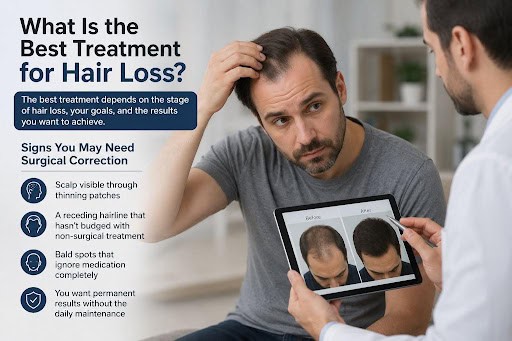
Honestly, there’s no single answer to what is the best treatment for hair loss. It comes down to how far your thinning has progressed, your budget, and what you’re actually hoping to achieve.
Early shedding usually responds well to non-surgical options. Advanced baldness, especially where the scalp is clearly visible, generally needs surgery for real, lasting change. A proper consultation with a specialist clears up most of this confusion fast.
Signs You May Need Surgical Correction
- Scalp visible through thinning patches
- A receding hairline that hasn’t budged with non-surgical treatment
- Bald spots that ignore medication completely
- You want permanent results without the daily maintenance
Hair Restoration for Thinning Hair: What Actually Works
Hair restoration for thinning hair starts with a proper diagnosis, and that step gets skipped more often than it should. A trichologist checks whether the cause is genetic, hormonal, or stress-related.
Once you know the cause, treatment becomes a lot more effective. Some people combine minoxidil with PRP for faster, fuller-looking results. Others jump straight to a transplant once thinning crosses a certain threshold.
Pro tip: the earlier you act, the better your long-term outcome tends to be.
Your Next Step Towards Healthy Hair Starts Here!
Choosing between hair restoration vs hair transplant can feel overwhelming, but the right guidance makes the decision much easier. A personalised consultation can help you understand your hair loss pattern, explore suitable treatment options, and choose an approach that matches your goals. The Skin and Hair Clinic provides expert advice and customised solutions to help you achieve healthier, fuller-looking hair. This information has been medically reviewed by Dr Jyotsana Kumari to ensure it is clear and clinically informed.
FAQs
Q: Is hair restoration the same as a hair transplant?
Not quite. Restoration means non-surgical methods, while a transplant is surgical, using your own follicles.
Q: Can non-surgical hair restoration regrow hair completely?
It can thicken hair and slow loss, but it rarely regrows hair in fully bald areas.
Q: How long do hair transplant results last?
Transplanted hair is generally permanent, since it’s taken from donor areas resistant to balding.
Q: Is hair restoration painful?
Most non-surgical treatments don’t hurt at all. Transplants involve some mild discomfort, managed with local anaesthesia.
Q: Who is a good candidate for a hair transplant?
Anyone with stable donor hair and noticeable thinning or baldness usually qualifies.