
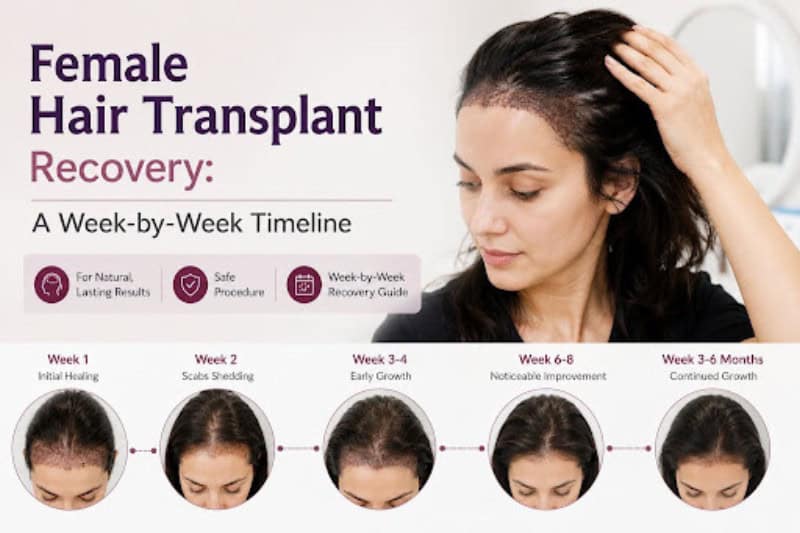
Female hair transplant recovery follows a predictable week-by-week timeline, with healing beginning immediately after surgery, noticeable growth appearing within two to six months, and full results typically developing between twelve and eighteen months. Full recovery takes about a year, but most of the visible change happens in the first six months.
Losing hair as a woman hits differently, and getting it back feels personal too. Whether you’ve already booked your procedure or you’re still on the fence, you need a real female hair transplant recovery timeline, not a vague “give it time” answer.
This guide breaks the process down stage by stage, from surgery day right through to month twelve, so you’re not left guessing what’s normal.
Key Takeaways
- Shock loss between weeks two and six is completely normal, as transplanted follicles temporarily shed before regrowing healthy hair.
- Visible hair density gradually improves between months four and nine, creating fuller coverage and a more natural appearance.
- Full transplant results may take up to eighteen months, allowing hair to mature, thicken, and blend naturally.
- Transplanted hair usually retains its natural colour and texture, matching surrounding strands for a seamless overall appearance.
- Proper aftercare protects grafts, supports healing, and significantly improves the chances of strong, healthy long-term hair growth.
Week One
The first seven days matter more than people expect. Expect some tenderness, and mild swelling isn’t unusual either.
- Small scabs form around each graft
- Redness starts fading within days
- Sleeping with your head propped up helps with the swelling
- Gentle washing usually kicks in around day three, once your surgeon gives the go-ahead
Try to leave the area alone. Grafts are still bedding in, and poking or scratching can undo that progress.
Weeks Two to Four
This is the stage that tests everyone’s patience. The hairs that were just placed start falling out, and honestly, the scalp can look a lot like it did before surgery.
Don’t let that fool you. The follicle is still there, sitting under the skin, even once the visible strand is gone. It’s simply resting before it pushes through again later.
Weeks Five to Eight
Not much seems to happen here, which can be oddly frustrating. Underneath, though, the follicles are anchoring themselves and getting ready for the next phase.
Swelling and redness should be gone by now. Scalp sensitivity settles too, so most people slip back into their normal hair routine around this point.
Months Two to Three
You might start noticing fine, thin hairs coming through in the treated areas. Growth here is patchy and a bit unpredictable, so don’t judge the outcome just yet.
Some women also notice the new strands feel different at first, before they mature into something closer to the surrounding hair.
Months Four to Six
This tends to be the real turning point in a female hair transplant recovery journey. Hair gets thicker, coverage improves, and styling stops feeling like a chore.
| Stage | Timeframe | What’s Happening |
| Healing | Days 1–14 | Scabbing, redness, and swelling settle down |
| Shock loss | Weeks 2–6 | Transplanted hairs shed temporarily |
| Dormancy | Weeks 6–8 | Follicles anchor beneath the scalp |
| Early growth | Months 2–4 | Fine new hairs start emerging |
| Density build | Months 4–9 | Hair thickens noticeably |
| Final result | Months 9–18 | Full density and natural texture settle in |
For a lot of women, this is when confidence shifts too, because the difference finally becomes obvious to other people, not just to you in the mirror.
Months Nine to Twelve
By month nine, most patients can already see a real change in density. Full maturity can still take up to eighteen months for some, and that’s completely normal.
If you’re comparing female hair transplant before and after photos, this stage usually shows the clearest jump. The texture blends in with your existing hair, and the treated area stops looking like a separate patch.
Can You Restore Hair Colour Naturally?

A lot of women ask this one: does regrown hair come back in its original shade, or something else entirely? Transplanted follicles usually keep their natural pigment, since they carry the same genetic blueprint as wherever they came from on your scalp. So if you’re wondering whether can you restore hair colour naturally is even possible, the answer is generally yes, because the transplant itself doesn’t touch pigment production. Any greying that shows up later is just normal ageing, nothing to do with the surgery.
What Is the Best Hair Recovery Treatment Alongside Surgery?
Surgery on its own isn’t always the full picture. When patients ask what is the best hair recovery treatment to pair with a transplant, a few options tend to come up consistently among clinicians:
- PRP (platelet-rich plasma) injections, which can support graft survival
- Gentle, sulphate-free shampoos while the scalp is still healing
- Keeping the area away from strong sun and heavy sweating
- Cutting out smoking, since it can slow healing down
None of these replace the surgery itself, but paired with proper guidance, they can genuinely improve how things turn out.
Supporting Your Scalp Through Female Hair Restoration
Good aftercare shapes the outcome nearly as much as the surgery does. It also helps to understand female pattern hair loss causes and treatment ahead of time, since things like hormones or genetics can quietly influence how your hair responds over the long run. A few small habits go a long way during female hair restoration:
- Sleep on your back for the first week
- Skip tight hats or hairstyles for about a month
- Hold off on intense exercise until your surgeon clears you
- Don’t skip your follow-up appointments
These small choices in the early weeks protect the grafts and support the benefits of hair transplant surgery you’re ultimately working towards.
Book Your Consultation with The Skin and Hair Clinic Today!
Waiting for full results tests anyone’s patience, but knowing the female hair transplant recovery timeline makes it easier to sit with. Every stage, from the scabbing to the shedding to the slow, steady regrowth, plays its part in the outcome. If you’re ready to start this journey with proper support behind you, The Skin and Hair Clinic offers guidance built around your specific needs, from your first consultation right through to your final results. This information has been medically reviewed by Dr Jyotsana Kumari to ensure it is clear and clinically informed
FAQs
Q: How long does female hair transplant recovery take overall?
Most women are back to daily life within two weeks, though full density can take nine to eighteen months to show up.
Q: Is shedding after a hair transplant normal for women?
Yes. Shock loss between weeks two and six is expected, and it doesn’t affect your final result.
Q: When can I wash my hair after a female hair transplant?
Gentle washing usually starts around day three, using a mild shampoo your surgeon has approved.
Q: Will transplanted hair match my natural colour?
Yes, in most cases. Transplanted follicles carry the same pigment instructions as the donor area, so the colour tends to match naturally.
Q: When will I see final results from my transplant?
Most patients notice a real difference by month nine, with things settling into their final form by months twelve to eighteen.