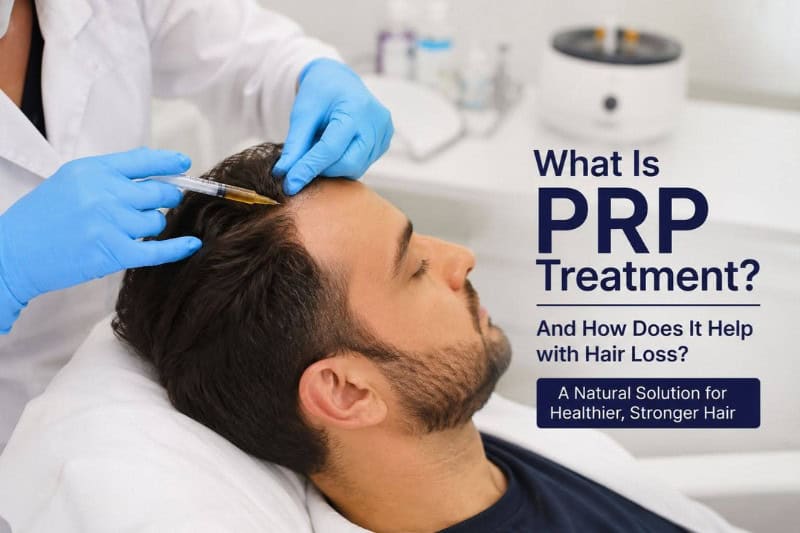
PRP treatment (Platelet-Rich Plasma) is a non-surgical hair restoration procedure that uses platelets from your own blood to stimulate inactive hair follicles. It helps reduce hair shedding, encourages healthier hair growth, and improves hair density naturally over time.
Did you know? According to a report by NIH, platelet rich plasma was consistently linked to higher hair density compared with a placebo.
It’s a big reason clinics across the UK now treat this as a serious option for thinning hair, not a fad. At The Skin and Hair Clinic, patients tend to ask the same thing first: what is PRP treatment, really? So, let’s understand it thoroughly!
Key Takeaways
- PRP therapy involves extracting, concentrating, and using your own platelets, which is a completely natural way of stimulating hair follicles.
- Different studies have demonstrated that hair density and thickness can be enhanced at measurable levels after using platelet-rich plasma (PRP).
- Platelet-rich plasma (PRP) treatment against alopecia in women is most effective for widespread hair loss.
- The healing process after PRP injection takes very little time, so almost everyone can get back to doing their everyday things very quickly, the same day they get the injections.
- Effects of platelet-rich plasma (PRP) on hair growth are usually visible after four to six months.
What Does PRP Stand For?
PRP stands for Platelet Rich Plasma. That’s the platelet-rich plasma meaning in three words: no complications.
Your blood carries platelets: tiny cells packed with growth factors. These growth factors repair tissue and start healing. PRP therapy just concentrates them, then puts them exactly where you need them most: your scalp.
How Does PRP Rich Plasma Actually Work?
A nurse or doctor draws a small portion of your blood, much like a routine blood test. It goes into a centrifuge, which spins it fast enough to separate it into layers. The PRP rich plasma layer, the one thick with platelets, gets drawn off and injected back into the thinning parts of your scalp. From there, the growth factors get to work. They:
- Stimulate hair follicle stem cells
- Extend the growth phase of the hair cycle
- Improve blood flow around each follicle
- Reduce follicle inflammation and early cell death
It’s a genuinely natural process too. Nothing synthetic enters your body at any point. Your own blood does the heavy lifting.
Does Platelet Rich Plasma Work?
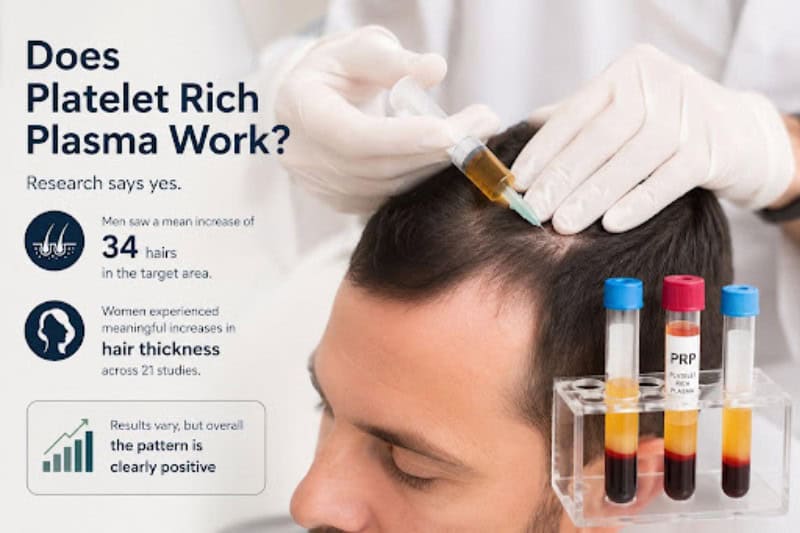
Here’s the question everyone actually cares about. Does platelet rich plasma work? For a lot of people, yes. Take a widely cited NIH-published study that followed men with pattern hair loss across three treatment cycles. Patients ended up with a mean increase of nearly 34 hairs in the target area, plus a real bump in overall hair density from where they started.
Women see similar gains. A 2024 systematic review pulling together 21 trials and 628 participants found PRP therapy meaningfully increased hair thickness compared with control groups.
Results still vary from person to person, though. Genetics, how advanced the hair loss is, and how consistent you are with sessions all play a part. Even so, the pattern across these studies leans clearly positive.
PRP Hair Restoration Therapy: Who Is It For?
PRP hair restoration therapy isn’t limited to one type of patient. It suits a fairly wide range of people.
Men With Androgenetic Alopecia
Male pattern baldness tends to respond well when you catch it early. Treating thinning at the crown or hairline sooner rather than later gives follicles a real shot at recovery.
PRP for Hair Loss in Women
PRP for hair loss in women has picked up serious momentum lately. Female pattern hair loss usually shows up as overall thinning rather than a receding hairline, and PRP treats the whole scalp, which fits that pattern nicely.
Post-Transplant Patients
Plenty of clinics now pair PRP with hair transplant surgery. It helps grafts survive and speeds up healing during the weeks that follow.
PRP Treatment in the UK: What to Expect at a Clinic
Search PRP treatment in the UK, and you’ll get dozens of clinics appearing, so it helps to know what a proper session actually involves before you book anything.
| Step | What Happens | Typical Time |
| Blood draw | Small vial taken from your arm | 5 minutes |
| Centrifuge spin | Blood is separated into layers | 10-15 minutes |
| Scalp numbing | Topical anaesthetic applied | 15-20 minutes |
| PRP injections | Plasma is injected into the scalp | 20-30 minutes |
| Aftercare advice | Instructions given before you leave | 5 minutes |
A full session usually wraps up in under an hour. Most patients describe the injections as mild discomfort, a bit like a series of small pinpricks rather than anything sharp or lasting.
PRP Injection Recovery Time
PRP injection recovery time is short, honestly shorter than most people expect. Most patients are back to their normal day within hours. You might notice:
- Slight redness on the scalp for a few hours
- Mild tenderness where the injections went in
- Minor swelling that settles within 24 to 48 hours
Skip washing your hair for a day, hold off on intense exercise briefly, and stay out of direct sun. That’s really it. There’s no lengthy downtime here, which is exactly why the benefits of PRP for hair restoration suit people with packed schedules.
Platelet Rich Plasma Hair Results: A Realistic Timeline
Platelet-rich plasma hair results don’t show up overnight, and anyone who tells you otherwise is overselling it. Hair growth is a slow biological process, and PRP works with that rhythm instead of fighting it.
- After 1-2 Months: Decreased hair shedding, hairline or scalp changes
- After 3-4 Months: Very thin hairs reappearing at the surface
- After 6 Months: Hair coverage becomes noticeably thicker, denser
- After 9 to 12 Months: Full results are visible, often maintained with top-up sessions
Most protocols involve three to four sessions, spaced one month apart, to achieve noticeable PRP before and after results. After that, maintenance treatments are typically recommended every four to six months.
Common Mistakes People Make With PRP
Booking a single session of platelet plasma treatment for hair loss and expecting instant thickness is probably the biggest mistake people make. PRP builds results gradually, through repeated stimulation over time, not in one go. Skipping the maintenance sessions is another common slip. Follicles need ongoing support to hold onto their gains, especially with progressive conditions like androgenetic alopecia.
Picking an unqualified provider is a real risk as well. Poor technique or contaminated equipment can lead to infection or patchy, uneven results. Always check the clinician’s training and the clinic’s hygiene standards before you commit to booking.
Book Your PRP Hair Consultation Today!
Still wondering what is PRP treatment? Well, the best way to get a clear understanding of how this treatment might help you is through a personalised consultation. PRP is simply the use of naturally occurring substances in the body to stimulate dormant or inactive hair follicles and, at the same time, reduce hair loss while encouraging healthy hair growth.
At The Skin and Hair Clinic, our professionals will analyse your hair concerns, let you know if PRP suits your condition, and prepare a treatment programme just for you. Book your consultation today and take the first step towards stronger, fuller-looking hair with expert guidance you can trust. This information has been medically reviewed by Dr Jyotsana Kumari to ensure it is clear and clinically informed
FAQs
Q: Is PRP treatment painful?
Most of the patients get a feeling of mild discomfort, which still resembles the small prick of tiny needles. Numbing cream can be applied to reduce the feeling before one gets the injections.
Q: How many PRP sessions will I need?
The majority of individuals go through three to four initial PRP sessions spaced a month apart, followed by a maintenance regimen every four to six months.
Q: Can PRP be combined with other hair loss treatments?
Yes. It is common for clinics to combine PRP with minoxidil, finasteride, or hair transplant surgery for the best results.
Q: Is PRP suitable for everyone?
PRP is relatively safe in general. Still, those who have certain blood disorders or types of scalp infection should check with the doctor before receiving treatment.
Q: How soon will I see PRP hair growth results?
Early changes like reduced shedding show up within two months. Fuller, thicker growth usually follows by month six.