
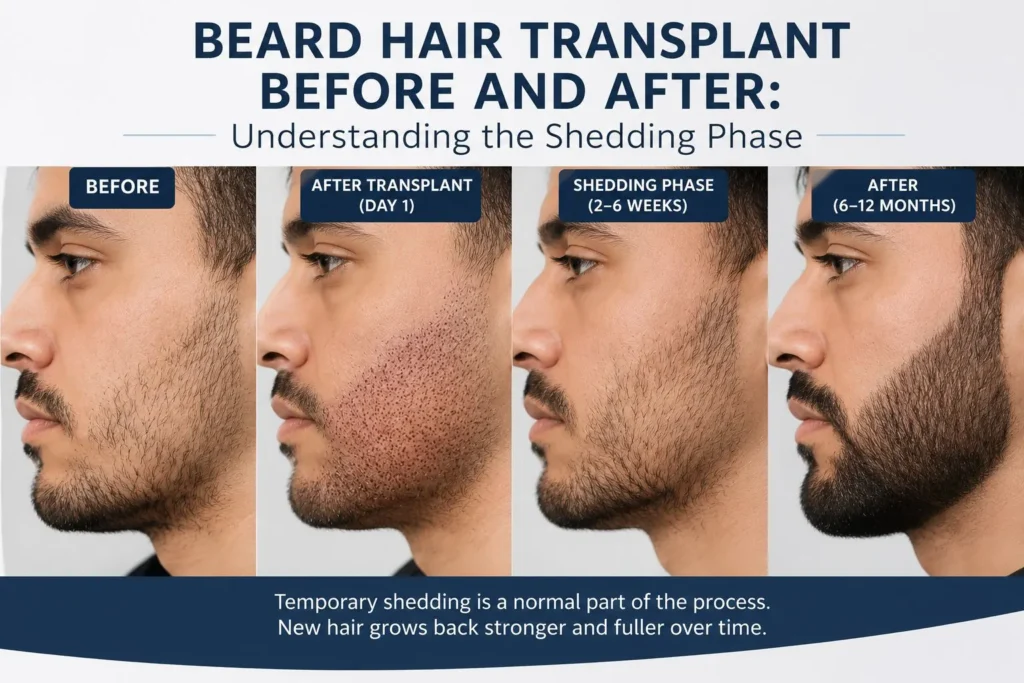
Beard hair transplant before and after photos usually skip straight from “patchy” to “full and dense,” which is misleading. Between those two points sits a stage almost nobody shows you: the shedding phase, when the newly transplanted hairs fall out again. It’s a normal part of how a beard transplant works, but if you don’t know it’s coming, it can feel like the procedure has failed. This guide walks through the full timeline, why shedding happens, and what a genuine before-and-after actually looks like at each stage.
What a beard hair transplant actually involves
A beard hair transplant moves individual follicles, usually from the back of the scalp, into thin or patchy areas of the beard. Most beard transplant UK clinics use FUE (Follicular Unit Extraction) or DHI (Direct Hair Implantation), both of which avoid the linear scarring linked to older strip methods, and implant follicles at an angle matching your natural growth direction.
Graft numbers vary depending on what you’re fixing: filling gaps along the cheek line might need 1,000–2,000 grafts, while building a full beard from close to nothing can require 1,500–4,700, depending on donor density and how full you want the result.
[IMAGE: Diagram showing donor area on scalp and recipient areas on the face]
The beard transplant before and after timeline, stage by stage
The full transformation takes roughly a year, and it doesn’t move in a straight line. Knowing what happens at each point stops you from panicking halfway through.
Days 1–7: redness, scabs, and swelling
In the first week, the transplanted area looks worse, not better. Expect redness around each graft site, small scabs, and some swelling, particularly near the lip or jawline. Grafts are still fragile and haven’t fully anchored, so scrubbing, picking at scabs, or shaving is off the table until your clinic gives the go-ahead.
Weeks 2–4: settling in
The scabs flake off naturally and the redness fades. The transplanted hairs are often still visible at this point, which can create a false sense that everything’s going well. That’s about to change.
Months 1–3: the shedding phase
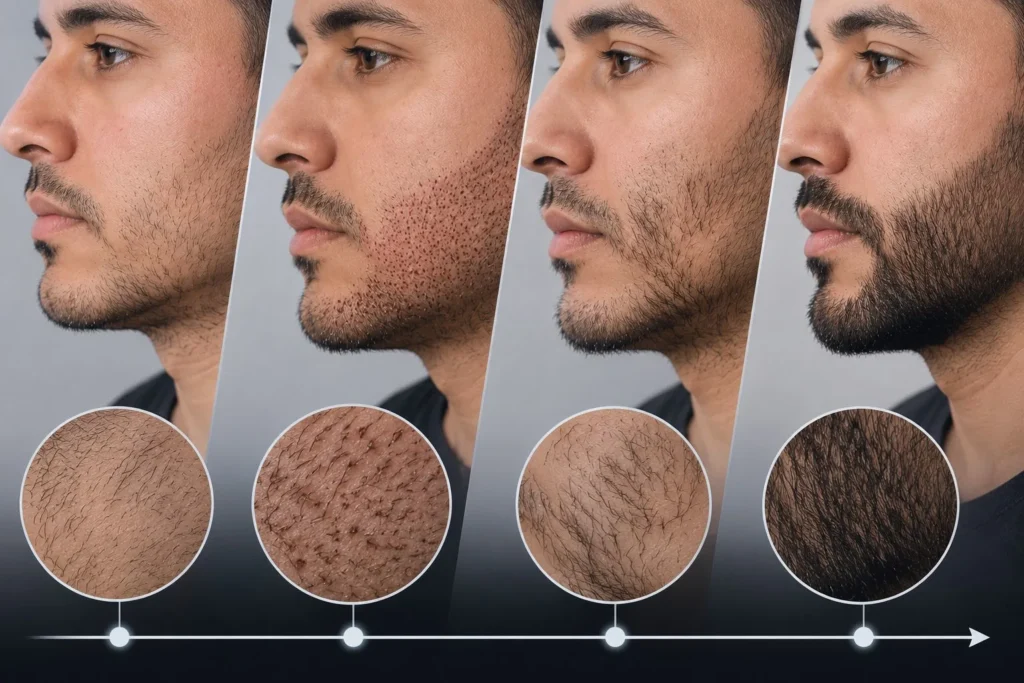
This is the part almost no clinic photographs, and the part most patients aren’t warned about. Somewhere between four and twelve weeks post-op, the transplanted hairs shed. This is known as “shock loss,” and in practice, what we find is that it catches even well-prepared patients off guard, because the beard can briefly look sparser than it did before treatment.
Here’s why: each transplanted follicle enters a resting phase after the trauma of relocation, and shedding the existing hair shaft is part of that reset. The follicle itself stays alive under the skin. It hasn’t failed, it’s regrouping before producing new growth. Judging your results during this window is one of the most common mistakes patients make.
Myth: “If the hair falls out, the transplant didn’t take.”
Reality: Shedding between one and three months is expected in the vast majority of cases. The follicle remains intact beneath the skin and re-enters an active growth phase afterwards.
Months 4–6: new growth begins
Fine new hairs push through, often lighter than your natural beard hair at first. Growth tends to be patchy, with some areas filling in faster than others, which is normal and not a sign of uneven graft survival.
Months 6–12: density and maturity
By month six, most transplanted follicles are producing hair, though texture and thickness keep improving. Final density and styleability usually land between month nine and twelve, which is why any comparison taken earlier should be read as a work in progress.
[IMAGE: Timeline graphic showing the four growth stages with approximate weeks/months]
Normal versus what needs a follow-up call
| Stage | Normal | Worth contacting your clinic about |
| Days 1–7 | Redness, mild swelling, small scabs | Spreading redness, pus, or fever |
| Weeks 2–4 | Itching as scabs flake off | Scabs still present after 3 weeks |
| Months 1–3 | Transplanted hairs shedding | Shedding of hair outside the treated area |
| Months 4–6 | Patchy, fine early regrowth | No visible regrowth at all by month 5 |
| Months 6–12 | Gradual thickening and darkening | Persistent bald patches with no change |
Bottom line: most of what feels alarming during recovery, especially the shedding phase, is part of the expected process. Persistent symptoms outside these windows are the exception, and worth flagging to your clinic.
Reading before and after photos properly
Most clinic galleries jump from “day one, freshly implanted” straight to “month twelve, fully grown,” skipping the shedding phase entirely. In practice, what we see at The Skin and Hair Clinic is that patients shown the full timeline in advance cope with month two far better than those who only see the highlight reel.
When comparing beard transplant before and after photos, whether it’s beard implants uk galleries or beard hair implants results, look for multiple time-stamped photos, consistent lighting and angles, a visible donor area, and natural hair direction: beard hair grows downward and outward, not straight out like scalp hair.
The takeaway
A dip around months one to three isn’t a setback. It’s a normal stage on the way to a result that usually settles by month nine to twelve. If you’re researching clinics, ask to see photos from the shedding phase itself, not just the day-one and month-twelve shots. The Skin and Hair Clinic can talk you through what to expect at each stage during a consultation, before you commit to a graft count or a date.
Frequently Asked Questions
Q: How long does the beard transplant shedding phase last?
A: Shedding typically starts around week four and runs through month three. By month four, most patients see the first signs of new growth replacing the shed hairs, though timing varies slightly from person to person.
Q: Is it normal for a beard transplant to look worse before it looks better?
A: Yes, this is one of the most consistent patterns in beard hair transplant before and after cases. The shedding phase around months one to three often makes the area look sparser than pre-surgery, before follicles re-enter growth and density builds from month four onward.
Q: How many grafts does a full beard transplant need?
A: Minor gap-filling usually needs 1,000–2,000 grafts, while a full beard build from a mostly bare face can require 1,500–4,700 grafts. Your surgeon will confirm an exact number after assessing your donor density and the area being treated.
Q: Can I shave during the shedding phase?
A: Most clinics ask you to avoid shaving the treated area for at least four to six weeks, and some prefer you wait until shedding settles. Shaving too early risks irritating grafts that haven’t fully anchored, so check with your clinic first.
Q: Are beard transplant results permanent?
A: Yes. Transplanted follicles are usually taken from the back of the scalp, an area genetically resistant to hair loss, and they keep that resistance once relocated to the face. Once a follicle survives the shedding phase, it typically keeps producing hair long-term.