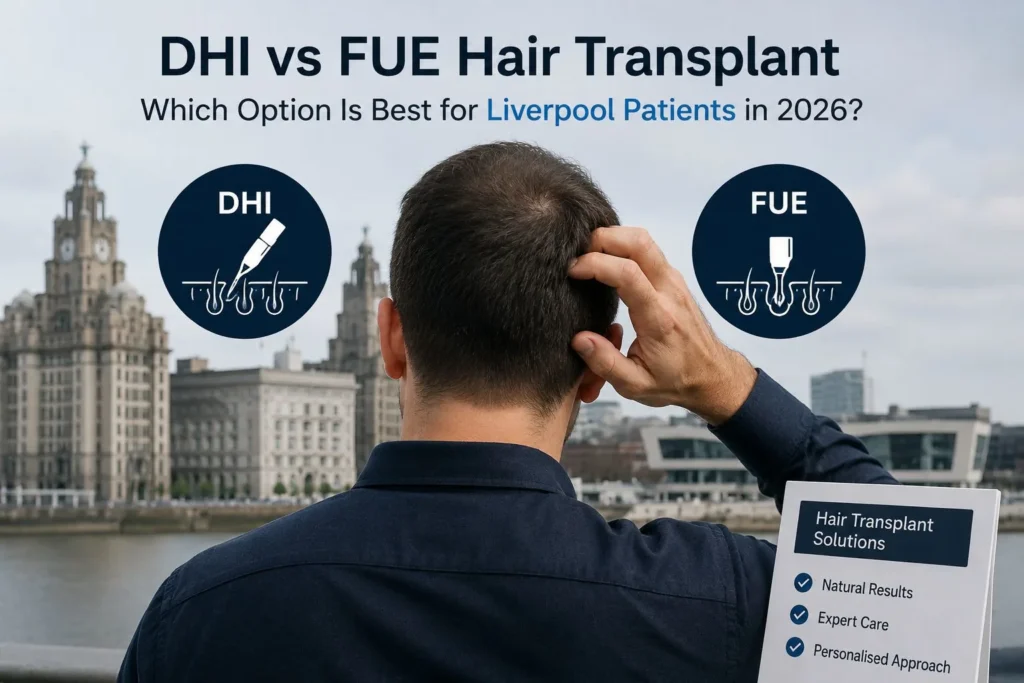
FUE works best for patients who need lots of grafts, and DHI wins for tight, natural hairlines with shorter downtime. Stick around, because the right choice really does depend on your scalp.
According to the International Society of Hair Restoration Surgery, 90% of patients chose to have hair transplantation to become/feel more attractive.
So it’s no surprise that so many people search for a DHI vs. FUE hair transplant comparison before they book anything. Both techniques get great results. They just suit different faces, budgets, and hair loss patterns. In this blog, we will understand which of the DHI vs FUE hair transplant options is best for Liverpool patients in 2026. So, read until the end!
Table of Contents
Key Takeaways
- FUE handles larger areas and higher graft counts, while DHI delivers sharper hairline precision.
- DHI vs FUE results mostly come down to graft density and how much control the surgeon has over placement.
- FUE hair transplant recovery typically reaches full results somewhere between ten and eighteen months.
- DHI hair transplant recovery usually brings less swelling and a quicker early healing stage.
- The best hair transplant method ultimately depends on your goals, your budget, and your donor area.
Understanding the DHI Hair Transplant Procedure
DHI stands for Direct Hair Implantation. In this procedure, a surgeon uses a pen-shaped tool, often called a Choi implanter, to extract a follicle and place it straight into the scalp. No pre-made channels, no waiting around. Because the surgeon controls angle and depth in one motion, the hairline tends to look sharper and denser once it’s grown in.
Why DHI Hair Transplant in UK Clinics Push It for Hairlines
A lot of DHI hair transplant in UK clinics lean on this method specifically for the front hairline. That precision helps recreate the slightly uneven, soft edge that real hair grows in naturally. If you’re only dealing with a smaller patch, this is usually where DHI helps.
What is the FUE Hair Transplant Method
FUE stands for Follicular Unit Extraction, which takes individual follicles out with a tiny punch tool. The surgeon then opens small incision sites and places the grafts by hand. It’s a bit more manual, which sounds slower, but it actually handles large sessions well. Anyone needing thousands of grafts across the crown or mid-scalp tends to end up here.
What FUE Hair Transplant Recovery Actually Looks Like
FUE hair transplant recovery tends to follow a fairly predictable path. Most people have their bandages off within two to five days. You can usually wash your hair gently by day six. NHS guidance states that new growth typically kicks in around the four-month mark, with full results showing anywhere between ten and eighteen months later. Swelling and redness settle down within the first couple of weeks for most patients.
DHI vs FUE Results: What Actually Changes
DHI vs FUE results come down to your specific case more than anything else. DHI often packs grafts more densely in smaller zones, simply because there’s no gap between extraction and placement. FUE, on the other hand, lets surgeons map out graft placement across a wider area before implantation starts. That planning stage is what makes FUE so practical for bigger sessions.
Here’s a quick side-by-side comparison of DHI vs. FUE hair transplant:
| Factor | DHI | FUE |
| Tool used | Choi implanter pen | Punch extraction tool |
| Best for | Hairlines, small areas | Large areas, high graft counts |
| Session length | Longer per graft | Faster for bulk grafts |
| Scarring | Minimal, pinpoint | Minimal, dot-like scars |
| Shaving required | Often no full shave | Usually, a full or partial shave |
| Recovery speed | Slightly faster | Standard, well-documented |
What to Expect From DHI Hair Transplant Recovery
DHI hair transplant recovery often feels a little gentler than people expect. Skipping the pre-cut channel stage tends to mean less swelling overall. Scabbing usually clears up within a week, and most patients are back at a desk job within three or four days.
Finding the Best Hair Transplant Method for Liverpool Patients

So, which is the best hair transplant method for you? Honestly, it comes down to your specific hair loss pattern. A few things worth thinking through before your consultation:
- Go with DHI if you’ve got a small, well-defined area and want the sharpest possible hairline.
- Go with FUE if you need thousands of grafts spread across a larger, thinning scalp.
- Factor in cost, since DHI sessions run longer and often cost more per graft.
- Ask your surgeon how much hands-on experience they have with each technique.
- Be realistic about how much downtime you can actually afford right now.
Liverpool’s unpredictable weather won’t affect your long-term results either way. What matters more is how you look after your scalp in that first week. Keep it dry, keep it protected, and you’ll be fine no matter which route you take.
A Few Mistakes Worth Avoiding
- Don’t assume one hair transplant technique is better than the other. The right option depends on your donor density, graft requirements, and personal goals.
- Avoid making your decision based on online trends or social media recommendations. What works for someone else may not be the best choice for you.
- Don’t choose a clinic based on price alone. A low-cost procedure may come with compromises in safety, expertise, or aftercare.
- Always check the surgeon’s qualifications, experience, and previous patient results before committing to treatment.
- Take time to compare clinics, ask questions, and ensure you feel confident in the team performing your procedure.
Start Your Hair Restoration Journey Today!
A consultation is genuinely the quickest way to work out which technique, DHI hair transplant vs FUE, suits your scalp. A qualified surgeon will look at your donor density and hair loss stage before recommending anything. The Skin and Hair Clinic offers proper hair transplant treatment for patients across Liverpool and the wider UK. So, visit our website and book a consultation now!
Frequently Asked Questions
1. Is DHI more expensive than FUE?
Generally, yes. DHI costs more per graft because of the specialised tools and longer session times involved.
2. Which method leaves less scarring, DHI or FUE?
Both leave tiny, pinpoint scars rather than a visible line, unlike older FUT techniques.
3. Can I combine DHI and FUE in one procedure?
Some clinics do exactly that, using FUE for bulk coverage and DHI for the finer hairline work.
4. How soon can I return to work after a hair transplant?
Most people are back at a desk within three to seven days, depending on which technique they chose.
5. Does hair grow back permanently after DHI or FUE?
Yes. Transplanted follicles are typically resistant to balding and keep growing for the long haul.