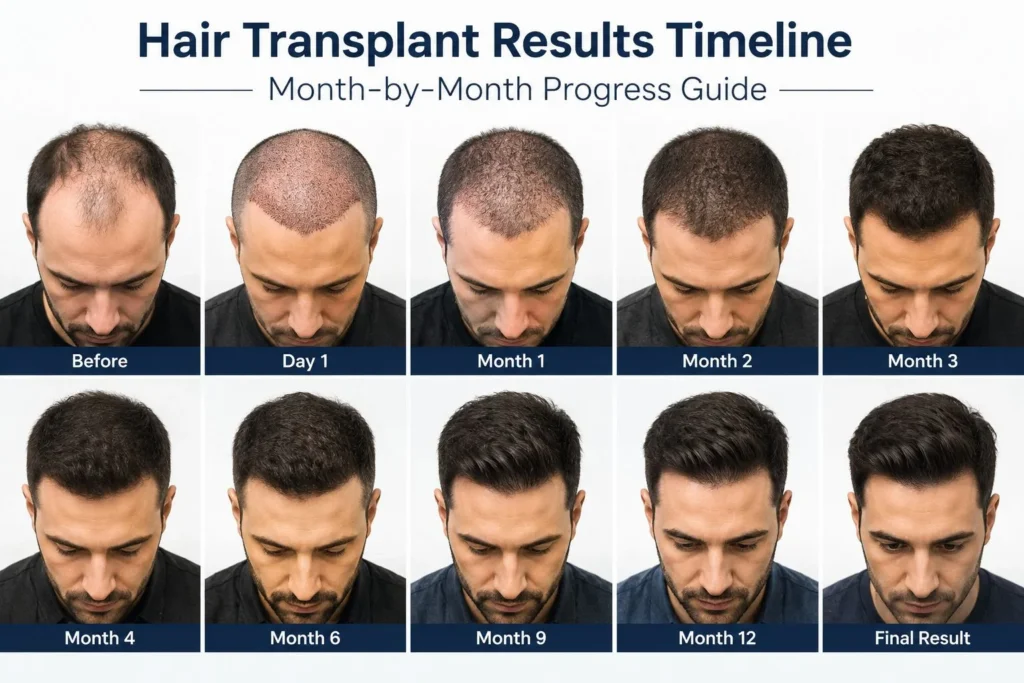
Your hair transplant results timeline runs anywhere from 12 to 18 months, and honestly, most patients are not told that clearly enough before their procedure.
Did you know? According to Grand View Research, the UK has a significant population that is concerned about hair loss, leading to a substantial demand for hair transplant system treatments.
Yet a huge proportion of those patients still arrive at the shedding phase completely blindsided by it. In this blog, we will walk you through the full hair transplant results timeline, week by week and month by month, so you know exactly what is happening, what is normal, and when things start looking genuinely good.
Table of Contents
Key Takeaways
- Shock loss is completely normal and happens to the vast majority of patients.
- Month 3 is when real growth starts. The first two months of dormancy are not a sign that anything has gone wrong.
- By Month 6, around half your final result is visible. This is when most patients genuinely start feeling the difference.
- Full results take 12 to 18 months. Anyone promising earlier than that is setting unrealistic expectations.
- What you do post-operation shapes what you see long-term. Aftercare, nutrition, and lifestyle choices are not optional extras.
What the Hair Transplant Growth Journey Actually Looks Like
Here is the thing nobody tells you directly: hair does not grow in a perfectly predictable pattern after a transplant. The hair transplant growth stages involve shedding, a quiet dormant phase, and then gradual regrowth. The follicle needs time to adjust, settle, and restart its natural cycle.
Month-by-Month Breakdown: What to Expect and When
Week 1 to 2: The Healing Phase
Your scalp is going to look rough. That is expected.
- Redness and scabbing form around the graft sites
- Swelling around the forehead is common for the first few days
- Do not pick at the scabs, no matter how tempting it gets
- The grafts are still anchoring into the scalp tissue
It feels uncomfortable, but this discomfort is the healing process doing its job.
Week 3 to 4: Shock Loss After Hair Transplant
This is the part that sends people into a spiral. Shock loss after a hair transplant is when the transplanted hairs start to shed. They fall out. Sometimes in noticeable clumps. It can look like the whole procedure has reversed itself overnight.
What is actually happening is this: the hair shaft is detaching because the follicle has entered a resting phase called telogen. The root is still there, still alive, still intact beneath the surface. Shock loss is a natural biological reset. The follicle sheds the old shaft so it can eventually push through a brand new one.
Months 1 to 2: The Quiet Stretch
This is the hardest phase for most people, not because anything painful is happening, but because nothing visible is happening at all.
- Redness gradually fades
- Scabs are fully gone
- The scalp looks more or less the same as before the procedure
There is very little to photograph here. Very little to celebrate. The follicles are dormant and resting, which is exactly what they should be doing. Do not judge anything yet. This phase is not a failure. It is a foundation.
Month 3: The First Real Signs of Growth
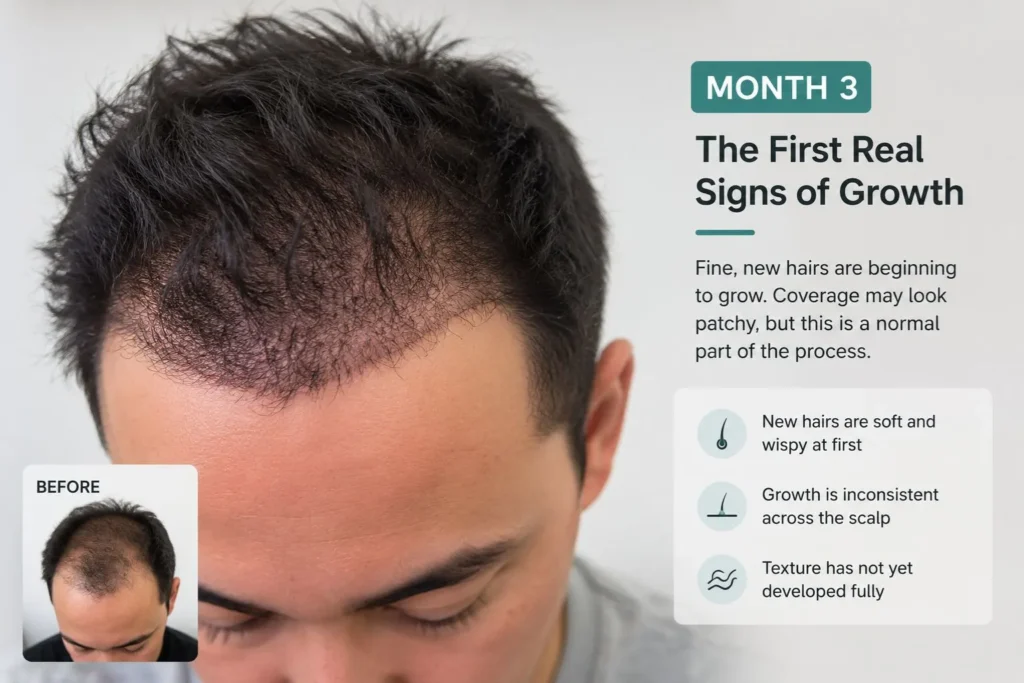
Hair transplant 3 months is when most patients finally exhale. Fine, new hairs begin to push through the scalp. They are wispy and thin at first. Coverage looks patchy and uneven. Some areas seem ahead of others. All of this is completely normal and expected.
- New hairs feel soft and almost transparent at first
- Growth is inconsistent across the transplanted zone
- Texture has not yet developed fully
Month 4 to 5: Picking Up Speed
Growth becomes more noticeable week by week now. You will start to see real density buildings in areas that looked sparse just weeks before.
- Hair texture starts to normalise
- Growth rate picks up noticeably
- Some zones fill in faster than others, which is perfectly fine
This is a good time to take comparison photos. The before-and-after difference from Month 1 to Month 5 is often genuinely striking.
Month 6: The Milestone Most Patients Live For
Hair transplant 6 months is the stage people tend to photograph, share, and genuinely feel proud of. Around 50 to 60% of your final result is visible by this point. The hairline is taking proper shape. Density has improved enough that most people around you will notice a real difference.
- Hairline definition becomes much clearer
- Density continues building steadily
- Confidence genuinely starts coming back
This is exciting. But the best part? You still have more growth ahead.
Month 7 to 9: The Thickening Phase
The hairs that have already grown begin to mature. Shaft diameter increases. They become coarser, stronger, and start behaving more like your natural hair.
- Overall coverage improves week on week
- Hair responds better to styling
- The transplanted area starts to blend with the surrounding hair
Month 10 to 12: Nearly There
Hair transplant 12 months is when roughly 80 to 90% of your final result is visible. For most patients, this stage brings real satisfaction.
- Density feels close to its permanent state
- The hairline looks natural and well-defined
- Most people feel comfortable in social situations without thinking twice about their hair
Month 12 to 18: The Final Chapter
The last 10 to 20% of growth comes in during this phase. Fine hairs thicken into their permanent form. The result matures and settles. What you see at Month 18 is your final outcome.
Hair Transplant Timeline: Quick Reference Table
| Stage | What Happens |
| Week 1 to 2 | Scabbing, redness, graft anchoring |
| Week 3 to 4 | Shock loss phase begins |
| Month 1 to 2 | Dormant phase, little visible change |
| Month 3 | First fine hairs break through |
| Month 4 to 5 | Growth accelerates, density builds |
| Month 6 | 50 to 60% of results visible |
| Month 7 to 9 | Hair thickens and matures |
| Month 10 to 12 | 80 to 90% of results visible |
| Month 12 to 18 | Final results fully settled |
When Does Hair Transplant Actually Grow?
Patients ask this constantly, “When does a hair transplant grow?” The answer is simple: Month 3 for the first signs. Month 6 for real, noticeable improvement. Month 12 for near-complete results.
But here is something worth saying clearly. Your timeline is your own. Do not compare your Month 4 photos to someone else’s Month 4 photos online. Genetics, age, scalp health, and graft density all play a role. Some people grow faster. Some slower. Both are normal.
What Affects Your Personal Hair Transplant Results Timeline
- Age: Younger patients generally see quicker regrowth
- Graft count: Higher graft numbers mean more follicles going through the cycle simultaneously
- Aftercare compliance: Skipping post-op instructions genuinely slows results
- Scalp health: A well-nourished, healthy scalp activates follicles more effectively
- Smoking and diet: Both have a measurable effect on circulation, healing, and growth speed
Take the Next Step Towards Natural, Lasting Hair Growth!
Whether you are weighing up your options or already in recovery and wanting a specialist to guide each stage, The Skin and Hair Clinic in Liverpool offers personalised consultations with GMC-registered surgeons. Every patient gets a customised plan and genuine aftercare support across the full hair transplant results timeline. Book your free consultation and take the first step.
Frequently Asked Questions
1. When does hair transplant growth become noticeable?
Most patients see the first fine hairs appear around Month 3. By Month 6, around half of the final result is typically visible to others.
2. Is shock loss after a hair transplant permanent?
No, not at all. Shock loss is temporary. The hair shaft sheds, but the follicle root stays alive beneath the scalp. New hair begins pushing through within 2 to 3 months.
3. What should I expect at the hair transplant 3 months after?
Thin, wispy hairs start emerging at Month 3. Growth looks patchy and uneven at first, but the follicles are actively restarting. It gets much better from here.
4. How much progress is visible in the hair transplant 6 months after?
Roughly 50 to 60% of your final result is visible at Month 6. Hairline definition sharpens, and density has improved noticeably compared to earlier months.
5. Is the hair transplant 12 months mark the final result?
Not quite. At 12 months, most patients can see 80 to 90% of their final outcome. The remaining growth and thickening continue right through to Month 18