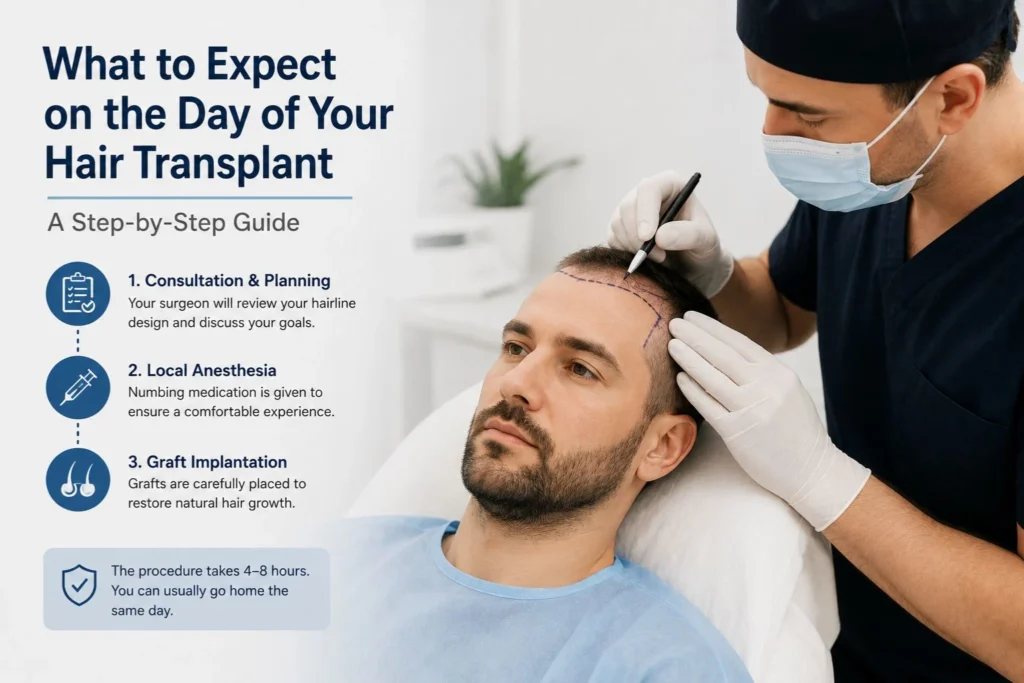
On the day of your hair transplant, you go through a clear, medically guided process that runs roughly 6 to 8 hours from the moment you walk in to the moment you go home.
Did You Know? According to the Market Research Future analysis, the UK hair transplant market is projected to grow from 393.08 USD Million in 2025 to 1373.0 USD Million by 2035, making it one of the most common cosmetic surgical procedures in the world.
A lot of first-timers go for treatment, not knowing what happens on the day of a hair transplant. They picture something dramatic. The reality? It is calm, quiet, and far more manageable than most people assume.
This guide walks you through the full hair transplant procedure steps, in the exact order they happen. So, continue reading!
Table of Contents
Key Takeaways
- Eat breakfast and wear a button-down top on the morning of your procedure.
- The anaesthetic injections are the sharpest moment of the day. After that, you feel nothing.
- Donor extraction and implantation together take the most time, usually 4 to 7 hours.
- Shock loss between weeks 2 and 4 is normal and does not mean the transplant has not worked.
- Expect full results between months 9 and 12. Patience is part of the process.
Before You Arrive: Smart Hair Transplant Preparation
What to eat before your hair transplant
- Have a proper breakfast. Nothing heavy, but do not skip it either.
- Avoid alcohol for at least 48 hours before your appointment.
- Drink water. You will be sitting for a long time, so hydration helps.
- If you take regular medication, check with your clinic whether to continue it.
What to bring on the day
- A loose button-down shirt or zip-up hoodie. Nothing that pulls over your head.
- Your ID and any consent forms or documents the clinic sent you.
- Someone to drive you home. You will be fine, but it is better not to navigate public transport alone.
The night before: keep it simple
- Wash your hair with a mild shampoo and leave it product-free.
- No gels, sprays, or dry shampoo on the morning of your procedure.
- Sleep well. Sounds obvious, but it genuinely does make a difference.
- Lay out comfortable clothes in advance so the morning is stress-free.
The Hair Transplant Procedure Steps: What Actually Happens
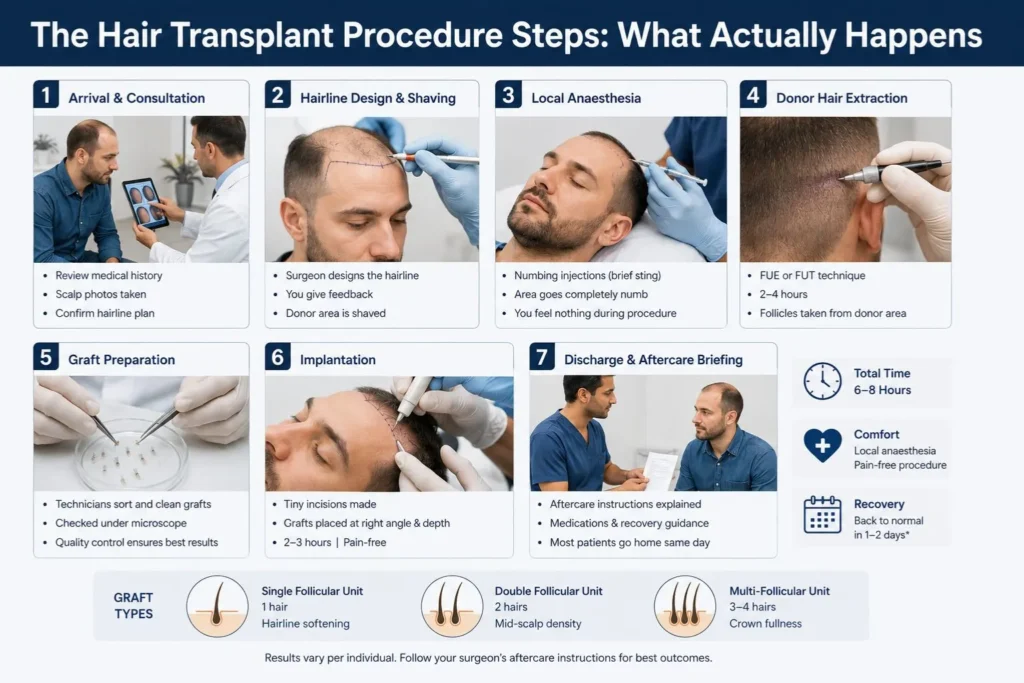
Here is a simple, honest account of what happens on the day of a hair transplant, broken down in the order you will experience it.
Step 1: Arrival and Consultation Check-In
This part of the hair transplant consultation to surgery process is calm and unhurried. The team will:
- Go through your medical history and make sure everything is in order.
- Take pre-op photographs of your scalp for the clinical record.
- Sit down with you and your surgeon to confirm the hairline plan.
Do not hold back at this point. If something is worrying you, say it now. A good surgeon wants you settled and informed before anything starts.
Step 2: Hairline Design and Shaving
Your surgeon marks out your new hairline directly on your scalp using a surgical marker. This is surprisingly collaborative. You look in a mirror, give feedback, and the design is adjusted until it feels right for your face. Once agreed, the donor area (typically the back and sides of your head) is carefully shaved. With some FUE cases, only a small patch needs trimming rather than the whole area.
Step 3: Local Anaesthesia
This is the step people worry about most. The injections sting for a minute or two. Then the area goes completely numb, and you feel nothing for the rest of the procedure. That brief sting is genuinely the worst part of the whole day for most patients. Once it passes, you are through the hardest bit.
The anaesthesia process takes about 10 to 20 minutes. After that, you are comfortable and ready.
Step 4: Donor Hair Extraction
Now the real work of the hair transplant procedure steps begins. Your surgeon extracts healthy hair follicles from the donor zone using one of two main techniques:
- FUE (Follicular Unit Extraction): In an FUE hair transplant, individual follicles are removed one at a time using a tiny punch tool, leaving no linear scar and allowing for a quicker recovery compared to the strip method.
- FUT (Follicular Unit Transplantation): A narrow strip of scalp is removed and then carefully divided into individual grafts.
This stage takes anywhere from 2 to 4 hours. Most patients put their headphones in, watch something, and honestly forget time is passing.
Step 5: Graft Preparation
While extraction is still underway, a dedicated technician team gets to work under the microscope. They sort, clean, and assess every graft before it is used. Any unit that does not meet quality standards is set aside. This stage matters more than most people realise. It directly affects how natural and dense your final result looks.
| Graft Type | Hairs per Unit | Best Used For |
| Single Follicular Unit | 1 hair | Hairline softening |
| Double Follicular Unit | 2 hairs | Mid-scalp density |
| Multi-Follicular Unit | 3 to 4 hairs | Crown fullness |
Step 6: Implantation
This is the stage that shapes your outcome. Your hair transplant day-by-day transformation begins right here. The surgeon creates tiny, precise incisions in the recipient area and places each graft at exactly the right angle, depth, and direction to mirror natural hair growth. It sounds fiddly because it is. This is a skilled, painstaking task.
- Implantation typically takes 2 to 3 hours.
- You feel no pain. The anaesthesia is still fully active.
- The angle each graft is placed determines whether the result looks natural or artificial.
Take a moment to appreciate what is happening. Thousands of individual hairs, placed by hand, one by one.
Step 7: Discharge and Aftercare Briefing
Once the last graft is placed, the team cleans up the donor area, applies any necessary dressings, and walks you through your aftercare plan in detail. As part of what to expect during hair transplant recovery, they will cover:
- How to sleep and wash your hair in the first few days
- Which activities to avoid and for how long
- What medications to take and when
- What is normal to see and feel, and what would warrant a call to the clinic
Most patients leave within 30 to 60 minutes of the procedure. You will likely feel tired but perfectly alert. A bit of tightness or a mild headache in the first 24 hours is normal and settles quickly.
Hair Transplant Day by Day: Early Recovery at a Glance
Understanding the hair transplant day-by-day recovery timeline removes a lot of unnecessary worry:
- Days 1 to 3: Some redness, light swelling, and small scabs around each graft site. All expected.
- Days 4 to 7: Scabs begin to shed on their own. Do not pull or pick at them.
- Weeks 2 to 4: The transplanted hairs often fall out. This is shock loss. It is temporary and completely normal.
- Months 3 to 6: New growth starts coming through. Thin at first, then thicker.
- Months 9 to 12: This is when the full result becomes visible, and you see what you have been waiting for.
Your Hair Restoration Journey Starts Here!
You now know exactly what the day involves. There are no surprises left to worry about. The Skin and Hair Clinic offers free, no-obligation consultations with GMC-registered surgeons who work exclusively in hair restoration. Take the step you have been putting off. Book your free consultation today and start your journey toward permanent, natural results.
Frequently Asked Questions
1. How long does a hair transplant procedure take on the day?
Most people are at the clinic for 6 to 8 hours in total. The exact time depends on how many grafts are being placed and which technique is used.
2. Is a hair transplant painful on the day?
The anaesthetic injections sting briefly. Once those are done, the procedure itself is completely painless. Most patients are surprised by how comfortable it is.
3. Can I eat and drink before a hair transplant?
Yes, and you should. Eat a light meal and drink plenty of water beforehand. Avoid alcohol for at least 48 hours before your appointment.
4. What should I wear to a hair transplant appointment?
A button-down shirt or zip-up top is ideal. Avoid anything that needs to be pulled over your head, especially after implantation.
5. When will I see results after my hair transplant?
New growth usually starts appearing around months 3 to 4. The full, final result is typically visible between months 9 and 12.