
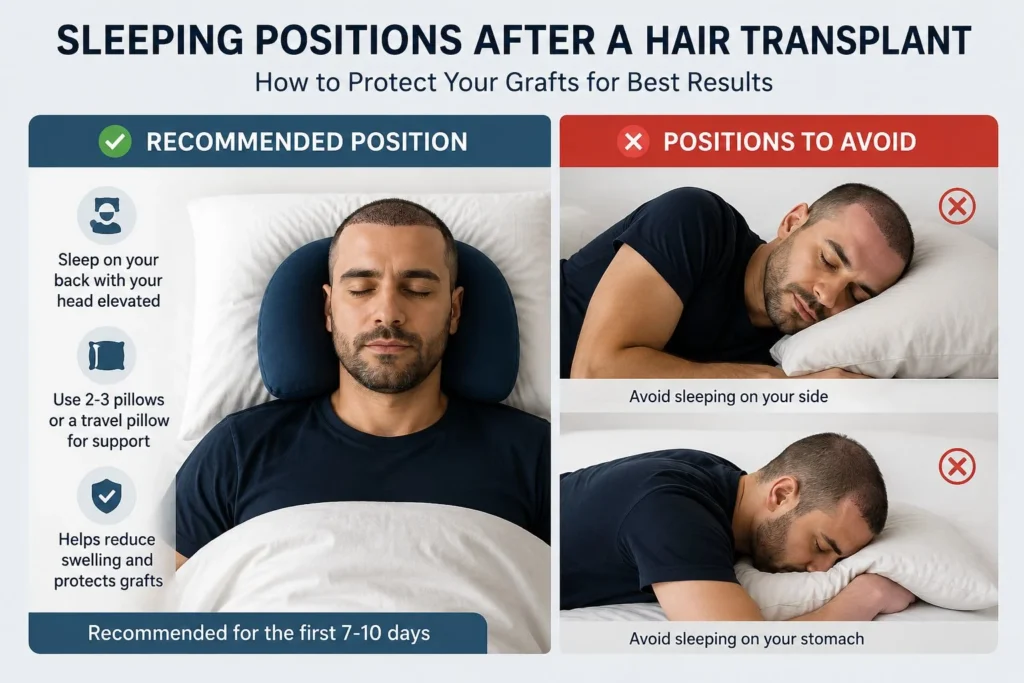
The correct sleeping position after hair transplant is on your back, with your head and upper body elevated at a 30 to 45-degree angle and this is not optional advice. For the first seven to ten days post-procedure, your newly implanted grafts are not yet anchored into the scalp. Any friction, pressure, or sideways rolling during the night can physically dislodge them. Getting your sleep setup right before you leave the clinic is one of the most protective things you can do for your results.
Table of Contents
Why your sleeping position after a hair transplant matters so much
Most patients focus on the procedure itself, the technique, the surgeon, the graft count. Far fewer think carefully about what happens during the hours they are unconscious each night for the following week. This is where a significant number of avoidable complications occur.
In the first 72 hours following an FUE hair transplant, the individually extracted and implanted follicular units sit in micro-channels created in the recipient area. They have not yet begun the biological anchoring process, a phase that takes roughly seven to ten days as the surrounding tissue closes around the base of each graft. During this window, the grafts are genuinely vulnerable to mechanical displacement.
The International Society of Hair Restoration Surgery (ISHRS) identifies improper post-operative positioning as one of the preventable contributors to poor graft survival. Pressure from a pillow against the recipient area, or the scalp rubbing against a surface during sleep, can extract a graft from its channel entirely and once dislodged, it cannot be reimplanted.
Swelling after hair transplant is the second major concern. Fluid accumulates naturally in the forehead and around the eyes following the procedure, and lying flat accelerates this by allowing fluid to pool. Elevation uses gravity to reduce that accumulation and keeps swelling manageable. Without it, some patients wake on day two or three with significant periorbital oedema swelling around the eyes that is uncomfortable and alarming, even if temporary.
How to set up your bed before your first night
Getting this right in advance removes the temptation to improvise at midnight when you are tired and sore. The setup is straightforward, but each element serves a specific function.
The angle: 30 to 45 degrees
Head elevation after hair transplant is the single most important element of your sleep setup. A 30 to 45-degree angle is the clinical target high enough to keep swelling down and protect the grafts from contact, but not so upright that you strain your neck and wake up constantly adjusting.
A purpose-made wedge pillow is the most reliable way to achieve this. Wedge pillows designed for post-surgical recovery are widely available online in the UK look for one that supports the full length of your torso, not just your head. Stacking regular pillows works but tends to collapse as you move, leaving you flat by 3am. If you have a recliner chair at home, the first few nights in it may actually be more comfortable and more consistent than a bed.
The neck pillow: preventing sideways drift
A U-shaped travel pillow placed around your neck performs a critical function: it stops your head from rolling to one side while you sleep. This is not about comfort, it is about keeping the recipient area off any surface for the entire night. The back of your head, where the donor area sits, should rest inside the curve of the travel pillow. The transplanted area at the top and front of the scalp should not make contact with anything.
Protecting your bedding
Place a clean, soft towel or a disposable medical underpad over your pillow and wedge each night. Some minor oozing from the recipient area is normal in the first 24 to 48 hours, and waking to find dried blood on a white pillowcase is both unhygienic and alarming. Change the covering daily. Keeping the surface clean also reduces the low infection risk that exists whenever there are open micro-channels in the scalp.
How to sleep after hair transplant: a night-by-night guide
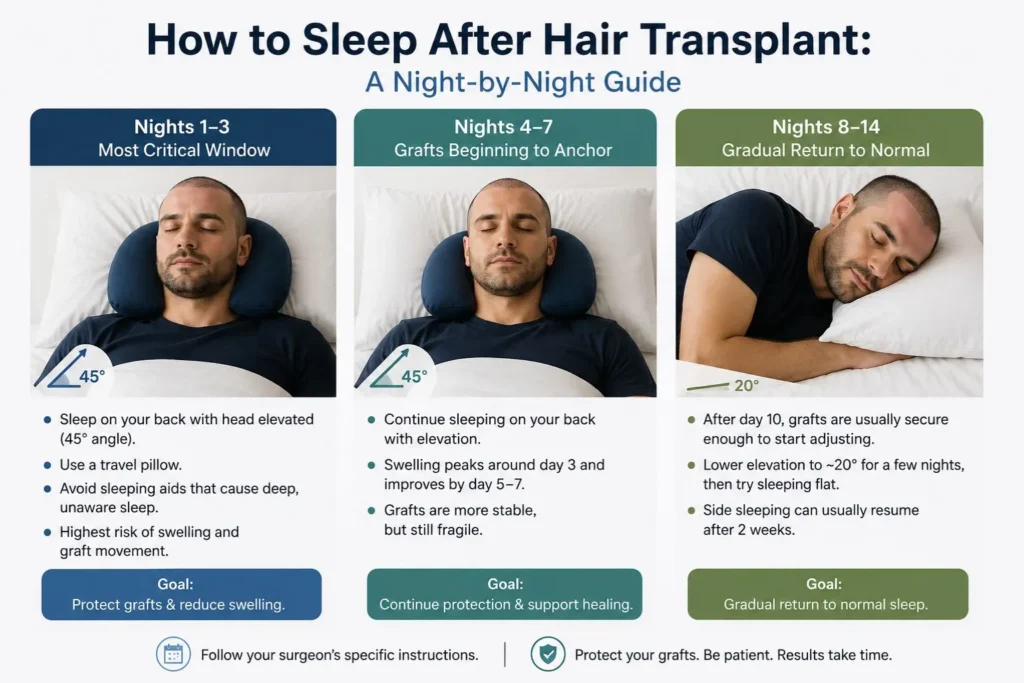
Recovery does not look the same on night one as it does on night seven. Understanding how the rules shift helps you make sensible adjustments rather than either panicking unnecessarily or relaxing precautions too early.
Nights 1 to 3: the most critical window
This is the period of greatest graft vulnerability and the highest risk of significant swelling after hair transplant. Strict elevation is essential, do not sleep flat under any circumstances. Keep the travel pillow in place throughout the night. If you wake and find you have rolled to one side, gently return to your back without touching the scalp. Avoid sleeping aids that cause heavy, unaware sleep if possible, as these make it harder to self-correct.
Nights 4 to 7: grafts beginning to anchor
By day four, the tissue around the graft base begins closing. The grafts are more stable but still not fully secure. Continue elevation and the travel pillow setup. Swelling typically peaks around day three and begins to resolve by day five to seven, so you may notice the elevation becomes less critical for comfort but maintain it for graft protection.
Nights 8 to 14: gradual return to normal
Most surgeons advise that after ten days, the grafts are sufficiently anchored for normal sleep positions to resume cautiously. You can begin to reduce the elevation angle incrementally dropping to 20 degrees for a few nights before lying fully flat. Side sleeping can typically resume after two weeks, though individual surgeon guidance should take precedence over any general timeline.
Pillow after hair transplant: which type actually works
The question of which pillow after hair transplant is best comes up frequently, and the honest answer is that no standard pillow is designed for this purpose. Here is a practical comparison of your options.
| Pillow Type | Elevation | Head Stability | Verdict |
| Wedge pillow (full torso) | Consistent 30–45° | Good if combined with travel pillow | Best option for most patients |
| Stacked regular pillows | Inconsistent collapses overnight | Poor no lateral support | Unreliable for the first 72 hours |
| Recliner chair | Consistent angle | Good armrests limit rolling | Excellent alternative to bed |
| Inflatable travel pillow | No elevation | Good lateral support only | Use alongside wedge, not instead of it |
| Hospital-style adjustable bed | Precise elevation | Good | Ideal if accessible |
The verdict: a full-length wedge pillow combined with a U-shaped travel pillow is the most practical and reliable setup for the majority of patients recovering at home.
Sleeping upright after hair transplant: what nobody tells you
Sleeping upright after hair transplant is uncomfortable. There is no version of this that is easy, and it is worth being honest about that rather than pretending a wedge pillow transforms the experience into restful sleep. Most patients find nights one through three genuinely difficult, a combination of post-procedure tenderness, the unfamiliar position, and the anxiety of protecting something they have invested significantly in.
A few things that genuinely help: taking any prescribed anti-inflammatory medication before bed rather than in the morning; keeping the room cool (heat increases swelling and discomfort); and accepting that fragmented sleep during this window is normal and temporary.
What we consistently find at The Skin and Hair Clinic is that patients who prepare their sleep setup thoroughly before their procedure date rather than improvising the night of report significantly less stress and disruption during recovery. Having the wedge pillow, travel pillow, and clean coverings ready to go removes decision-making from a period when you are least equipped to handle it.
Common mistakes patients make when sleeping after a hair transplant
Myth: A few hours on my side will not make a difference.
Reality: Graft displacement does not require sustained pressure even brief contact between the recipient area and a pillow surface during the first 72 hours carries risk. The grafts do not know how long you were lying on them. One careless night can undo the procedure’s results in a localised area.
Myth: Swelling after hair transplant is inevitable regardless of how I sleep.
Reality: Head elevation after hair transplant significantly reduces the degree of swelling, even if it cannot eliminate it entirely. Patients who maintain consistent elevation through the first four nights typically experience far less periorbital swelling than those who sleep flat and less swelling means less discomfort and a faster return to normal appearance.
Myth: Once the grafts look settled on day five, I can sleep normally.
Reality: Visual appearance is not a reliable indicator of graft anchorage. The surface heals faster than the deeper tissue. Most surgeons and the ISHRS guidance recommend maintaining elevated positioning until at least day ten, regardless of how the scalp looks externally.
The nights that protect the months of results ahead
The first ten days of sleep are a small but decisive part of a hair transplant journey that unfolds over twelve to eighteen months. Protecting your grafts during this window does not require anything extraordinary: a wedge pillow, a travel pillow, clean coverings, and the discipline to stay on your back. The patients who find recovery straightforward are almost always the ones who took the setup seriously before they needed it.
If you have questions about post-operative care before or after a procedure at The Skin and Hair Clinic, our clinical team is available to walk you through every stage of your recovery plan in detail.
Frequently asked questions
1: What is the right sleeping position post-hair transplant?
The right sleeping position post-hair transplant is lying flat on your back but with your head raised about 30-45 degrees. Such positioning keeps the grafts safe from touches with the pillow surface and then again, gravity is employed to help in decreasing the swelling of the forehead.
2: How to sleep after a hair transplant without loosening the grafts?
After a hair transplant, safely sleeping means combining the use of a full-length wedge pillow to keep the right angle and a travel pillow (U-shaped) for your neck to avoid your rolling. During the night, the recipient part of the newly transplanted area shouldn’t be touching any hard surfaces. If you place the pillows on the sides of your body, it will reduce your chance of rolling over in sleep.
3: How long should I sleep after my hair transplant?
The common advice from most surgeons is to keep your head elevated at a 30 to 45-degree angle while sleeping for the first seven to ten nights after a hair transplant. Beyond this time, the grafts are usually well-enough secured to allow for a gradual decrease in elevation. It is important that you adhere to your own surgeon’s post-operative guidelines as the healing time may differ based on the operation done.
4: Is swelling after a hair transplant going to get worse if I sleep without elevation?
Absolutely, sleeping flat leads to much worse swelling after hair transplant. When lying down without an elevated head, the liquid settles in the forehead and around the eyes, resulting in swollen eyelids and periorbital areas after two or three days. Maintaining your head in an elevated position following hair transplant is among the most efficient methods to minimize post-operative swelling.
5: Which pillow is the best for me after a hair transplant?
Ideally, you should use a full-length wedge pillow that keeps your upper body raised at about a 30 to 45-degree angle consistently and a U-shaped travel pillow which supports the sides of your head. Stacked regular pillows are not reliable because they tend to move during the night and you will end up lying flat without knowing it which is the worst time to do so when your eyes are closed.
6: Is it okay for me to sleep on my side after hair transplant?
Actually, you must not sleep on your side for a minimum of ten days post hair transplant. Side sleeping will exert pressure not only on the newly transplanted hair (recipient area) but also on the original hair (donor area), which both should be well protected during the initial recovery period. Around two weeks after the operation, and if permitted by your surgeon, side sleeping with care can usually be resumed.