
First and foremost, if you want to wash your hair safely after a hair transplant, you must leave the transplanted area untouched for 48 to 72 hours at least, then follow a gentle, no-pressure method using lukewarm water and a mild shampoo. The grafts are most susceptible in the first ten days and any rubbing, scratching, or direct water pressure during this time can dislodge one or more grafts entirely. Doing the process correctly from the very beginning safeguards your investment in the procedure.
Table of Contents
Why the first wash matters more than most patients realise
Right after a hair transplant, the newly transplanted hair follicles are just lying in tiny cuts that haven’t closed up around them yet. They are not anchored at all. During the first 72 hours, the only thing that is holding them there is the initial inflammatory response of the body, a kind of natural anchoring mechanism.
This is the reason why hair transplant washing instructions are not simply advice, they are actually a sort of clinical aftercare. It is very easy to accidentally wash away the grafts that took hours to implant with just one overzealous rinse on day two. Most reputable UK clinics, even those registered with the Care Quality Commission (CQC), will give you a written protocol of aftercare precisely because this period is so critical.
The better part: once you know the reason why the sequence of actions is the way it is, the process is not difficult to do. You just need a bit of patience.
When can you wash your hair after a hair transplant?
Most surgeons will tell you to wait 48 to 72 hours before you try washing your hair in any way. Some clinics even stick to the 72 hours fully for their standard. The specific hour should be, in any case, given by your surgeon because the method used can make the difference. An FUE hair transplant and FUT procedure can have slightly different recovery timeframes, and your washing schedule should reflect that.
Almost all clinics do not recommend washing at 24 hours. Still a very small number of them used to very gently wash a scalp at 24 hours with a saline solution that was provided, this is not a normal case but an exceptionally rare one. If your clinic hasn’t mentioned it, don’t think it applies to you.
Step-by-step: how to wash hair after hair transplant (Days 4–10)
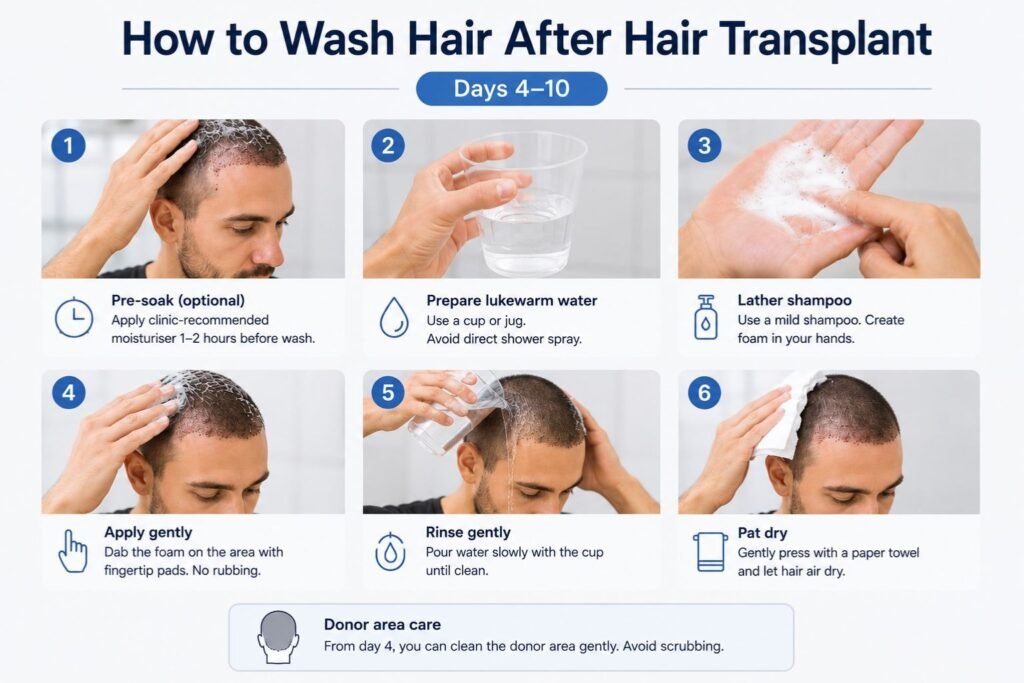
This is the phase where most patients feel anxious, and rightly so. Follow these steps carefully each day during the cleansing phase.
What you’ll need
A moisturising lotion or pre-wash spray, if your clinic supplied one
A mild, fragrance-free shampoo baby shampoo (such as Johnson’s) works well, or use the clinic-prescribed product if provided
A clean plastic cup or jug
Soft paper kitchen towel (not a regular bath towel)
The washing process
Step 1
Step 1 Pre-soak (optional but very good idea): If your clinic gave you a moisturising cream, rub it in the transplanted patch one and a half to two hours before washing. It will dissolve the crusts and will make washing more gentle on the hair follicles.
Step 2
Get your water ready: Get a cup or a small jug and fill it with water at the temperature of the human body. It is very important because hot water will cause inflammation and will make the hair follicles more vulnerable. It will be always best to keep the showerhead away from your transplanted area during this phase.
Step 3
Get a lather of shampoo ready separately: Take just a tiny bit of shampoo (one should be able to cover it with a 10p coin) and put it into your palm. Rub your hands against each other and finally, you will have a powdery foam. You will be putting the foam on your head and not the shampoo liquid directly.
Step 4
Application with fingertip pads only: You must use only the soft pads of your fingertips, never the nails , gently dab and press the foam onto the transplanted area. No circular rubbing, no massaging, no dragging. Instead of
Step 5
Rinse out softly with the cup: You will be able to wash away all the shampoo by slowly pouring lukewarm water from your cup. Repeat until no residue remains. Shampoo residue is an irritant to the skin and slows down healing.
Step 6
Pat dry: Grab a paper kitchen towel sheet and gently press, don’t rub scalp, to soak up the excess moisture. After that, leave the hair to air dry naturally. Avoid a hairdryer because the heat may harm the fragile new follicles.
Still, your donor area (usually the back and sides of your head) can be cleaned with a bit more assurance from about the fourth day, although rough scrubbing should be avoided.
Handling scabs after hair transplant: what’s normal and what to do
Scabbing is a natural part of the healing process. Small crusts form around each graft that has been implanted as the skin heals, and although seeing them might be disturbing, they are actually a positive indication. The only major rule is: don’t ever pick at them.
If you try to take a scab off that isn’t ready to come off, you will most likely end up removing the graft underneath. Since the follicle is not yet connected to the blood supply, it will detach plus the scab.
By about days 11 to 14, the grafts are pretty firm. Then, you may do a mild circular massage during the washing process with the pads of your fingers only to help the scabs that are still there slowly and naturally fall off. Most scabs will have been completely shed by the end of the second week.
Should you come across any scabs that might be infected (redness extending beyond the area of the graft, discharge, or a lot of swelling after day five), get in touch with your clinic. While infection after a good procedure is very uncommon, it does still occur and needs to be treated without delay.
Common mistakes with gentle washing after hair transplant
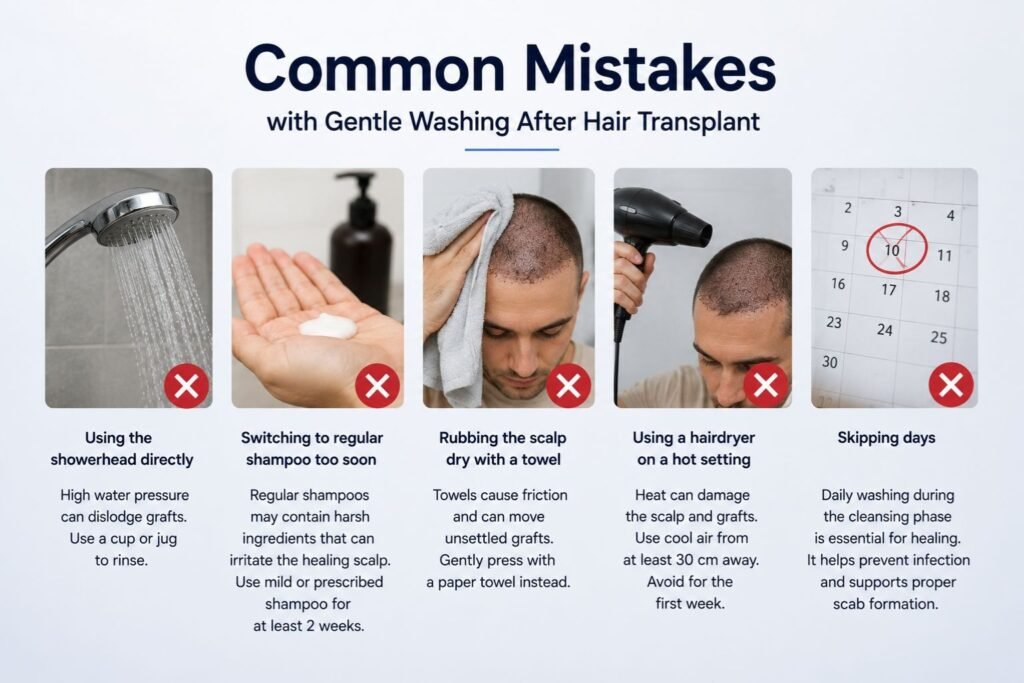
Even patients who read their aftercare instructions carefully sometimes slip into habits that risk their results. These are the most frequent errors we see.
Using the showerhead directly: The water pressure from a normal shower might be strong enough to dislodge the hair grafts during the first ten days. So it is better to use a cup or a jug to rinse during this period.
Switching to their regular shampoo too soon: Almost all the commercial shampoos contain sulphates, alcohol or fragrances that can aggravate the skin that is healing. So it is better to only use a mild or a clinic-prescribed shampoo for at least the first two weeks.
Rubbing the scalp dry with a towel: Bath towels cause friction. So even just a very light rubbing over the transplanted area can move the grafts that are not yet fixed. Using a paper kitchen towel and gently pressing it against the scalp is a much safer choice.
Using a hairdryer on a hot setting: If you have to use the dryer, the safest thing would be to use the coolest air setting from a distance of at least 30 cm. Most surgeons recommend not using a hairdryer at all for the first week.
Skipping days: Washing daily during the cleansing phase is not an option – it is a part of the healing process. Regular cleaning of the scalp decreases the risk of infection and it also helps scabs to develop properly.
Shampoo after hair transplant: what to use and what to avoid
The right shampoo after a hair transplant is one that cleans without stripping, irritating, or disrupting the healing skin. Most UK clinics recommend one of the following:
- Baby shampoo – mild, pH-balanced, and widely available. Johnson’s Baby Shampoo is a common recommendation.
- Clinic-prescribed post-transplant shampoos – products like Tricovel or specific medical-grade formulas are sometimes supplied with aftercare kits.
- Fragrance-free, sulphate-free shampoos – if you prefer a branded alternative, look for products marketed for sensitive or post-procedure skin.
During the first two weeks, avoid at all cost products with sulphates (SLS/SLES), strong fragrances, essential oils, alcohol (usually denatured on UK labels), or anti-dandruff actives like zinc pyrithione and ketoconazole, unless instructed by a doctor.
After day 15 or so, it is safe to slowly start using your regular shampoo again, but of course, still keep the washing mild for the first month.
The key thing to take away
Establishing the proper washing routine within the first two weeks after your hair transplant is very important and can A lot contribute to the protection of your results. Soft, steady, and no-pressure washing, plus an intention not to rush scabbing, provide freshly transplanted hair follicles the optimal setting for grounding and giving growth.
If you are either getting ready for your operation or have already done one, it would be best to ask the clinic about the specific hair transplant washing instructions. Same thing, if anything seems off or uncomfortable to you during the time of recovery, it is always better to get in touch with your doctor instead of waiting. Remember that early questions are always better than experiencing avoidable complications.
Frequently Asked Questions
1. How do I wash my hair after a hair transplant without dislodging grafts?
Use a foam-only technique: lather a mild shampoo in your hands, then gently dab the foam onto the scalp without any rubbing, massaging, or scratching. Rinse with a cup of lukewarm water rather than a showerhead, and pat dry with a paper kitchen towel. This approach removes the two biggest risks: friction and water pressure.
2. When can I wash hair after transplant?
Most patients can return to a normal washing routine from around day 15, though continuing to use a mild shampoo and lukewarm water for the first four weeks is advisable. Your surgeon’s individual guidance takes precedence; some techniques or graft densities may require a longer cautious period.
3. What shampoo should I use after a hair transplant?
Baby shampoo is the most widely recommended option in the UK due to its mild, fragrance-free formula. If your clinic has provided a post-operative shampoo, use that as a first preference. Avoid sulphate-based or strongly fragranced products for at least the first two weeks after surgery.
4. Is it normal to see scabs after hair transplant?
It is quite typical to develop scabs following hair transplantation because these scabs indicate a normal healing process at the site of the grafts. The scabs act as a shield to the new follicles and usually shed on their own by the end of the second week. It is strongly advisable that you don’t pick or scratch them since digging a scab out can often take away the graft underneath as well.
5. Can I use a hairdryer after a hair transplant?
Definitely not in the first week. The heat of a hairdryer can be very harmful to freshly implanted and still healing skin so only use very cool air at a distance of 30 cm for at least after the 7th day, and never aim it at the transplanted area.
6. Why can’t I just rinse my hair in the shower normally?
The water pressure from a standard showerhead even on a gentle setting can be enough to dislodge newly implanted grafts before they’ve anchored into the blood supply. Using a cup or jug gives you control over flow and pressure, which is essential during the first ten days of recovery.