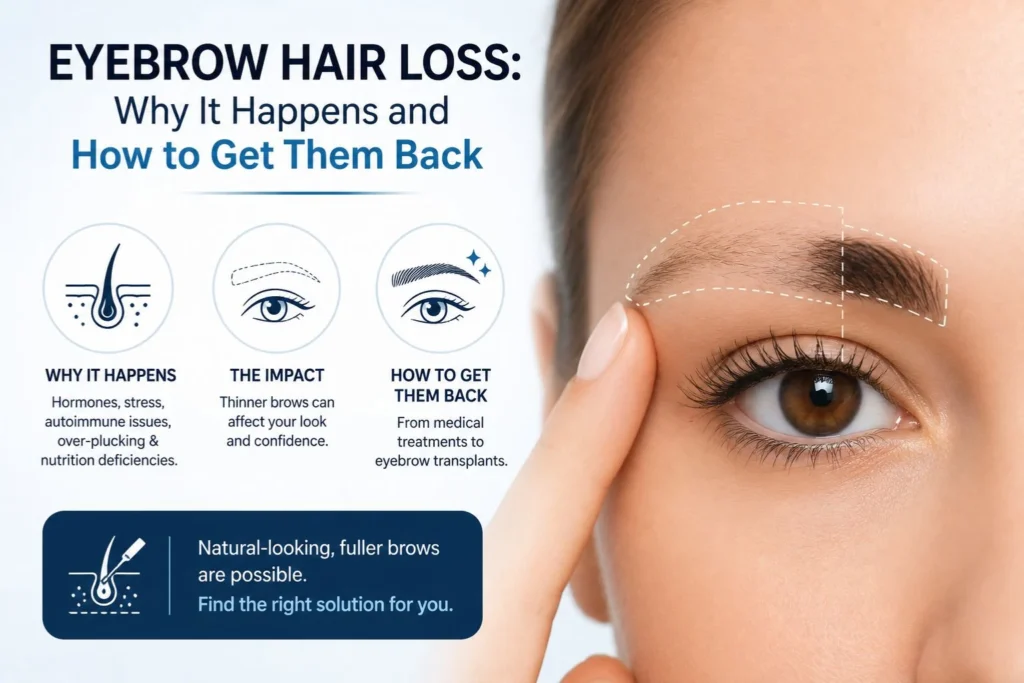
Eyebrow hair loss happens when the hair follicles in your brow area are disrupted by illness, hormonal changes, nutritional gaps, or damage from repeated hair removal. It is far more common than most people realise, and in many cases, it is reversible once the underlying cause is identified. If you have been asking yourself why am I losing my eyebrow hair, you are not alone and the answer matters, because the right treatment depends entirely on the cause.
Table of Contents
What your thinning eyebrows might be telling you
Eyebrows do not thin without reason. Unlike scalp hair, which follows a multi-year growth cycle, brow hairs have a shorter active growth phase which means they respond to internal disruptions more quickly and visibly. A single missed blood test result could explain months of unexplained thinning.
The key is learning to distinguish between gradual, symmetrical thinning (more likely to be systemic related to your whole body) and patchy or asymmetrical loss (more likely to be localised, such as a skin condition or trauma to the follicle).
The most common eyebrow hair loss causes
Thyroid disorders
Thyroid eyebrow hair loss is one of the most well-documented and frequently missed causes of brow thinning. Both hypothyroidism (underactive thyroid) and hyperthyroidism (overactive thyroid) interfere with the normal hair growth cycle. A characteristic sign is thinning or complete loss of the outer third of the eyebrow, the section closest to the temples.
According to the British Thyroid Foundation, thyroid disorders affect approximately one in 20 people in the UK, with women being significantly more affected than men. TSH, T3, and T4 blood tests can confirm a thyroid imbalance, and once the condition is treated, eyebrow regrowth is often possible.
Alopecia areata and eyebrow thinning
Eyebrow thinning alopecia, specifically alopecia areata is an autoimmune condition in which the immune system mistakenly attacks healthy hair follicles. It can affect the scalp, brows, lashes, or body hair in isolation or in combination. The National Institute for Health and Care Excellence (NICE) recognises it as one of the more common causes of non-scarring hair loss in the UK.
Unlike thyroid-related thinning, alopecia areata often presents as sudden, well-defined patches of loss rather than gradual overall thinning. It can be unpredictable, hair may regrow spontaneously, then fall again. A dermatologist can usually diagnose it through clinical examination, though a skin biopsy is sometimes used to confirm the diagnosis.
Nutritional deficiencies
Hair follicles are among the most metabolically active cells in the body, and they are among the first to suffer when your nutritional intake falls short. Deficiencies in iron, ferritin, zinc, biotin, and vitamin D have all been associated with hair thinning including eyebrow loss.
A 2023 review published in the Journal of Dermatological Treatment highlighted low serum ferritin as a particularly consistent finding in patients presenting with diffuse hair loss. The important caveat: taking supplements without knowing your levels can cause its own problems (excess vitamin A, for example, has been linked to hair loss). Always confirm deficiencies through a blood test before supplementing.
Hormonal changes
Fluctuating oestrogen and progesterone levels during menopause, pregnancy, or postpartum recovery can shift hair follicles into a resting phase earlier than usual. This is called telogen effluvium, and while it more commonly affects the scalp, brow hairs are not immune.
Polycystic ovary syndrome (PCOS) and insulin resistance might be at play here because excessive androgens disrupt the hair follicle function. You may want to have your hormone levels checked if your hair loss is happening alongside changes in your periods, skin or weight.
Over-plucking eyebrow loss
This is one of the most common and most preventable causes, particularly in women who began threading or tweezing heavily in their teens or twenties. Over-plucking eyebrow loss occurs when repeated trauma to the follicle causes scarring over time. Unlike other forms of eyebrow hair loss, this type can become permanent if the follicle is sufficiently damaged, and in such cases, an eyebrow transplant may be the only reliable path to full restoration.
The tricky part: it is often difficult to know whether the follicle is dormant (and capable of regrowth) or permanently scarred. A trichoscopy a non-invasive examination of the scalp and brow under magnification, can help a dermatologist distinguish between the two.
Skin conditions affecting the brow area
Eczema, psoriasis, seborrhoeic dermatitis, and contact dermatitis can all disrupt hair follicles in the brow area, particularly when inflammation is persistent or when topical steroids used to manage flares are applied repeatedly over the same area. The hair loss here is secondary it is not the follicle being attacked directly, but rather the hostile local environment making it difficult for hair to grow normally.
Stress and physical illness
Significant physical or psychological stress surgery, a severe illness, bereavement, or prolonged anxiety can push a large proportion of your hair follicles into the resting phase simultaneously, triggering diffuse shedding around two to three months after the stressor. This is another manifestation of telogen effluvium, and while distressing, it is usually temporary.
Why am I losing my eyebrow hair: when to see a doctor
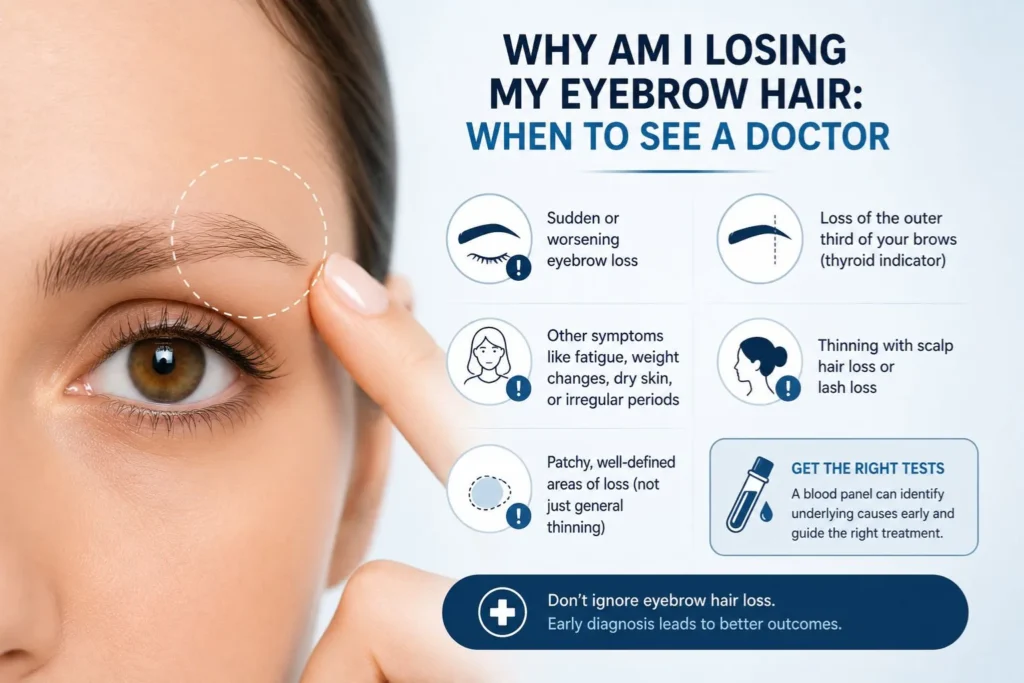
Many people wait months before seeking help, often assuming their brow thinning is cosmetic rather than medical. The truth is that eyebrow hair loss is a symptom and symptoms deserve investigation.
You should book an appointment with your GP or a dermatologist if:
- Your eyebrow loss is sudden or noticeably worsening
- You have lost hair from the outer third of your brows (a key thyroid indicator)
- You have other symptoms such as fatigue, weight changes, dry skin, or irregular periods
- The thinning is accompanied by scalp hair loss or lash loss
- You notice patchy, well-defined areas of loss rather than general thinning
A good starting point is a blood panel covering thyroid function (TSH, free T3, free T4), full blood count, ferritin, vitamin D, zinc, and a basic hormonal screen. This can rule out the most common systemic causes quickly.
How to restore eyebrows naturally and with treatment
Addressing the root cause first
No topical treatment will work if there is an unmanaged medical condition driving your hair loss. Thyroid disorders treated with levothyroxine, iron deficiency corrected through diet or supplementation, and hormonal imbalances addressed through appropriate medical care these are the real levers. Sparse eyebrows treatment should always begin at this level.
Topical treatments
Minoxidil (originally developed for scalp hair loss) has shown promising results for eyebrow regrowth in several small clinical studies. A 2021 study published in the Journal of the American Academy of Dermatology found low-concentration topical minoxidil to be effective and well-tolerated when used on the brows. It is not currently licensed for eyebrow use in the UK, but is sometimes used off-label under dermatologist supervision.
Bimatoprost a prostaglandin analogue originally used for glaucoma, has also been explored for brow growth, though evidence remains limited.
PRP (Platelet-Rich Plasma) treatment:
The idea behind PRP therapy is to take a small amount of the patient’s blood, separate from it the liquid part that contains growth factors (platelet-rich plasma), and then inject it into the brow. Per a 2022 systematic review, PRP was a very safe treatment for alopecia areata and increased hair density was found. Different people will have different results and typically more than one treatment is necessary.
How to restore eyebrows naturally: lifestyle and nutritional support
For mild deficiency-related or stress-related loss, dietary changes and targeted supplementation can genuinely help. Prioritising iron-rich foods (red meat, lentils, leafy greens), zinc sources (pumpkin seeds, shellfish), and adequate protein gives the follicle the building blocks it needs. Reducing chronic stress through sleep, exercise, and where appropriate, talking therapies, supports healthy hair cycling over time.
Common misconceptions about eyebrow hair loss
Myth: I’ve plucked my eyebrows too much, and now they’re thin. There’s nothing that I can do about it.
Reality: It is true that long-term over-plucking can result in permanent follicle damage, but in many cases of over-plucking eyebrow loss the follicles are only dormant and not destroyed. A trichoscopy is able to determine if the follicle is still alive. A lot of patients do get partial or even full hair regrowth after they stop removing hair and help the follicle to stay healthy.
Myth: Loss of eyebrow hair is just a cosmetic issue.
Reality: It is a sign that can indicate underlying problems like thyroid disease, autoimmune disorders, or lack of proper nutrients. If it is treated as a cosmetic issue only, then it will delay finding out about other conditions that may have serious implications for health.
Myth: Castor oil will restore my eyebrows.
Reality: There is no robust clinical evidence to support castor oil as an eyebrow growth treatment. It may condition existing hairs and reduce breakage, but it does not stimulate dormant follicles. It is not a substitute for investigating the cause of your hair loss.
Eyebrow hair loss is treatable but only if you know the cause
Eyebrow hair loss is almost always telling you something and in the vast majority of cases, it is something treatable. Whether the cause is thyroid related, autoimmune, nutritional, hormonal, or follicle damage from years of over-plucking, there are established pathways that can help restore eyebrows naturally or through targeted clinical intervention.
If you have been wondering why I am losing my eyebrow hair and have not yet had a medical review, that is the most important next step. At The Skin and Hair Clinic, our dermatologists assess brow loss comprehensively looking at the full clinical picture rather than just the cosmetic result so that any treatment we recommend is grounded in what is actually driving your hair loss.
Frequently asked questions
Q: Why am I losing my eyebrow hair all of a sudden?
A: Sudden eyebrow hair loss is most commonly linked to alopecia areata, a significant stressor or illness in the preceding two to three months, or a new nutritional deficiency. Because the cause can range from something easily corrected to a condition requiring medical management, sudden loss warrants a GP appointment and a basic blood panel rather than a wait-and-see approach.
Q: Can thyroid problems cause eyebrow hair loss?
A: Yes, thyroid eyebrow hair loss is a well-established symptom of both hypothyroidism and hyperthyroidism. The classic pattern is thinning or loss of the outer third of the brow. If this pattern describes your experience, ask your GP for a thyroid function test (TSH, free T3, free T4) as a first step.
Q: Is eyebrow hair loss from over-plucking permanent?
A: Not always. Over-plucking eyebrow loss ranges from temporary (where follicles are dormant but intact) to permanent (where scarring has destroyed the follicle). The only way to know for certain is through trichoscopy performed by a dermatologist or trichologist. Many patients who stop all hair removal and support follicle health do see meaningful regrowth.
Q: What is the best sparse eyebrows treatment available in the UK?
A: As sparse eyebrows can have various causes, the best options depend on the root cause. If hormonal or thyroid imbalances are to blame, treatment of the disorder is needed first. For alopecia areata, topical corticosteroids, immunotherapy or platelet-rich plasma therapy are available.
Q: Can eyebrow hair grow back after loss?
A: In many cases, yes. Regrowth is most likely when the underlying cause has been identified and treated, when the follicle has not been permanently scarred, and when treatment is started before too much time has passed. The earlier you seek assessment, the better your options generally are.
Q: Does diet affect eyebrow hair growth?
A:Yes, it has that potential, In particular when one has deficiencies in iron ferritin zinc, or vitamin D. By incorporating these into the diet or taking supplements (after the confirmation of blood test results), one can facilitate the restoration of follicles. Yet, relying on diet only will not fix eyebrow thinning caused by autoimmune diseases or hormonal disturbances, but it is a very important factor for maintaining healthy hair overall.