
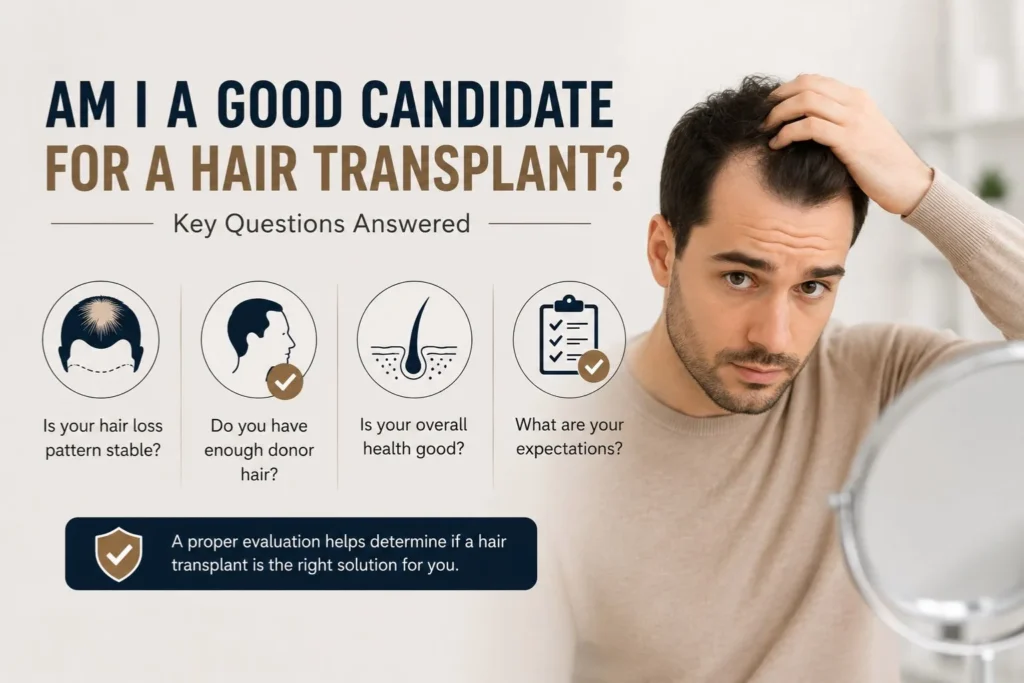
A lot of people are suitable candidates for a hair transplant. Yet, not everyone qualifies. Keep reading to discover whether or not you qualify.
Did you know? According to a report by Grand View Horizon, the UK hair restoration market generated a revenue of USD 121.6 million in 2023 and is expected to reach USD 396.0 million by 2030.
Hair loss affects millions worldwide. It hits confidence and self-image hard. A hair transplant can be life-changing. But it works best for the right person. So, am I a good candidate for a hair transplant? That is the question most people ask after noticing serious thinning. This guide breaks down everything you need to know. Clearly. Honestly. Without the jargon.
Table of Contents
key takeaways
- Stable hair loss is the most important factor for a successful hair transplant.
- If the donor site is in good condition and has ample hair follicles, it will be highly conducive to effective transplant outcomes.
- Age matters less than the stability and pattern of hair loss.
- If you have any health issues, inform your doctor and get the treatment done before the operation.
- A professional consultation is the only reliable way to assess your eligibility.
What does hair transplant eligibility actually mean?
It is a fact that a hair transplant is not the solution for all kinds of hair loss issues. Whether a person qualifies for a hair transplant eligibility or not is determined by various important factors. Before suggesting surgery, a doctor checks these aspects.
The procedure moves healthy hair follicles from a donor area to thinning or balding areas. For this to work, the right conditions must be in place.
Key factors that determine your candidacy
- Stable hair loss pattern
- Adequate donor area hair transplant density
- Good overall health
- Realistic expectations
- Age-appropriate hair loss stage
The technique used also plays a role in candidacy. A DHI hair transplant, for instance, is particularly suited to candidates with a defined thinning pattern and sufficient donor density.
Who can get a hair transplant?
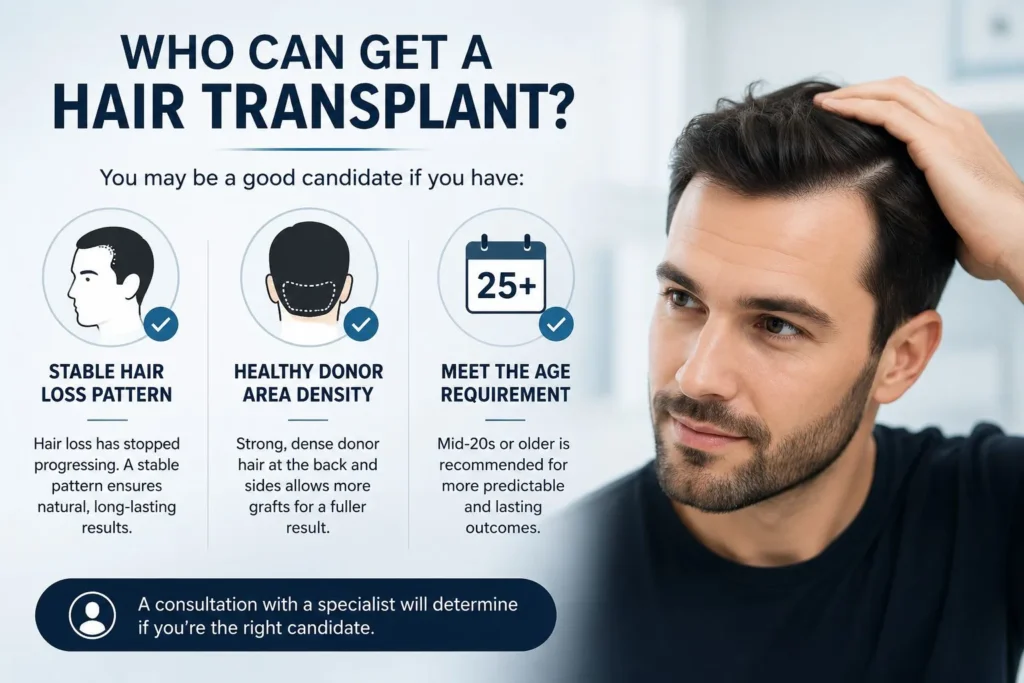
Understanding who can get a hair transplant starts with your hair loss pattern and health. Here are the traits of a strong candidate.
Stable hair loss pattern
Your hair loss must have stopped progressing. Hair loss that is active or spreading quickly raises a big concern. Besides, the outcome of the results looks uneven over time. A specialist will monitor your loss pattern before proceeding.
Healthy donor area density
Usually, the donor area hair transplant zone typically sits at the back and sides of the scalp. These hairs are naturally resistant to hair loss as they carry the specific genes. If you have high donor density, a greater number of grafts can be extracted from these areas. This directly affects how full the transplanted area will look.
Hair transplant age requirement
The hair transplant age requirementis not fixed. But the majority of surgeons suggest that you should be at least in your mid-20s before getting one. The reason? Usually, younger individuals experience hair loss in patterns that are difficult to predict. In fact, having surgery at an early stage of hair loss could bring unsatisfactory results over time. But being young by itself doesn’t mean one can’t get a hair transplant. The pattern and stability of hair loss matter more.
Quick guide to hair transplant candidacy criteria
Use this table to get a quick sense of where you stand:
| Factor | Ideal Condition |
| Donor Hair Density | Thick and abundant |
| Hair Loss Stage | Stable for 1-2 years |
| Age | Mid-20s or older |
| Overall Health | No major illnesses |
| Scalp Condition | Healthy, no active infection |
| Expectations | Realistic and informed |
Candidates who meet the ideal conditions in the table above, particularly those with abundant donor hair, are often good candidates for a FUT hair transplant.
Evaluating hair transplant candidacy criteria: health conditions
Your general health plays a big role. Doctors consider many aspects before approving. Here is what they check:
- Blood-clotting disorders may put you in danger during surgery
- It is difficult for the body to recover from wounds with diabetes that are not being managed properly
- If the patient has psoriasis or alopecia areata, scalp conditions that are active, they must first be treated
- Certain medications, like blood thinners, may have to be stopped before surgery
Always share your full medical history with your surgeon. Being honest is the main ingredient for safe and successful results. The hair transplant candidacy criteriaare not meant to exclude you. They exist to protect you.
Who is Not a good candidate for a hair transplant?
It is just as important to know when a transplant is not the right fit. Here are some situations where a hair transplant may not be a good idea.
Poor donor area density
The number of follicles in the donor area must be sufficient to provide the desired coverage. Taking too many often means scarring and an even worse appearance of the donor region.
Diffuse unpatterned alopecia
This type of hair loss affects the entire scalp, including the donor zone. Transplanted hair from an unstable donor area can also fall out. Results are often poor.
Unrealistic expectations
A hair transplant definitely is going to increase hair density and scalp coverage. It cannot create a full head of hair as if from nowhere. Those who want the perfect finish all the time end up disappointed most of the time. Honest conversations with your surgeon matter greatly.
Very young patients with rapid hair loss
Operating too early, when hair loss is still active, wastes grafts. It also creates an unnatural look as the surrounding hair continues to thin.
Do not self-diagnose: Why a consultation is essential
Reading guides is helpful. Yet, it is not capable of substituting a professional opinion. An expert hair restoration surgeon examines the scalp with a magnifier and evaluates donor density, baldness pattern, and medical history before making a trustworthy judgment.
Don’t decide by merely looking at before-and-after pictures on websites. Each scalp is unique, and what functioned for one might not function for you. Get a professional consultation.
Don’t Let Hair Loss Hold Back!
Now you have the answer to the question, “Am I a good candidate for a hair transplant?” So, don’t wait until the mirror tells a story you no longer want to see. Schedule a consultation now and get the expert answer you deserve. The team at The Skin and Hair Clinic combines clinical expertise and a friendly approach. They assess every factor, from donor density to lifestyle, to give you the most honest recommendation. Take the first step and reclaim your confidence.
Frequently Asked Questions
1. What is the ideal age to get a hair transplant?
Most surgeons recommend waiting until your mid-20s at the earliest. Although the age limit for hair transplantation is flexible, younger individuals tend to have less predictable hair loss patterns. A stabilized pattern of hair loss matters more than the age factor.
2. How do I know if my donor area is strong enough?
For evaluating donor area hair transplant density, the doctor will use a trichoscope or dermoscope. This allows them to determine the hair follicle count per square centimeter. Only a consultation with a professional will give you an accurate assessment.
3. Can women get a hair transplant?
Yes, women can also be hair transplant candidates. But the way hair transplant candidacy is determined in women is different. For example, if a woman has diffuse thinning but doesn’t have a stable donor area, then she might not be a candidate for surgery. A thorough examination by a doctor is very important.
4. What medical conditions disqualify me from a hair transplant?
Uncontrolled diabetes, blood disorders, active scalp infections, and autoimmune diseases that cause hair loss are examples of conditions that can affect eligibility. These conditions won’t disqualify you permanently, but you will have to manage or treat them first.
5. How long does hair loss need to be stable before a transplant?
Many surgeons would like hair loss to be stable for one to two years at least. That is because it will help to predict any future loss and be able