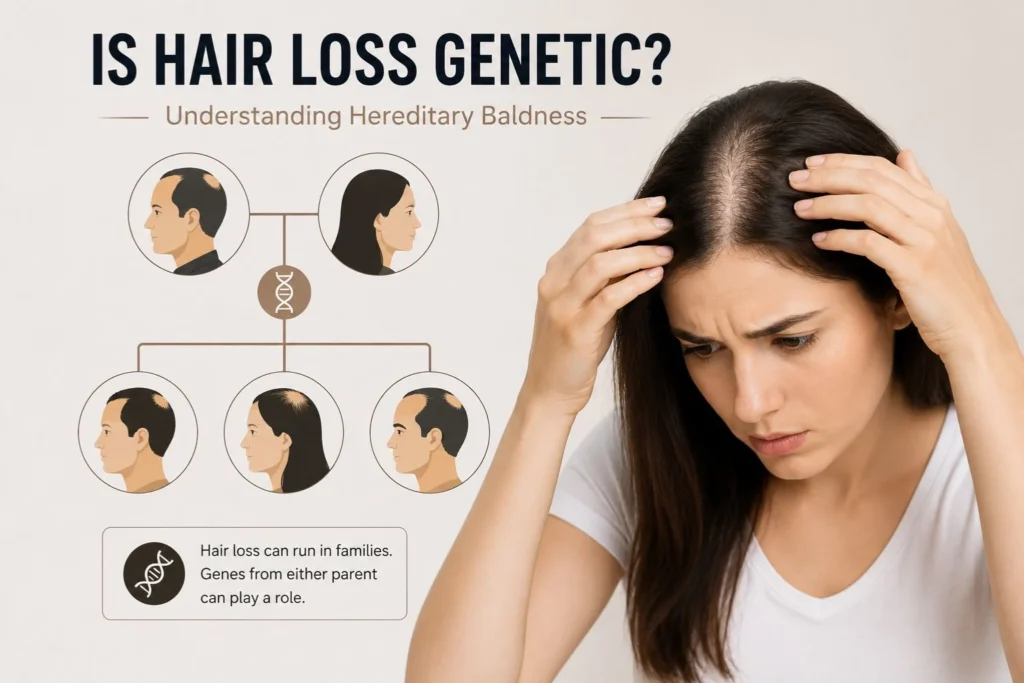
Hair loss is mainly hereditary, but it’s a lot more interesting than you think. Keep reading to find out why your family lineage won’t tell you everything.
Did you know? According to the Harvad Health Publishing, up to 40% of men and women will experience a more obvious form of this condition.
If you have seen your hairline receding in the mirror or worry about what lies ahead, knowing that hair loss is genetic will help you make informed decisions. At The Skin and Hair Clinic, the question comes from patients daily, and the answer is both simpler and more complex than most people expect.
Table of Contents
Key Takeaways
- Hair thinning is mostly influenced by your genes; more than 85% of male pattern baldness cases result from one’s inherited characteristics.
- Baldness is not only linked to one parent; the idea that “baldness is inherited only from the mother” is false. You can inherit hundreds of genes affecting your risk from both parents.
- DHT is the main culprit in the hair follicles that are genetically predisposed. It is DHT that leads to shrinking and makes hair gradually smaller.
- Your DNA doesn’t determine everything; it’s a mixture of many gene variants that collectively decide the degree of your susceptibility.
- Knowing your genetics before treatment matters. It will assist you in choosing the most suitable method, avoid wasted money, and get the best possible outcome.
The Science Behind Androgenetic Alopecia Genetics
The most common form of hair loss is called androgenic alopecia. The world itself tells you a lot. “Andro” refers to androgens, meaning hormones. “Genetic” confirms that it is your DNA that determines the situation.
Androgenetic alopecia genetics are based on a hormonal sensitivity of hair follicles to DHT (dihydrotestosterone). Those whose follicles are genetically sensitive to this hormone will experience follicle shrinkage with time. Each hair growth cycle becomes shorter. Eventually, the follicle stops producing visible hair altogether.
This process is called miniaturisation. It is gradual, progressive, and deeply tied to your inherited biology.
What Is DHT and How Does It Cause Hair Loss?
DHT and hair loss are directly related. DHT comes from testosterone through a conversion by the enzyme called 5-alpha reductase. In people with genetically sensitive follicles, DHT binds to the scalp receptors and triggers the shrinking process described above.
There are variations in the amount of DHT. Not everyone’s follicles react to it the same way, either. That difference comes down almost entirely to your genes.
Busting the Myth: Does Baldness Come From the Mother’s Side?
Many people wonder does baldness come from mother’s side. Most likely, you have heard this a thousand times. Check your parents, that’s where baldness comes from. It’s probably one of the most common misunderstandings about hair loss. And it’s not entirely true.
Why the “Mother’s Side” Myth Needs to Die
The reason behind the myth is that the AR gene (androgen receptor gene), which regulates how hair follicles respond to DHT, is situated on the X chromosome. Since men receive their X chromosome from their mother. So, yes, this gene matters, but it is only one piece of the puzzle.
Hereditary hair loss is actually polygenic, a fancy way of saying that your genes inherited from both parents determine your susceptibility. Scientists have found over 200 genetic variants linked to hair loss on multiple chromosomes. Your father’s baldness is just as relevant as your maternal grandfather’s.
So if someone advises you to trace your mother’s lineage for hair loss, you can politely correct them.
Polygenic Inheritance: Why It Is Not Just One Gene
Genetic hair thinning doesn’t work like a simple switch that can be turned on or off; rather, many genes act together to influence the process. This is what scientists call polygenic inheritance.
Think of it like this: each gene you inherit either nudges you slightly towards hair loss or slightly away from it. The total effect of all these nudges determines your individual risk.
| Factor | Influence on Hair Loss Risk |
| AR gene (X-linked) | Affects DHT receptor sensitivity |
| Paternal genetics | Contributes multiple variants |
| Maternal genetics | Includes the AR gene |
| DHT levels | Determined partly by genes |
| Age | Genetic effects worsen with age |
| Lifestyle and environment | Can accelerate or slow progression |
This table makes one thing clear: hereditary hair loss is not a one-parent story. Both sides of your family shape your risk.
Why Knowing Your Genetics Matters Before Treatment
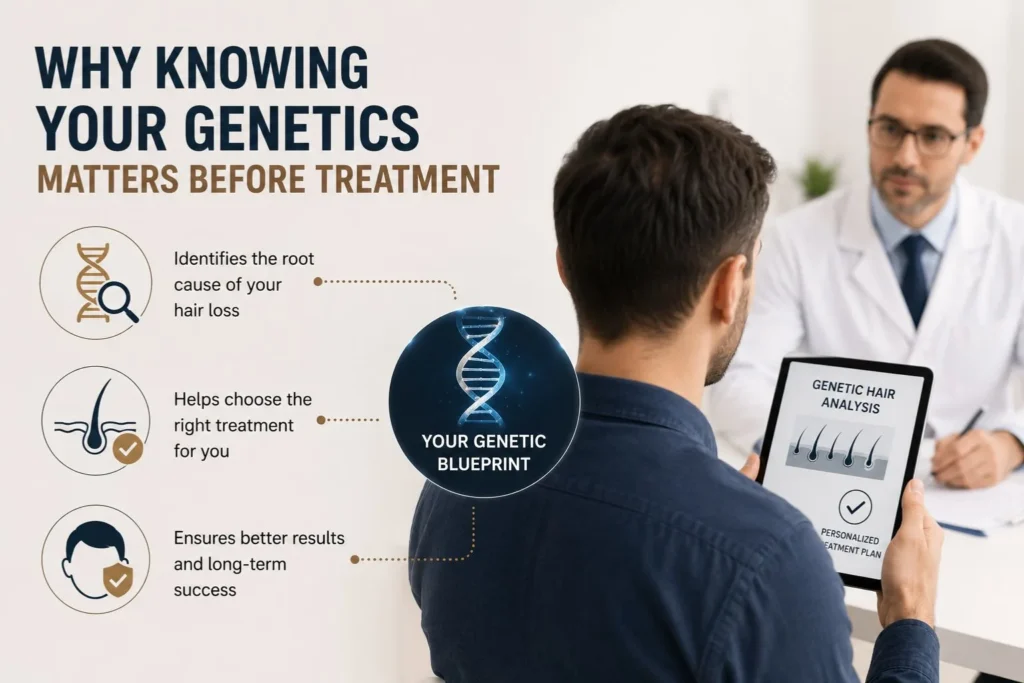
Understanding the genetic roots of your hair loss is not just academic. It is genuinely useful before you pick a treatment.
Choosing the Right Treatment Starts With Understanding the Cause.
Here is why this matters:
- When it comes to hair loss, genetic factors are not the only culprits. Hair loss can result from several non-genetic causes such as alopecia areata, thyroid disorders, and nutritional deficiencies. In such cases, hair restoration products targeting DHT and hair loss will be ineffective.
- Hereditary hair loss or thinning does not react the same way to various treatments. For example, a drug such as finasteride acts by inhibiting the enzyme 5-alpha reductase, which in turn decreases the production of DHT. This is a treatment for androgenetic alopecia, whereas other types of hair loss do not respond, as the origin of the problem is different.
- In FUE hair transplant procedures, donor areas need to be stable. Understanding the pattern and pace of your hereditary hair loss helps a surgeon assess whether you are a good candidate right now or whether waiting is wiser.
Signs That Your Hair Loss May Be Hereditary
Watch out for these telltale signs of genetic hair thinning:
- A gradual disappearing hairline that is symmetrical on both sides (mainly in men)
- Hair thinning at the crown that gradually spreads outwards
- Diffuse thinning across the top of the scalp (common in women with hereditary hair loss)
- Having a similar pattern in hair loss in the family history of parents or grandparents
- Hair that appears fine and limp rather than coarse and full
If this is actually the case with you, androgenetic alopecia is likely the cause
Regain Confidence With the Right Hair Loss Treatment!
Understanding is hair loss is genetic is a great step, but simply knowing doesn’t bring back hair. It’s what you do that matters.
At The Skin and Hair Clinic, our doctors with a GMC registration perform detailed scalp evaluations to determine the exact type of your hair loss. If your case calls for PRP therapy medication an FUE hair transplant, or a combination method, each plan is customized based on your individual genetics, health, and goals.
Don’t wait until the thinning becomes impossible to ignore. Schedule your free consultation now and get a clear, honest view of what is happening and what can be done about it.
FAQs
Q1. Is hair loss 100% genetic?
No. Although heredity is by far the most usual reason for losing one’s hair, other aspects like stress, hormonal shifts, diet lack, and illness may provoke or aggravate hair loss as well. Only a clinical assessment can reveal the real reason.
Q2. If my dad is bald, will I definitely go bald too?
Not necessarily. Having a bald father signifies a higher chance of hair loss for you, but still, the same result is not assured. Hair loss is controlled by more than one gene. So, several genes from both your parents come into play to determine your individual risk.
Q3. Does baldness come from the mother’s side or the father’s side?
Actually, both sides share the responsibility. The AR gene is inherited from the mother’s side through the X chromosome. Yet, the rest of the genes influencing hair loss are scattered among the two of you. Checking only one side gives you an incomplete picture.
Q4. Can women have hereditary hair loss?
Yes. Women can inherit the gene for hair loss, and in fact, they do, ever so often. Typically, the form of hair loss is diffuse thinning over the top of the scalp, whereas the receding hairlines we commonly see in men is not the usual pattern. It is one of the diagnoses that is most often missed or neglected.
Q5. When does genetic hair loss usually start?
Genetic hair thinning can begin as early as the late teens or early twenties, though it most commonly becomes noticeable in the late twenties to thirties. Earlier onset often indicates a stronger genetic predisposition.