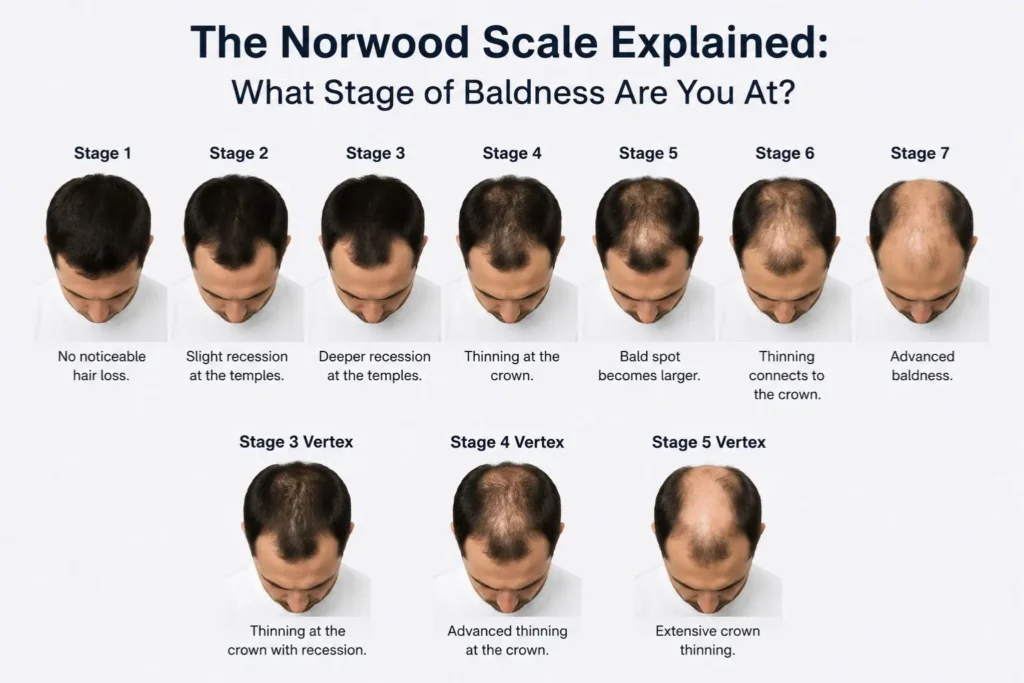
Understanding the stage of your hair loss is the key step in regaining control, and the Norwood scale explained gives exactly that roadmap. Keep reading to find out where you stand and what you can do about it.
“Did you know? According to the NIH, Male androgenetic alopecia (MAA) is the most common form of hair loss in men affecting 30-50% of men by age 50.”
Yet most men will only look for a solution when the hair loss is already at an advanced stage. Gaining knowledge about the Hamilton Norwood scale at an early stage can make a huge difference. At The Skin and Hair Clinic, we witness this quite often: men who regret not having done anything earlier. It is never too early to learn where you stand on the Norwood scale stages.
Table of Contents
Key Takeaways
- There are seven stages on the Norwood scale. Each stage illustrates a different level of hair loss in men, starting from a fully haired head to a very advanced horseshoe fringe.
- Taking the step to intervene early can really change the situation. Stages 1 to 3 of male pattern baldness are where one can do the most treatments, such as taking medications and making changes in one’s life.
- A person with Norwood 3 is the one who is actually going through a visible stage of hair thinning and so this is when one will really benefit from the help of a hair loss expert.
- Your donor area defines what surgeries are possible for you. A strong, thick donor area offers the surgeons a wider range of techniques at each step.
- Hair loss has multiple causes, genetics is one of them, but stress, lacking certain nutrients, problems with the thyroid, and even traction alopecia can all play a role.
Understanding the Norwood Scale and Why It Matters for Hair Loss
The Hamilton Norwood scale remains the leading method for classifying stages of male pattern baldness. It maps hair loss stages in men across seven distinct levels. Each level identifies a different pattern of hairline recession and hair density loss. It is a handy tool for doctors, and the surgeons, and trichologists to determine the seriousness of the problem and plan treatments.
Think of it as a GPS for your hairline. You cannot plan a trip without knowing your starting point.
A Clear Breakdown of All Norwood Scale Stages (1 to 7)
Here is a descriptive guide to each stage. No images needed, the words paint the picture clearly.
Stage 1: No Visible Hair Loss
Your hairline is right where it belongs. There are no signs of receding at the temples and no thinning in the crown. This is your baseline. Most men in their late teens fall here.
Treatment relevance: No need for treatment. Preventive care and healthy habits keep you here longer.
Stage 2: Early Hairline Recession
A slight recession appears at the temples. It is so faint that only a few people might be able to spot it. Some refer to it as a “mature hairline.” It is a natural part of ageing for many men.
Treatment relevance: By this stage, changes in one’s habits as well as the use of minoxidil may slow progression at this point.
Stage 3: The First Clinically Significant Stage
This is where Norwood 3 hair loss begins. A receding hair line in ‘M’ or ‘U’ shape is quite prominent. In addition, many men experience thinning at the crown in the 3A or 3 Vertex sub-types.
Treatment relevance: This is usually the stage at which medicines like finasteride are commonly introduced here. Early surgical options may also be explored.
Stage 4: Deeper Recession with Crown Thinning
The hairline has receded significantly. The bald area is now more prominent at the crown. There is still a band of hair separating the front from the crown. Due to the different light conditions, the contrast is more prominent.
Treatment relevance: Hair transplant consultations often begin at this stage. The donor area, the back and sides of the scalp, is assessed for density and suitability.
Stage 5: Connecting Bald Areas
The band separating the front and crown becomes thinner. The two bald patches are also going to join. The hair cover gets very low. Stage 5 is the main transformation point.
Treatment relevance: Surgical restoration is a strong option here. An FUE hair transplant is often preferred at this stage for its precision and minimal scarring, provided the donor area is healthy.
Stage 6: Large Bald Area Across the Top
The front and crown bald areas have fully merged. There is only hair on the sides, and the back remains. The top of the head is mostly without hair. The hair that is left is shaped like a horseshoe.
Treatment relevance: Surgery can still be an option but requires careful planning. A FUT hair transplant may be considered here as it allows harvesting a higher number of grafts in a single session.
Stage 7: Most Advanced Stage
Stage 7 is the most serious male pattern baldness stages. Just a thin strip of hair is left around the back and sides of the head. This leftover hair may also be fine or sparse.
Treatment relevance: Surgery will be less of an option, but not out of the question. An experienced surgeon will make a thorough assessment of the donor hair supply. Scalp micro pigmentation is also a popular non-surgical option here.
Why the Donor Area Is So Important
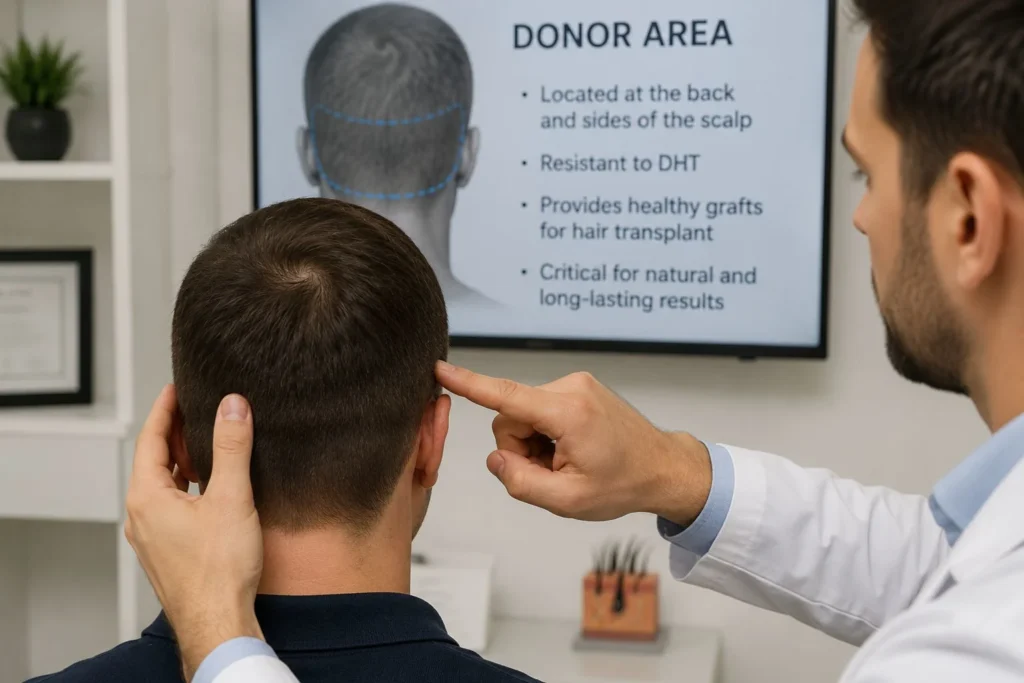
If you think about a hair transplant, the donor area is everything for you. This is the piece of hair at the back and sides of your scalp. It is inherently resistant to DHT, the hormone that causes androgenetic alopecia.
This is the area from which surgeons take grafts. The greater the density and health of this zone, the better your options. An in-depth evaluation of the donor area should always be included in any reputable consultation.
What Causes Hair to Follow the Norwood Pattern?
Androgenetic alopecia also known as genetic hair loss. DHT progressively reduces the size of hair follicles. Besides this, other factors that can contribute are:
- Hormonal changes, particularly elevated DHT levels
- Stress, which leads to telogen effluvium, the shedding phase that is temporary and disruptive
- Lack of nutrition, mainly deficiency of iron biotin zinc, or vitamin D
- Thyroid disorders, as the hair growth cycle is affected
- Traction alopecia, when the follicles are pulled repeatedly by tight hairstyles
Understanding the Norwood scale explained and your reason will determine the treatment plan. Not every hair loss is permanent.
Take the Next Step and Book Your Consultation Today!
Don’t let uncertainty hold you back. Knowing about Norwood scale stages can be the most powerful step you take towards your hair. The Skin and Hair Clinic offers a highly skilled, tailor-made consultation with surgeons who are registered with GMC. Whether you are at Stage 2 or Stage 6, there is always a path forward. Book your free consultation today and get a clear picture of your options.
Frequently Asked Questions
1. What is the Norwood scale used for?
It’s a scale mainly used to record and describe how far male pattern baldness has developed. It also assists doctors and surgeons in evaluating the severity of hair loss and choosing the most suitable treatment for each individual.
2. At what Norwood stage should I consider a hair transplant?
Generally, hair replacement surgery is first really considered at Stage 3 or 4 (or even higher) levels of hair loss. That said, one should remember that situations differ. A consultation will assess your donor area, age, and rate of progression before any recommendation is made.
3. Is Norwood 3 hair loss reversible?
Hair loss at the Norwood 3 stage due to androgenetic alopecia cannot be completely reversed. Yet, treatments like minoxidil and finasteride can help to slow the process. The sooner these drugs are taken, the more effective the results will be.
4. Can stress cause you to move up the Norwood scale?
Stress is not a direct cause of androgenetic alopecia. Yet, it often means telogen effluvium, which results in heavy hair shedding and may worsen the appearance of hair loss. Stress relief is beneficial for healthy hair.
5. What is the difference between the Hamilton Norwood scale and the Ludwig scale?
The Hamilton Norwood scale is mostly a male-oriented tool that tracks the hair loss in the temple and crown areas. The Ludwig scale, on the contrary, is a female pattern hair loss classification system that gives more importance to central thinning rather than hairline recession.