
Reviewed by Dr. Jyotsna Kumari

A high forehead often develops quietly, and for many women it’s one of the first visible signs of thinning near the front hairline. A female forehead hair transplant is now one of the most requested procedures among women looking to soften a receding or naturally high hairline and bring a more balanced frame to the face. Unlike a male hair transplant, which is usually planned around the crown and temples, female hair restoration is built around keeping a rounded, feminine hairline shape with fine, undetectable density at the front. This guide explains why foreheads can look higher in women, how the procedure works from consultation to recovery, and what makes the results look completely natural rather than “done.”
Did you know? Female pattern hair loss affects around 6% of women under 50, rising to about 38% of women over 70.
Key Takeaways
- A female forehead hair transplant lowers and reshapes the hairline using the patient’s own follicles, moved from a permanent donor area at the back of the scalp.
- High foreheads in women are usually linked to female pattern hair loss, hormonal changes, traction alopecia from tight hairstyles, or simply an inherited hairline position.
- FUE (Follicular Unit Extraction) is the most common technique for female hairline lowering because it leaves no linear scar and allows a soft, irregular hairline design.
- Results are permanent transplanted follicles keep growing for life once they establish in the new site, typically reaching full results by 12 months.
- A qualified, GMC-registered surgeon should always assess scalp laxity, donor density and hair calibre in person before recommending a female hair loss transplant.
- Recovery is generally quick: most women return to normal routines within 7 to 10 days.
What Causes a High Forehead in Women?
Not every high forehead is a hair loss story; some women are simply born with a naturally higher hairline. But for most people asking about a female forehead hair transplant, the forehead has grown taller over time because of thinning at the front hairline. The most common causes include:
- Female pattern hair loss (androgenetic alopecia) a genetic, hormone-driven form of thinning that widens the parting and softens the density along the hairline.
- Hormonal changes in pregnancy, menopause and thyroid conditions can all trigger temporary or long-term shedding near the front of the scalp.
- Traction alopecia years of tight ponytails, braids or extensions can permanently weaken follicles along the hairline.
- Previous surgery or scarring a brow lift or earlier hair procedure can sometimes raise the hairline further.
If thinning rather than a naturally high hairline is behind the change, it’s worth understanding the underlying pattern first. Our detailed guide to female pattern hair loss, its stages and treatment options walks through how to recognise early signs and what can be done at each stage, surgical and non-surgical.
What Is a Female Forehead Hair Transplant?
A female forehead hair transplant is a surgical procedure that moves healthy, DHT-resistant follicles from a dense donor area, usually the back or sides of the scalp to the thinning or receded front hairline. The goal isn’t simply to add hair; it’s to redesign the hairline so it looks like it was always there.

Why Female Hairline Design Is Different From Male Design
Male hairline design typically works with a straighter, more angular line and often includes temple points. Female hairline design is almost always softer: a gentle, rounded curve with a slightly lower centre point, finer single-hair grafts placed at the very front, and gradually increasing density moving backward. This graduated approach is what allows the new hairline to catch the light and move like natural, undisturbed hair rather than a hard-edged line.
FUE and Other Techniques Used for Female Hairline Lowering
Most female hairline and forehead procedures today are performed using FUE hair transplant technique, in which individual follicular units are extracted one at a time using a fine punch tool, rather than removing a strip of scalp. This matters particularly for women because:
- It leaves tiny, dot-like scars that are easy to hide even with hair worn up or short.
- It doesn’t require shaving the whole head a partial or trichophytic shave can often be concealed by surrounding hair.
- It allows precise, single-follicle placement along the hairline for a soft, undetectable edge.
Direct Hair Implantation (DHI) is a variation of FUE that implants grafts immediately after extraction, which some surgeons prefer for very fine hairline work. Which method suits you best depends on your donor density, hair calibre and the amount of lowering needed, something only assessed properly in a face-to-face consultation.
The Female Hair Restoration Journey: Consultation to Recovery
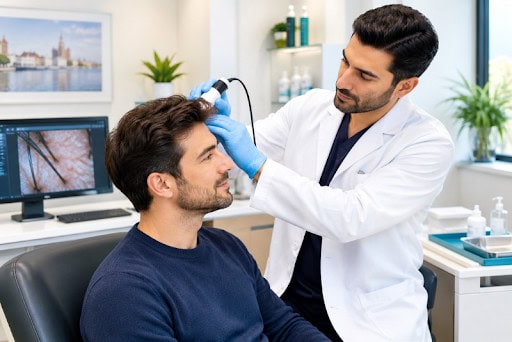
1. Consultation and Hairline Design
Your surgeon examines donor density, scalp laxity and hair diameter, discusses your goals, and sketches a hairline that suits your face shape. This step is where realistic expectations are set including how many grafts are needed and whether one session will be enough.
2. Procedure Day
Local anaesthetic is used, so the procedure is performed while you’re awake and comfortable. Depending on the number of grafts required, a female forehead hair transplant typically takes between four and eight hours.
3. Early Recovery (Week 1–2)
Some redness and tiny scabbing around the new grafts is normal for the first week. Most women feel comfortable returning to work and normal routines within 7 to 10 days, avoiding strenuous exercise for a little longer.
4. Growth Timeline (Month 3–12)
Transplanted hairs typically shed within a few weeks (this is expected and temporary), before new growth begins around month three or four. Density continues to build steadily, with final results generally visible between 9 and 12 months.
Do the Results Look Natural?
The honest answer is: they should, if the hairline is planned properly. A well-designed female forehead hair transplant avoids a flat, uniform edge instead, individual hairs are angled to match your natural growth direction and density is layered gradually. You can see how this looks in practice in our clinic’s before-and-after results gallery, which shows real outcomes from FUE, FUT and DHI procedures carried out under CQC-registered surgical care.
Female Hair Loss Transplant vs Non-Surgical Alternatives
Surgery isn’t the right first step for everyone. If hair loss is recent, diffuse, or linked to a temporary trigger such as stress, illness or postpartum shedding, non-surgical options such as topical minoxidil, PRP therapy or addressing an underlying deficiency may be enough to encourage regrowth. A female hair loss transplant tends to be the better option when thinning has been stable for a while, donor density is good, and the hairline itself, not just overall thickness, has receded or never suited the face shape. A proper in-person consultation is the only reliable way to know which category you fall into.
Ready to Talk About Your Hairline?
Every hairline is different, and the right plan depends on your donor density, hair calibre and goals. Book a private, one-to-one consultation with our GMC-registered surgical team to find out whether a female forehead hair transplant is right for you with clear, honest advice and no pressure to proceed.
Frequently Asked Questions
Q1: What is a female forehead hair transplant?
It’s a surgical procedure that relocates healthy hair follicles from a dense donor area to a receded or high front hairline, using techniques such as FUE or DHI to design a natural, feminine hairline shape.
Q2: How is a female hair transplant different from a male hair transplant?
Female procedures focus on preserving a soft, rounded hairline and often work around existing hair without a full shave. Male procedures more commonly address the crown and temples with a straighter hairline design.
Q3: Is a hair transplant for a high forehead permanent?
Yes. Grafts are typically taken from areas resistant to the hormone that drives pattern hair loss, so once they establish in their new position, they continue growing for life.
Q4: Am I a good candidate for female hair restoration?
Good candidates usually have stable hair loss, healthy donor density at the back or sides of the scalp, and realistic expectations about the results achievable in one or more sessions. A consultation with a qualified surgeon is needed to confirm suitability.
Q5: How long is recovery after a female forehead hair transplant?
Most women return to work and normal activities within 7 to 10 days. Full, final density typically develops over 9 to 12 months as transplanted follicles complete their growth cycle.
Q6: Will a female forehead hair transplant leave visible scarring?
FUE leaves small, dot-like scars in the donor area that are easily concealed by surrounding hair, rather than the single linear scar associated with older strip (FUT) techniques.
{
“@context”: “https://schema.org”,
“@type”: “FAQPage”,
“mainEntity”: [
{
“@type”: “Question”,
“name”: “What is a female forehead hair transplant?”,
“acceptedAnswer”: {
“@type”: “Answer”,
“text”: “It’s a surgical procedure that relocates healthy hair follicles from a dense donor area to a receded or high front hairline, using techniques such as FUE or DHI to design a natural, feminine hairline shape.”
}
},
{
“@type”: “Question”,
“name”: “How is a female hair transplant different from a male hair transplant?”,
“acceptedAnswer”: {
“@type”: “Answer”,
“text”: “Female procedures focus on preserving a soft, rounded hairline and often work around existing hair without a full shave. Male procedures more commonly address the crown and temples with a straighter hairline design.”
}
},
{
“@type”: “Question”,
“name”: “Is a hair transplant for a high forehead permanent?”,
“acceptedAnswer”: {
“@type”: “Answer”,
“text”: “Yes. Grafts are typically taken from areas resistant to the hormone that drives pattern hair loss, so once they establish in their new position, they continue growing for life.”
}
},
{
“@type”: “Question”,
“name”: “Am I a good candidate for female hair restoration?”,
“acceptedAnswer”: {
“@type”: “Answer”,
“text”: “Good candidates usually have stable hair loss, healthy donor density at the back or sides of the scalp, and realistic expectations about the results achievable in one or more sessions. A consultation with a qualified surgeon is needed to confirm suitability.”
}
},
{
“@type”: “Question”,
“name”: “How long is recovery after a female forehead hair transplant?”,
“acceptedAnswer”: {
“@type”: “Answer”,
“text”: “Most women return to work and normal activities within 7 to 10 days. Full, final density typically develops over 9 to 12 months as transplanted follicles complete their growth cycle.”
}
},
{
“@type”: “Question”,
“name”: “Will a female forehead hair transplant leave visible scarring?”,
“acceptedAnswer”: {
“@type”: “Answer”,
“text”: “FUE leaves small, dot-like scars in the donor area that are easily concealed by surrounding hair, rather than the single linear scar associated with older strip (FUT) techniques.”
}
}
]
}